
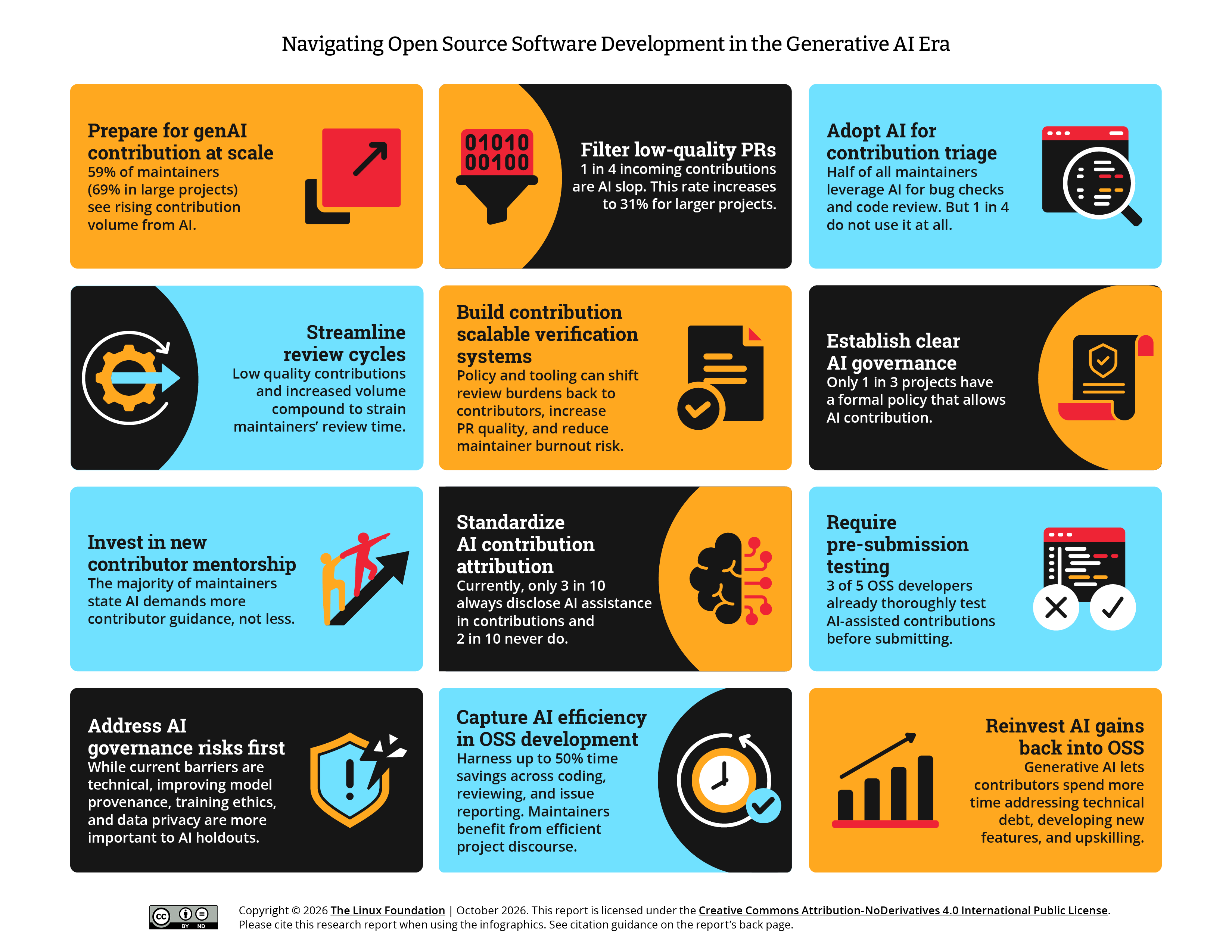
Linux Foundation Research, in collaboration with Red Hat, Futurewei, OpenSSF, and LF AI & Data, published the report 'Navigating Open Source Software Development in the Generative AI Era' on how generative AI is changing open source development. According to the survey data underpinning the study, approximately a quarter of incoming pull requests in open source projects are low-quality, mass-generated contributions by assistants, so-called 'AI slop'. Reviewing such changes falls to maintainers manually, and the influx of generated code is growing faster than the capacity to verify it.

What happened
The report was prepared by Sam Boyzel (Linux Foundation) and Annie Lai (Generative AI Commons), with a foreword by Brian Proffitt (Red Hat); the work has been assigned DOI 10.70828/BUHS3754. It is based on a survey of open source ecosystem participants: respondents identified maintainer burnout in large projects as the main problem. The full text is available for free as a 6.6 MB PDF, and the raw research data has been published on Zenodo, meaning the findings can be verified against primary materials. The publication of the report also became the subject of a separate discussion on Hacker News.
Context
The standard open source model relies on people: external developers submit pull requests, and maintainers—often volunteers—review and accept changes into the project. Generative assistants have drastically reduced the cost of code production, shifting the center of gravity from writing to verification: a contribution can be created in minutes, but reviewing it still requires a human. The term 'AI slop' refers to low-quality, mass-generated contributions by assistants that clutter the review queue. The report gains additional weight from its organizational backing: it is supported by the Linux Foundation, OpenSSF, and vendor-specific divisions, so the document may serve as a benchmark for developing contribution acceptance rules in large projects.
Why this matters for the industry
For the industry, the deficit in open source is shifting: if there was previously a lack of contributors, now there is a lack of trust in contributions. Formal policies for accepting AI contributions exist in only about a third of projects, so change acceptance relies on manual moderation, which ceases to scale with the mass influx of generated code. The report's authors call for a transition from reactive moderation to formal AI governance and contribution verification systems. For builders, this is a readable demand signal: tools for triaging AI contributions, automation of acceptance policies, and code provenance verification. If independent measurements confirm the trend, the first automatic quality gates for PRs in the CI of large projects and the practice of labeling AI-assisted changes are expected—this is a predictive interpretation, not a fact from the report.
Why this matters for users
If you submit pull requests to mainstream projects or use code generation in your work, consider this: AI-assisted contributions are increasingly encountering quality filters, so you should be prepared for manual checks and rejections, including without detailed explanations. Before submitting changes, it is reasonable to check if the project has rules for accepting AI contributions and to honestly label the use of assistants. The reverse side is also important: according to developer self-assessments, AI tools save from 19% to 52% of time depending on the task type—at the upper limit, this is almost half of working time. The report materials are open: the full PDF and raw data on Zenodo are available for free, so the figures can be verified independently before relying on them in your processes.
What is currently unknown / limitations
Key figures in the report are self-reported: from the available summary, it is not clear who classified 'AI slop' and by what criteria; if this is the perception of maintainers from the survey, rather than an audit of diffs, 'a quarter of PRs' measures opinion, not the actual share of contributions. The time savings estimate is given without a baseline and controlled comparison, so the range boundaries, especially the upper one, may be inflated. This is an industry survey of the Linux Foundation ecosystem with vendor participation, not a peer-reviewed work, and the sample may potentially reflect the interests of infrastructure companies. The authors' recommendations remain at the governance level: the report does not offer ready-made technical tools for contribution verification, and automatic detection of generated code is essentially an unsolved eval methodology task. A mitigating factor: the DOI and open raw data on Zenodo provide material for independent replication.
Sources
- Linux Foundation Research: Navigating Open Source Software Development in the Generative AI Era
- Full report text (PDF, Linux Foundation)
- Discussion on Hacker News (id 50497105)
Author
Look at AI, editorial team