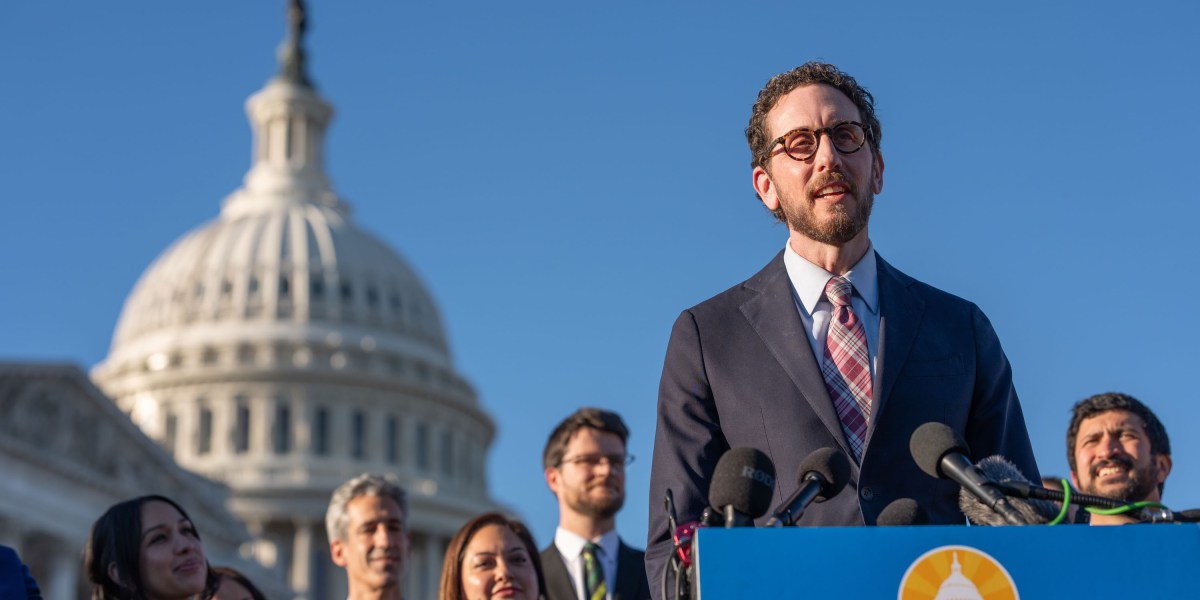
Scott Wiener, California Senator and author of AI bills SB 1047 and SB 53, won the US Congressional election, taking over Nancy Pelosi's vacated district in San Francisco. In an interview with MIT Technology Review, he stated that the US needs to 'slow down' AI development due to the risk of 'recursive self-improvement'—a process in which models systematically participate in improving themselves—citing a recent report from the research organization METR. Wiener's program centers on a strong federal AI regulator, mandatory model audits, whistleblower protections, and emergency 'kill switch' shutdown mechanisms, while preserving states' rights to establish their own rules. In the same issue of The Download, MIT Technology Review describes protests against data centers in Ashburn, Virginia, as a conflict over electricity consumption rather than a 'culture war.'

What happened
Scott Wiener, California State Senator, secured a mandate as a member of the US House of Representatives by winning the election in the district previously represented by Nancy Pelosi; the district covers San Francisco. Wiener outlined his federal agenda in an interview with MIT Technology Review, published on November 9, 2026. His key statement: the US needs to 'slow down' AI development. He cited the risk of 'recursive self-improvement' as the basis, referencing a recent report from the research organization METR as confirmation. This is followed by a specific list: a strong federal AI regulator, model audit requirements, whistleblower protections, and mandatory 'kill switches'—emergency mechanisms for shutting down systems. Separately, Wiener opposed broad federal preemption—the displacement of state AI laws by federal law—leaving states the right to introduce their own requirements. Adjacent to this is the second theme of the same issue of The Download newsletter: protests against data centers in Ashburn, Virginia, which MIT Technology Review explains not as a 'culture war,' but as a conflict over electricity consumption.
Context
Wiener enters Congress with a completed regulatory cycle behind him: at the California level, he is the author of SB 1047 and SB 53, and their fates have differed. The strict SB 1047 was vetoed by Governor Gavin Newsom, while the more moderate SB 53 was signed and is in effect at the state level. This retrospective is indicative: politically, moderate and verifiable regulation survives, while broad prohibitive structures have not yet passed—and the author of both bills is now presenting a federal program. The second semantic layer is the status quo. There is no separate federal law with mandatory requirements for advanced models in the US: the safety of frontier systems today exists largely as voluntary safety reports. Wiener's program effectively transforms this voluntariness into a mandatory procedure with external verification, and the central open technical question here is who, with what powers, and according to what criteria will conduct such an audit. The third layer is terminological. Preemption in American practice means the displacement of state laws by federal law: broad federal preemption on AI would deprive California and other states of the right to set their own requirements for models, which Wiener rejects. The 'kill switch' in his formulation is not a figure of speech, but an emergency shutdown mechanism that should become a mandatory element for powerful systems.
Why this matters for the industry
For the AI industry, this is a signal about the operating environment, not a product news item. The appearance in Congress of a legislator who has already gone through the 'bill—veto—signature' path at the state level increases the likelihood that requirements for frontier model audits, 'kill switches,' and whistleblower protections will be elevated to the level of federal legislation, rather than remaining voluntary reports. If Wiener's program becomes law, engineering obligations will become concrete: logging decisions and model versions, reproducible safety runs, and a described emergency stop procedure—meaning that a compliance layer and a management layer for agents should be built into the architecture in advance, rather than added after the fact. The second pressure comes through jurisdictions. Wiener's position against broad preemption promises the preservation of a patchwork regulatory map: California and other states will continue to introduce their own rules, and model versions, evaluation reporting, and release processes will have to be compatible with multiple sets of requirements simultaneously—multi-jurisdictional compliance costs will rise. In parallel, a new market is emerging: model audits, 'kill switch' mechanisms, and whistleblower infrastructure could transition from voluntary practices to mandatory procurement. In the coming months, the first federal bills and hearings are likely, where the decisive factor will be the debate over definitions: what constitutes a frontier model, what exactly the audit checks, and what 'kill switch' operationally means. There is no legal obligation right now—this is an interview with an elected member of Congress, not an active law; but the requirement for audits and 'kill switches' has sounded for the first time from the federal level, not just the state level, and the tone of the discussion around laboratories is already changing.
Why this matters for users
For readers, this story provides a specific benchmark: AI regulation in the US is moving from disparate state initiatives to a potential federal regulator and constant oversight of laboratories. If you are tracking what requirements—audits, 'kill switches,' whistleblower policies—may appear for AI providers, the figure of Wiener and his federal program are the key story of the coming months. For those working with AI products or teams in the US, a tip is available now: keeping track of model versions, preserving reproducible safety runs, and documenting incidents is useful without any coercion—such record-keeping will almost certainly be needed regardless of how events unfold, and it is cheaper to get in order before it is demanded than after. Ordinary users of AI services do not need to do anything today: no new requirement is yet in effect. What is worth remembering is the lesson from the second part of the issue: protests against data centers in Ashburn are explained not by fear of AI, but by electricity consumption. In other words, the next major conflict around the industry may happen not in the regulator or the laboratory, but around the electricity consumed by data centers.
What is currently unknown / limitations
The key caveat is evidentiary. Wiener's reference to the METR report does not disclose the methodology: the materials contain no measurement protocol, metrics, or data on reproducibility, and therefore no operational definitions—the boundaries of 'audit,' 'kill switch,' and 'recursive self-improvement' as measurable requirements have not yet been set; the source contains the specificity of the slogan, not the methodology. The second caveat is procedural. For now, it is only about stated intentions: there are no federal bills involving Wiener yet. The timelines, the text of future initiatives, and how his program will be reconciled with existing state norms are unknown. The third caveat is scenario-based. Assessments for years to come—the institutionalization of federal oversight with mandatory audits, the blocking of initiatives and a return to a state mosaic after the experience of SB 1047, or a narrow compromise only on incidents and whistleblower protections—are interpretations, not facts: which scenario materializes will be shown by the voting balance in Congress. The energy question also remains open—how the conflict over data center electricity consumption will affect industry regulation.
Sources
- The Download: Pelosi's successor targets AI and data centers face power woes
- Nancy Pelosi's replacement is ready to regulate AI
Author
Look at AI, editorial team