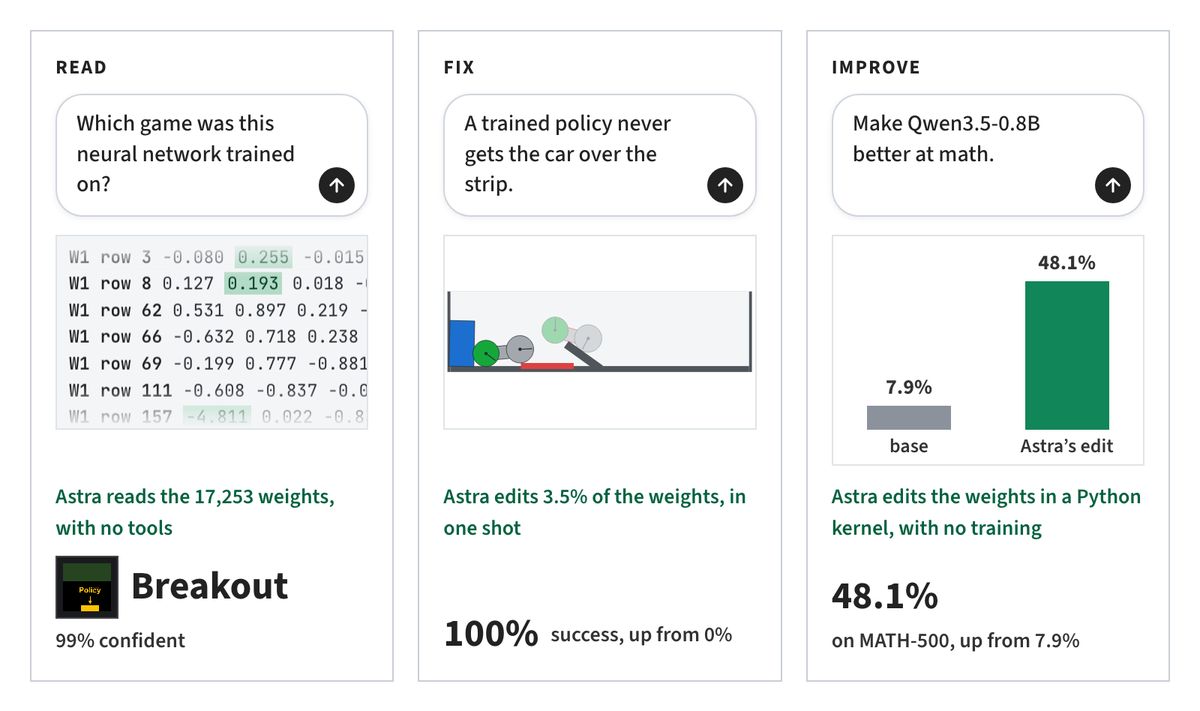
MIT CSAIL researchers—Rikiya Takehi, Jayden Teoh, Alex Zhang, and Omar Khattab—described the Weight-Space Programming approach: the frontier model GPT-6 Astra natively reads and writes neural network weights without resorting to gradient descent, training loops, or environmental feedback. In experiments, the model recognized trained networks based solely on raw weights, identified behavioral defects, and fixed them with pinpoint edits affecting fractions of a percent of parameters. This is currently a demonstration from the authors' blog, not a product.

What happened
A paper titled "Sparks of Weight-Space Programming" was published on the MIT CSAIL blog, built around three series of experiments. In reading weights, Astra used 17,253 raw numbers to determine with 100% accuracy which game—Breakout, Pong, Pac-Man, or Freeway—was trained in an MLP, as well as the language on which a 7.2M-parameter transformer was trained, and inductive (copying) attention heads. In a physical control task, the model edited 3.5% of the controller's weights (6,073 out of 171,664) in one go, raising success from 0% to 100%. On Qwen3.5-0.8B, Astra changed 0.016% of the weights without gradients, eliminating a reasoning loop: the result on MATH-500 increased from 7.9% to 48.1%, and on IFEval by three times.
Context
Typically, LLMs are applied to what surrounds the network—prompts, code, and pipelines—while the weights themselves are updated using gradient methods, from classic descent to optimizers like Adam and Muon. Weight-Space Programming attempts to move the optimization itself into the model's responsibility zone: it reads raw weights, diagnoses issues, and writes corrections without a training loop or gradients. Editing a fraction of a percent of weights implies intervention at the level of a specific circuit, bringing the approach closer to mechanistic interpretability and hinting at a new role for LLMs—an automatic localizer and patcher for specific defects instead of full fine-tuning. The publication format is modest: a post on the authors' own blog, currently without a peer-reviewed version.
Why this matters for the industry
For the industry, this is a claim of a paradigm shift in learning: if a frontier model can directly optimize weights, rather than just prompts and code around the model, symbolic optimizers and gradient descent may partially yield to reasoning about weights. There is nothing to build on this today: the sources lack APIs, prices, and data on latency and regressions, so the demo should be viewed as evidence of a possible direction, not a ready-made tool. The likely mature scenario is a hybrid where the LLM localizes the defect and proposes a weight patch, while gradients merely refine the result; in a speculative perspective, a layer of "model surgery as a service" may grow alongside training platforms—weight editing as a step in the release pipeline with diff, review, and benchmark regression runs. If code and independent replications emerge, the first product forms will likely be diagnostics in the style of "model X-ray" and a weight patch suggestion function within fine-tuning platforms, and founders should already stress-test their pitches: an investor may ask why client-specific fine-tuning wouldn't be replaced by a single frontier model call.
Why this matters for users
This is not hype about "AI that fixes AI," but a series of experiments with specific numbers—how many weights were edited and how metrics changed—which can be cross-referenced with the authors' post in the primary source. Neither developers nor users can try the technique: the code is not published, access to Astra has not appeared for open sale, and all demos are limited to tiny networks and Qwen3.5-0.8B. What makes sense today is to read the post, see how Astra reads raw weights, and watch for the appearance of code and independent reproductions. If the direction is confirmed, the main benefit for owners of small open models will be pinpoint repair of specific defects instead of full fine-tuning, potentially cheaper and safer, and manual tuning and small-scale fine-tuning may become optional over time.
What is currently unknown / limitations
The claimed 100% accuracy in game identification is given without sample size, repeated runs, or control conditions such as shuffled weights or randomized labels, and choosing from four classes is too easy a task to judge the scalability of reading raw weights. The scale of the demo is small by modern standards: an MLP with 17,253 parameters, a transformer with 7.2M, and a controller with 171,664 weights, and it is unknown how the approach behaves on larger models. The starting result of Qwen3.5-0.8B on MATH-500 before editing is suspiciously low for a model of this size: fixing broken behavior is easier than improving a healthy model, and there are no comparisons with gradient fine-tuning of comparable cost. Finally, the result exists only as a blog post without code and detailed methodology and has not yet been reproduced by independent teams.
Sources
Author
Look at AI, editorial team