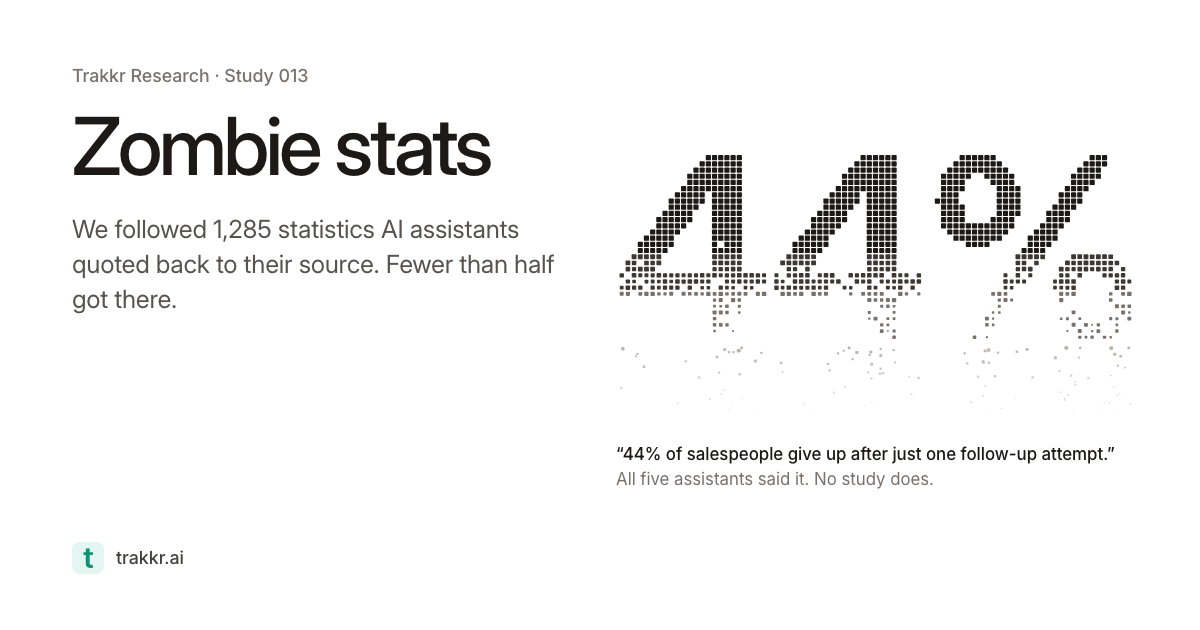
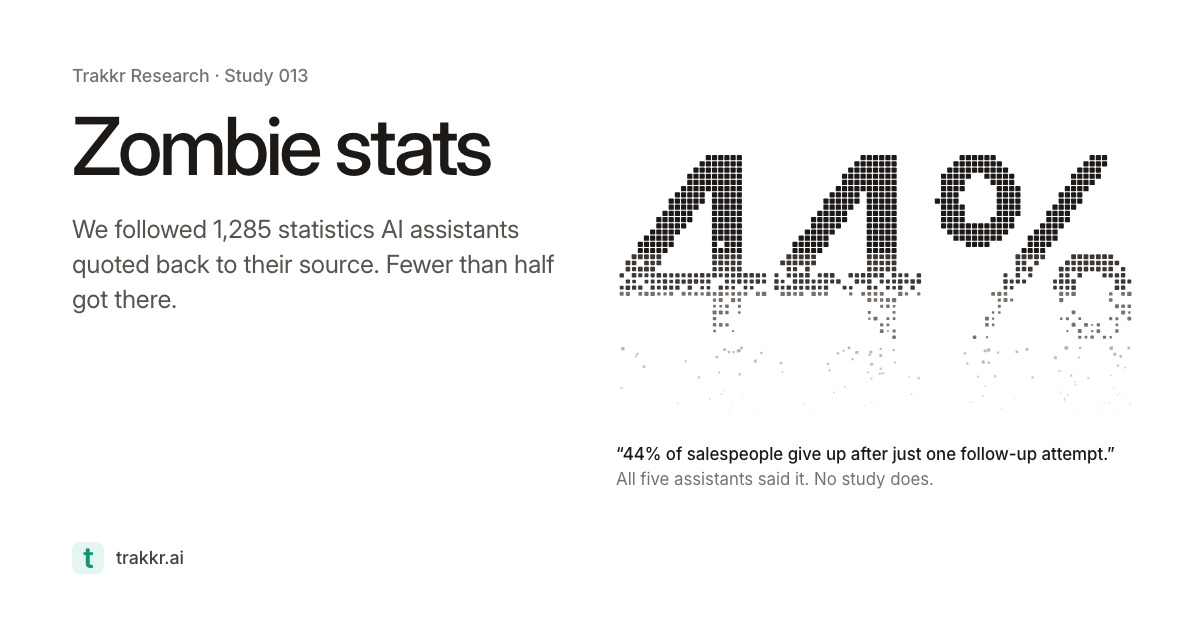
In its report “Zombie Stats: Where the Numbers AI Quotes Come From” (Study 013, October 2026), Trakkr Research traced 1,285 statistical figures cited by ChatGPT, Perplexity, Gemini, Claude, and Google AI Overviews back to their original sources, going up to five pages deep. Fewer than half of the figures could be verified prior to the study, and links most often led not to scientific sources, but to corporate blogs. The issue turned out not to be hallucinations: assistants rarely invent numbers, but they cite secondary retellings that have lost their connection to the original source—presenting them with the same confident tone as verifiable facts.

What Happened
In October 2026, Trakkr Research published Study 013, “Zombie Stats: Where the Numbers AI Quotes Come From.” The authors collected 1,285 statistical figures from the responses of five assistants—ChatGPT, Perplexity, Gemini, Claude, and Google AI Overviews—and traced each link to the original source to a depth of up to five pages. Each figure had one of four statuses: in 40% of cases, the study was found and confirmed the specific number; in another 8%, the study was found, but the number or context was distorted along the way; in 40%, the chain broke off at a source that was closed, deleted, or said nothing about the figure; and 11% of links led nowhere. In total, 60% of the figures in assistant responses do not reach a verifiable original source. ChatGPT leads in the share of confirmed figures at 57%, and it is the model that cites the least—1.3 citations per response. Claude outputs the most numbers—6.8 citations per response—with the lowest share of confirmed figures.
Context
The key finding of the report is that this is not a case of classic hallucinations. The number was present on the page the model linked to in 82% of cases, meaning assistants practically do not invent numbers from scratch. The defect lies further down the citation chain: 54% of links lead to corporate blogs where the original study is retold with a loss of context, and sometimes with a changed number. Hence the name: statistics become “zombie” when the number continues to roam the web after the connection to the study that generated it has been severed. A separate finding concerns the mutual agreement of models. On ten questions where all five assistants answered identically, only two figures were fully confirmed, while four numbers repeated by all five had no underlying study. When models rely on the same secondary sources, their unanimity looks like cross-verification, but it is not.
Why This Matters for the Industry
For the industry, the report shifts the conversation about the citation crisis from anecdotes to a measurable defect and precisely localizes the cause: not in generation, but in the retrieval layer and citation rules, making improvements to generation itself almost useless. Without retraining the model today, three working steps can be implemented: lower aggregators and corporate blogs in search results, giving priority to original sources; limit the number of statistical claims per response, as the sample showed that the lowest number of citations coincided with the highest accuracy; and add citation tracing audits to internal eval sets. Optimizing the “more links” metric is risky: it encourages citing exactly those secondary sources that corrupt data. A product prototype is no longer complex: an agent takes an assistant’s response, extracts numbers, follows links to a depth of three to five pages, and returns the status of each number (confirmed, changed, source unverifiable, dead end)—this is a day’s work with available search and agent APIs. The business risk is specific: in compliance documentation, regulatory, and investor materials, such statistics may contain numbers that cannot be defended before an auditor, given that NIST AI RMF 1.0 and the EU AI Act require assessing the quality of AI output. If independent replications confirm the findings—this is a forecast, not a result of the study itself—the share of confirmed citations may become a standard eval metric for RAG and assistants, and proof of a number’s origin may become a mandatory artifact in reporting processes.
Why This Matters for Users
For readers, the main shift is in habit: a number from a neural network is not proof, but a claim for verification. If statistics are needed for a post, presentation, business letter, or conversation with a client, it is worth asking the assistant for the original source, opening the link, and checking the year, sample size, and exact wording of the statement—in this sample, numbers and context changed multiple times during retelling. A clear example is the figure about “44% of sellers”: in the original, it was based on a narrow study where 15 women evaluated health websites, but after being replicated across corporate blogs, it turned into a “universal fact” that assistants confidently cite, now disconnected from the original context. And finally: the argument that “several models confirm this” does not work in favor of the number. If models learn from the same secondary source, repetition inherits its bias rather than creating independent confirmation.
What Is Still Unknown / Limitations
The material remains a report by Trakkr Research itself (Study 013), not an independent benchmark: open descriptions do not disclose the procedure for forming the question sample or the criteria for categorizing figures, making it difficult to reproduce the findings outside the authors’ methodology. An unverifiable number is not equal to a fabricated one: some links broke off at closed or deleted pages, the content of which can no longer be restored. The sample is limited to five assistants and 1,285 figures, so it is premature to extrapolate the shares to all models and scenarios without independent replications. It is possible to build forecasts about future standards and metrics based on this data, but this is an interpretation, not a conclusion of the report.
Sources
- Zombie Stats: Where the Numbers AI Quotes Come From (Trakkr Research, Study 013)
- Only 40% of AI-Cited Stats Are Verifiable, Trakkr Research Finds (aigovernance.com)
- Zombie Stats: AI Numbers Often Lack Real Sources (Grafy News)
Author
Look at AI, editorial team