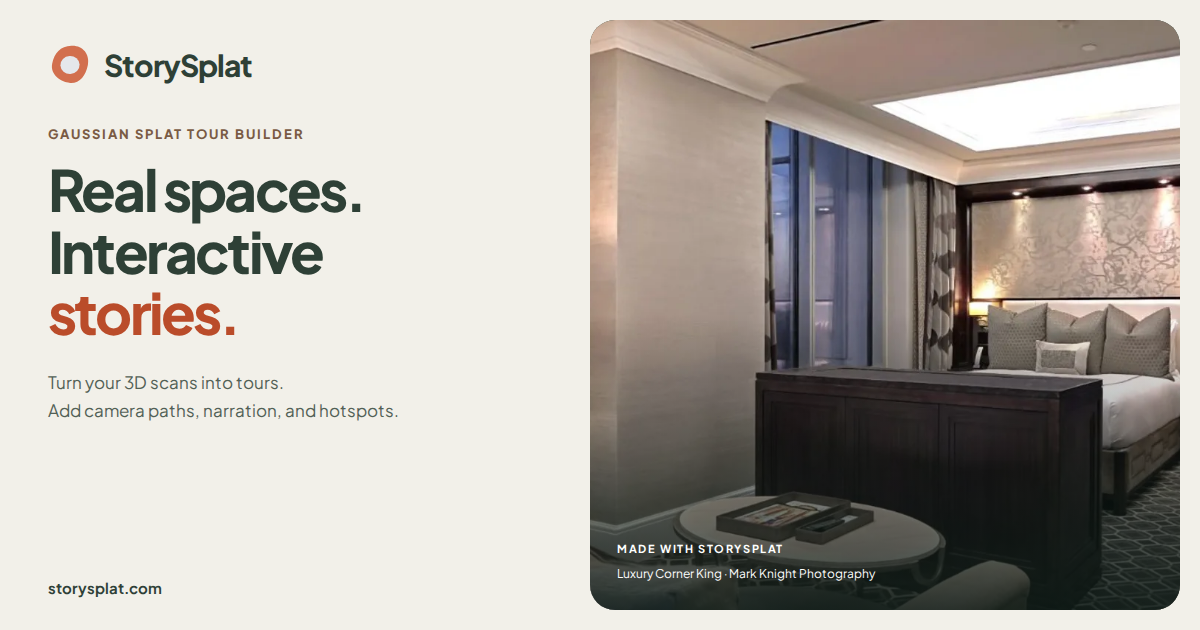
StorySplat 2.5 is an update to the web platform for interactive tours of 3D Gaussian Splatting scenes: the scanned scene now casts shadows from any type of light source, the editor has gained new tools and support for all major splat formats, and the beta Scene Agent and WebMCP bridge allow an AI agent to control the editor with manual confirmation of critical actions. Animation and VR have exited beta, and rendering of finished tours to MP4 runs on the user's local GPU.
What happened
The release features shadows from directional, spotlight, and point light sources, where occlusion is created by the walls and furniture of the scanned scene itself—light no longer shines through objects. Splat clouds with moving shadows and experimental wind have been implemented in scenes. The editor's toolset has been expanded to include lasso, polygon, brush, 3D brush, 3D magic wand, clone stamp, and remove floaters, all of which work with PLY, Compressed PLY, SOG, SPZ, GLB with the KHR_gaussian_splatting extension, and LCC/LCC2 formats. The beta Scene Agent controls the editor directly and builds tours with hotspots and highlighting, while the WebMCP bridge opens more than 100 editor tools to external browser AI agents; however, saving, publishing, and exporting require manual human confirmation. Animation and VR have officially exited beta: tours are rendered to MP4 with 16:9, 9:16, 1:1, and 360° aspect ratios up to 4K on the local GPU, and VR mode supports Meta Quest, Pico, and Apple Vision Pro.
Context
Gaussian splatting is a 3D graphics format in which a scene is represented as a point cloud reconstructed from ordinary photos or videos. Such a cloud has no explicit surface or materials, so correct lighting, including shading by walls and furniture, is a non-trivial task: the classic problem with splat viewers was that light passed through objects. The second line of context is agentic automation. The WebMCP bridge opens web application tools to an external browser AI agent via a standardized interface: the agent performs routine operations, while critical actions like saving, publishing, and exporting are confirmed by a human. StorySplat brings this pattern to a 3D editor, becoming an early working example of an agent-native web tool. Finally, the format ecosystem: support in a single editor for PLY, SPZ, SOG, GLB with KHR_gaussian_splatting, and LCC/LCC2 reduces friction in research and production pipelines and indirectly pushes for consolidation around the KHR_gaussian_splatting format.
Why this matters for the industry
The update addresses two major weaknesses of web splat viewers: realistic lighting, where the scene blocks light instead of glowing through, and the lack of workflow automation. The latter is more significant: the WebMCP bridge with human-in-the-loop confirmation is one of the first practical examples of an agent-native web tool in the 3D space. If the pattern proves viable, other 3D and creative editors will have a ready-made template for "agent controls the tool, human confirms critical operations," and closed APIs without agent access will start to lose out. For the platforms themselves, the signal is that splat hosting and viewers are quickly becoming commoditized, so protection must come through workflow automation and integrations, not just the ability to view. The utilization scheme is also notable: heavy MP4 rendering runs on the user's local GPU, server-side inference is not involved, and broad format compatibility reduces friction when transferring scenes between pipelines.
Why this matters for users
Everything described can be tested in one evening: the editor on storysplat.com opens for free without a credit card, and after uploading a .ply, .splat, .spz, or .sog file, new shadows, splat clouds, the beta Scene Agent (which builds tours with hotspots and highlighting), and connection of an external browser agent via WebMCP are available. For professional projects, a commercial plan starting at $19 per month and credits at one cent each are provided, so a client pilot can be launched in days. Finished tours are rendered to MP4 with 16:9, 9:16, 1:1, and 360° aspect ratios up to 4K on your own GPU, without queues on someone else's server, and the VR mode, which has exited beta, works on Meta Quest, Pico, and Apple Vision Pro. This set of features makes the platform suitable for real projects—from virtual real estate tours to educational scenes.
What is still unknown / limitations
There are no quantitative metrics in the sources: shadow quality (light leaks, artifacts), performance on weak GPUs, and FPS in VR have not been measured, and no direct comparison with alternative splat viewers is provided. Scene Agent remains in beta, and limits for the credit model and beta features are not disclosed in public materials. There is no public data on hardware requirements and rendering latency. Assessments that the WebMCP pattern will become a standard for other 3D platforms are interpretations by review authors, not confirmed facts.
Sources
- StorySplat | Gaussian Splat Tour Builder (official site)
- StorySplat Documentation
- StorySplat 2.5 Adds Splat Clouds, Shadows and a WebMCP Agent — Radiance Fields
Author
Look at AI, editorial team