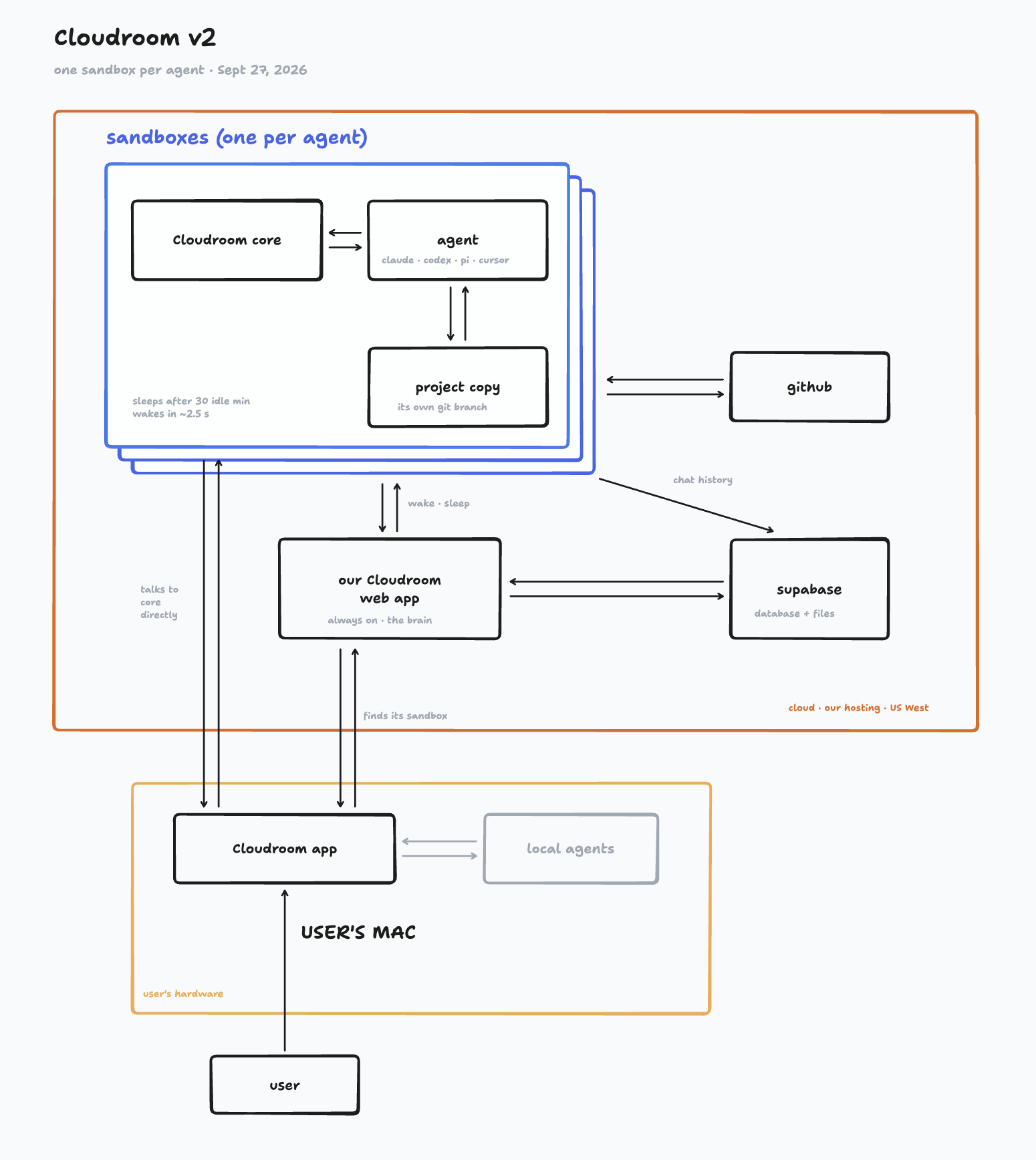
Cloudroom has emerged as an open-source platform with a Rust core under the Apache 2.0 license that runs AI coding agents in the cloud: each agent is assigned an isolated sandbox on a separate Linux machine, while inference is handled via the user's own subscriptions. The desktop application consolidates Claude Code, Codex, Cursor, Devin, and other agents into a single interface: local streams run on Mac, cloud streams run on the server, and switching between them does not lose history. A separate subagents mechanism allows a lead agent to delegate subtasks to other models.
What Happened
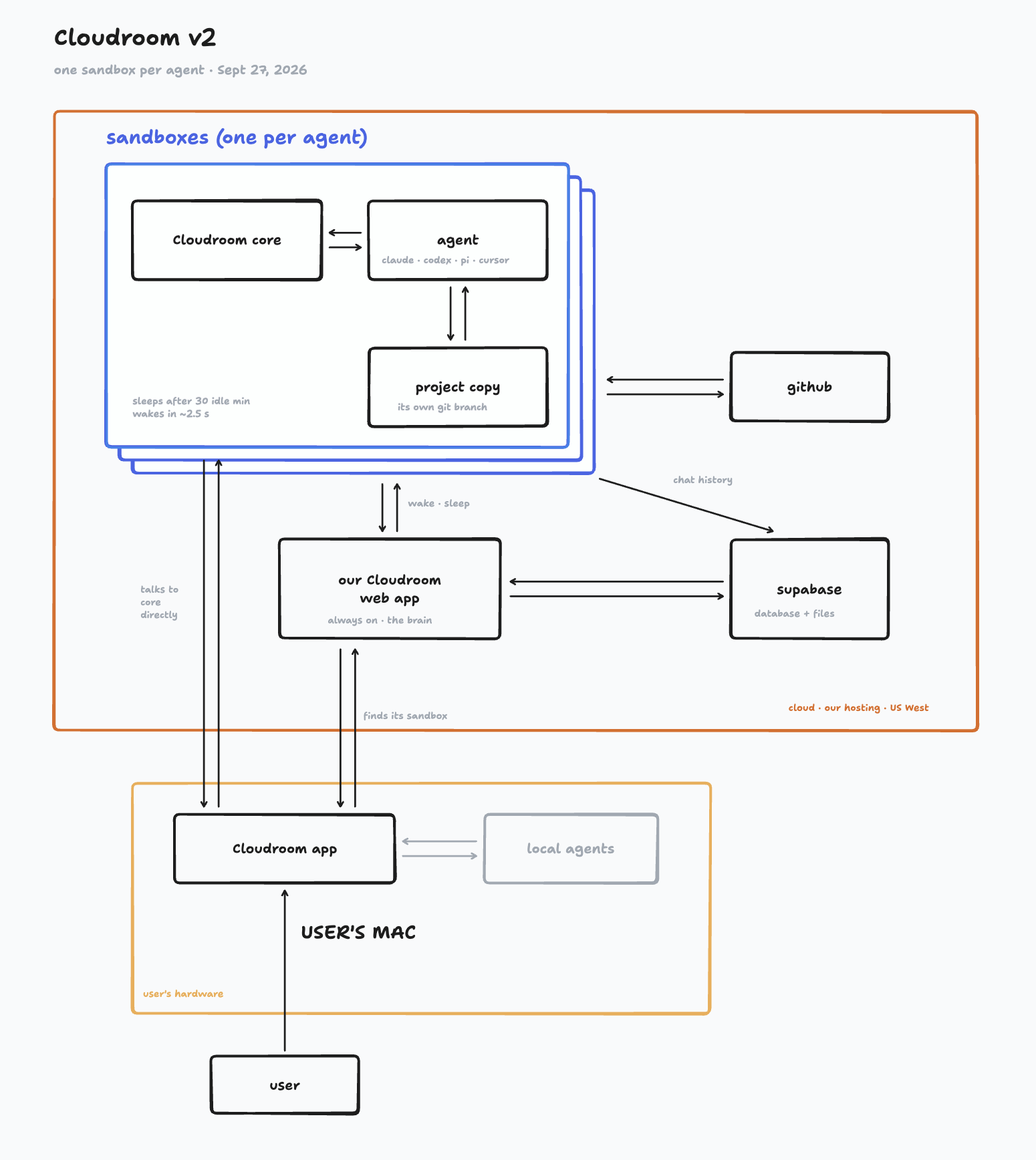
The Cloudroom project was announced with the slogan "Every agent. One app" and is being discussed on Hacker News. Its core is written in Rust and distributed under Apache 2.0; the current build is core-v0.1.62 from October 17, 2026, with releases coming out almost daily. The architecture is designed so that each launched agent receives a separate Linux machine with an isolated sandbox, and inference is performed using the user's own subscriptions without proxying requests to models (BYOK). The desktop application for Mac with Apple Silicon brings Claude Code, Codex, Pi Agent, Cursor, OpenCode, Grok, fx, Hermes, and Devin into a single interface; local streams are computed on the Mac, cloud streams on the server, and users can switch between them without losing session history. The stated key capability is subagents: a lead agent, for example Claude Code on Opus, distributes subtasks to other models via OpenRouter; in project examples, GPT-6 Astra handles the API, Sonnet 5.5 handles the interface, and DeepSeek V4 Pro handles documentation.
Context
The category of cloud coding agents is filled with closed services: in products like Devin, Cursor, and OpenCode, inference and history storage remain on the vendor's side. Cloudroom attempts to occupy a separate layer of the stack above them — not models or a standalone agent, but the orchestration of third-party agents according to the "one agent — one dedicated machine" scheme. The BYOK (bring your own keys) principle means that users connect their own subscriptions to models, so the platform's margin on generation is zero, and it earns revenue through service fees. The Apache 2.0 license on the core makes the project's architectural claims verifiable: the sandbox isolation mechanism and subagents delegation logic can be checked against the source code on GitHub, rather than just the website description.
Why This Matters for the Industry
For the industry, Cloudroom adds a fully open option to the race of cloud coding agents that can be deployed on one's own servers: infrastructure and session history remain with the team, not the vendor. This creates pricing and privacy pressure on Devin and Cursor in the niche of model key control and lowers the barrier for pilots that require agent isolation. If the daily release rhythm is maintained, cloudroom-core could become an open reference implementation for the orchestration layer, forcing major market players to respond with BYOK compatibility and session history portability. The bet is broader than a specific product — the "operating system for agents" pattern: portable history between tools and models, isolation by default, and no intermediary in inference. If this pattern takes hold, value in multi-agent workflows will shift from the best single agent to managing a fleet of executors, where an expensive lead planner directs cheap specialized executors.
Why This Matters for Users
The direct benefit is immediately visible: the application for Mac with Apple Silicon is distributed for free, Claude Code, Codex, or Pi subscriptions are connected directly, and local streams are free and continue to work even when the laptop is closed. The Free tier allows up to 100 cloud agents in 30 days; beyond that, Pro is offered for $50 per month and Ultra for $500. For those who do not want to depend on someone else's cloud, the core can be launched on Ubuntu 24.04 with a single script on any Linux VPS. Finally, the project is free educational material: the mechanics of lead → subagents delegation and switching streams between Mac and the cloud without losing history can be studied through open code and documentation.
What Is Still Unknown / Limitations
Several key claims remain product promises rather than verified results. Session history portability between heterogeneous agents is not explained: how state is serialized and normalized between different systems is unknown. The "model → task type" mapping table in subagents is presented without a methodology for model selection, quality metrics, or delegation costs. The core is in the core-v0.1.62 stage with daily releases, so any attempts at reproduction quickly become outdated. Demand is not confirmed: the Hacker News thread received 2 points and 1 comment. The Linux build remains in alpha status, and the stated support for other agents in the list requires verification against the project documentation.
Sources
- Cloudroom — official project website
- GitHub: davidondrej/cloudroom-core — open self-host Rust core
- Hacker News: Cloudroom – Every agent. One app (discussion item 50135735)
Author
Look at AI, editorial team