The Earendil team released the stable 1.0 version of Pi on October 1, 2026 — a minimal agent harness, a TypeScript-based coding CLI agent used by hundreds of thousands of people weekly, with the earendil-works/pi repository on GitHub gathering around 111,000 stars. The release features native MCP support via Codemode and virtual models with request routing between Claude Opus and GPT-6 Luna; simultaneously, the experimental Pi Durable was released as a substrate for long-lived agent applications.
What Happened
The release moved Pi from version 0.99 to stable 1.0: the harness core is fixed as a platform, and the code is open under the MIT license. The main novelty is Codemode: instead of hundreds of declared tools in the prompt, the model writes JavaScript in a QuickJS sandbox and calls tools in parallel; according to the authors, in an example request to GPT-5.6, the prompt is compressed by approximately 40%, from ~5300 to ~3300 tokens. The second pattern is virtual models: the Jev classifier distributes individual requests between models, for example, planning goes to Claude Opus, and code implementation to GPT-6 Luna; the router/auto mode enables mixed routing automatically. Additionally, 1.0 includes lazy tool loading, prompt cache warming for Anthropic models, intermediate system messages in conversation, a new TUI theme, and full-screen mode by default. In parallel, the experimental Pi Durable package was published — a substrate for long-lived agent applications, uploaded to npm.
Context
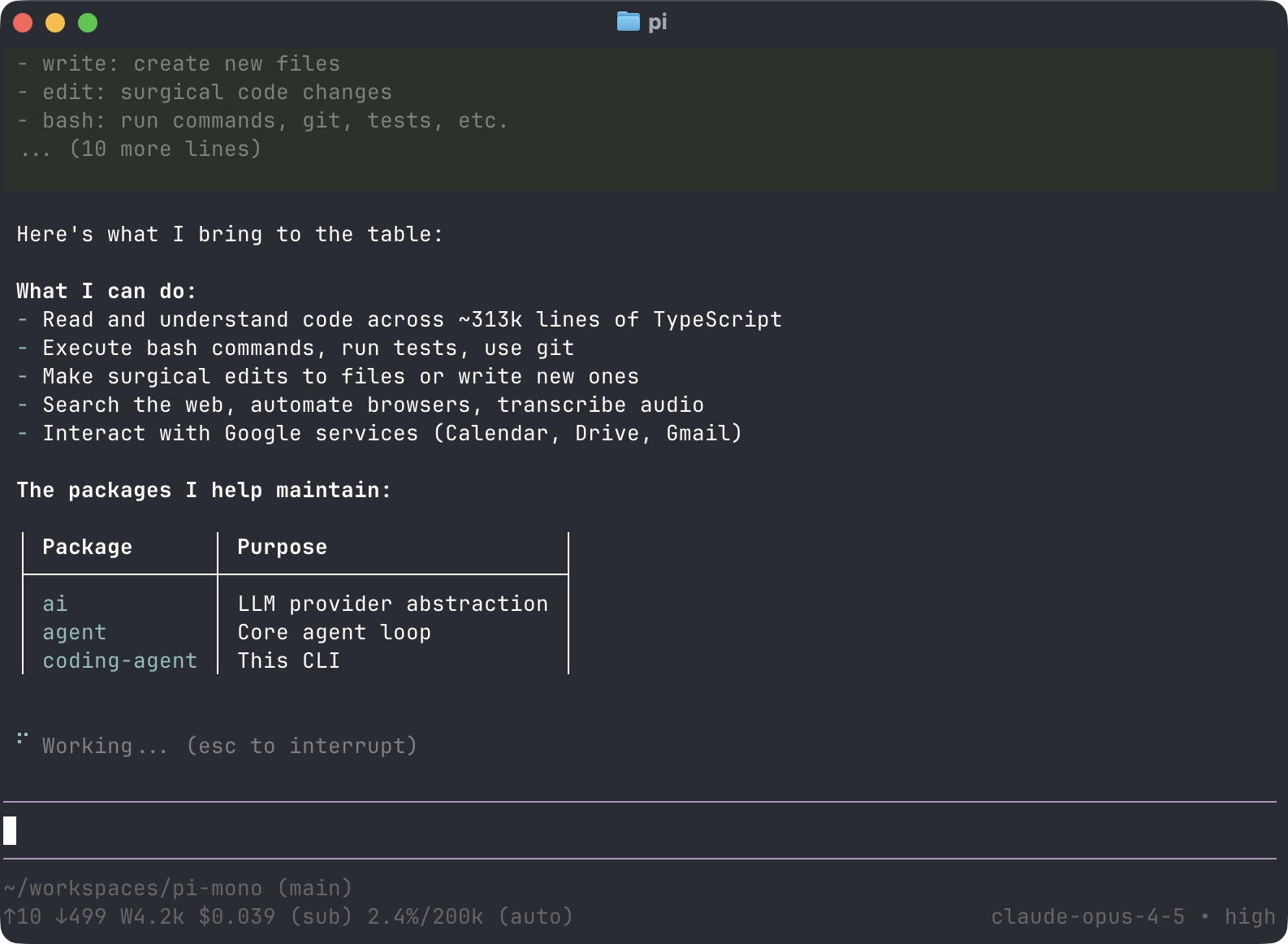
Pi belongs to the agent layer between models and applications, commonly referred to as a minimal harness: instead of feature bloat, the authors keep the core compact and provide extensibility through an extension-SDK and npm packages. The logic is simple: model capabilities are growing faster than the value of thick wrappers, so context savings and cheap orchestration themselves become a product. Codemode addresses a very specific problem — hundreds of tool schemas eat up the context window, and the pattern of “model code in a sandbox instead of a tool catalog” became an engineering response to the fixed window size. Virtual models solve the reverse unit economics problem: it is profitable to use an expensive model only where it is truly needed, and the Jev classifier acts as a separate trainable routing layer. The transition from 0.99 to 1.0 is not a leap in model capabilities, but a substantive consolidation of the engineering base and a public signal of maturity, which teams rely on when deciding whether they can build a working loop on the harness, not just a demo.
Why This Matters for the Industry
For the industry, Pi 1.0 solidifies the trend of “minimal harness as a product”: a stabilized API under MIT lowers the barrier to entry for startups and businesses building agents on the SDK, but at the same time turns the harness itself into a near-commodity, shifting value to orchestration and extensions. Codemode has become a notable architectural pattern for context savings: the claimed prompt reduction of approximately 40% on the vendor's GPT-5.6 example directly affects inference costs of agent pipelines, and if the pattern is confirmed in independent measurements, competing harness projects and MCP clients will start copying it. Virtual models with the Jev classifier are a working example of cheap routing of “expensive planning, cheap implementation,” which other harness projects will look up to; routers of this type may emerge as a separate product category. Accompanying features — lazy tool loading, prompt cache warming for Anthropic, intermediate system messages — form a coherent methodology for working with a fixed context window, rather than a growth in model capabilities. If savings and routing accuracy are confirmed by third-party teams, the unit economics of agent pipelines will have to be recalculated; within a two-year horizon, the hypothesis of “minimal harness plus extensions via npm” as a standard layer of the stack between models and applications will either be solidified or refuted, and partial assimilation of these features into vendor products and large frameworks seems likely.
Why This Matters for Users
If you were looking for an open alternative to Claude Code or Codex CLI under your control, Pi 1.0 is a ready-made option. It is installed with one command (curl -fsSL https://pi.dev/install.sh | sh), works with 15+ providers from Anthropic to Ollama, does without sub-agents and permission pop-ups, and settings are changed directly in the code with instant /reload. You can immediately try Codemode on your MCP catalog, enable router/auto for mixed routing of Claude Opus and GPT-6 Luna, build your first extension from 50+ ready-made examples on GitHub, and evaluate the speed of the edit cycle via /reload. Codemode and prompt cache warming provide measurable context savings already in the pilot, and the most honest way to check the vendor's numbers is to take measurements on your own tasks. Pi Durable should be perceived as an experiment: a substrate for long-lived agent applications with persistence is interesting for prototypes, but for now it is not a foundation for production.
What Is Still Unknown / Limitations
The key figures of the release rely on vendor data: the only quantitative claim about the benefit of Codemode (minus 40% prompt, GPT-5.6 request example) is not accompanied by methodology, baseline, and independent reproduction, so confidence in this conclusion should be kept moderate. The sources do not have latency measurements and price comparisons — baseline lines on cost and speed will have to be taken independently on your own loads. The source channel's assessment of “still the best agent” remains subjective and was not supported by measurements. Everything related to Pi Durable is experimental: its maturity, limitations, and fate as a separate project are unknown. Expectations of pattern reproduction by other harness projects and assimilation of features into vendor products within a 6–24 month horizon are interpretations, not established facts, and competitive pressure from Claude Code and Codex CLI remains the main external uncertainty for the entire category of minimal harnesses.
Sources
- Pi 1.0 | Earendil (official announcement)
- GitHub — earendil-works/pi: Release v1.0.0
- Pi — Minimal Agent Harness (pi.dev, documentation)
Author
Look at AI, editorial team