The open-source editor bb by @sawyerhood (website getbb.app) implements the concept of an "IDE that builds itself": the entire interface is assembled from TypeScript components and plugins that agents can rewrite and extend via prompts, and everything visible in the UI is duplicated in the CLI, SDK, and HTTP API. We learned about the project from a post in the Tips AI Telegram channel, whose author has long worked with Orca from Stably AI, but after a stream on September 21, 2026, took a closer look at bb. The stakes here are higher than in the debate over "yet another editor": the agent development environment category is taking shape in such a way that value is shifting from models to harnesses — environments where CLI agents like Claude Code and Codex work on existing provider subscriptions.
What happened
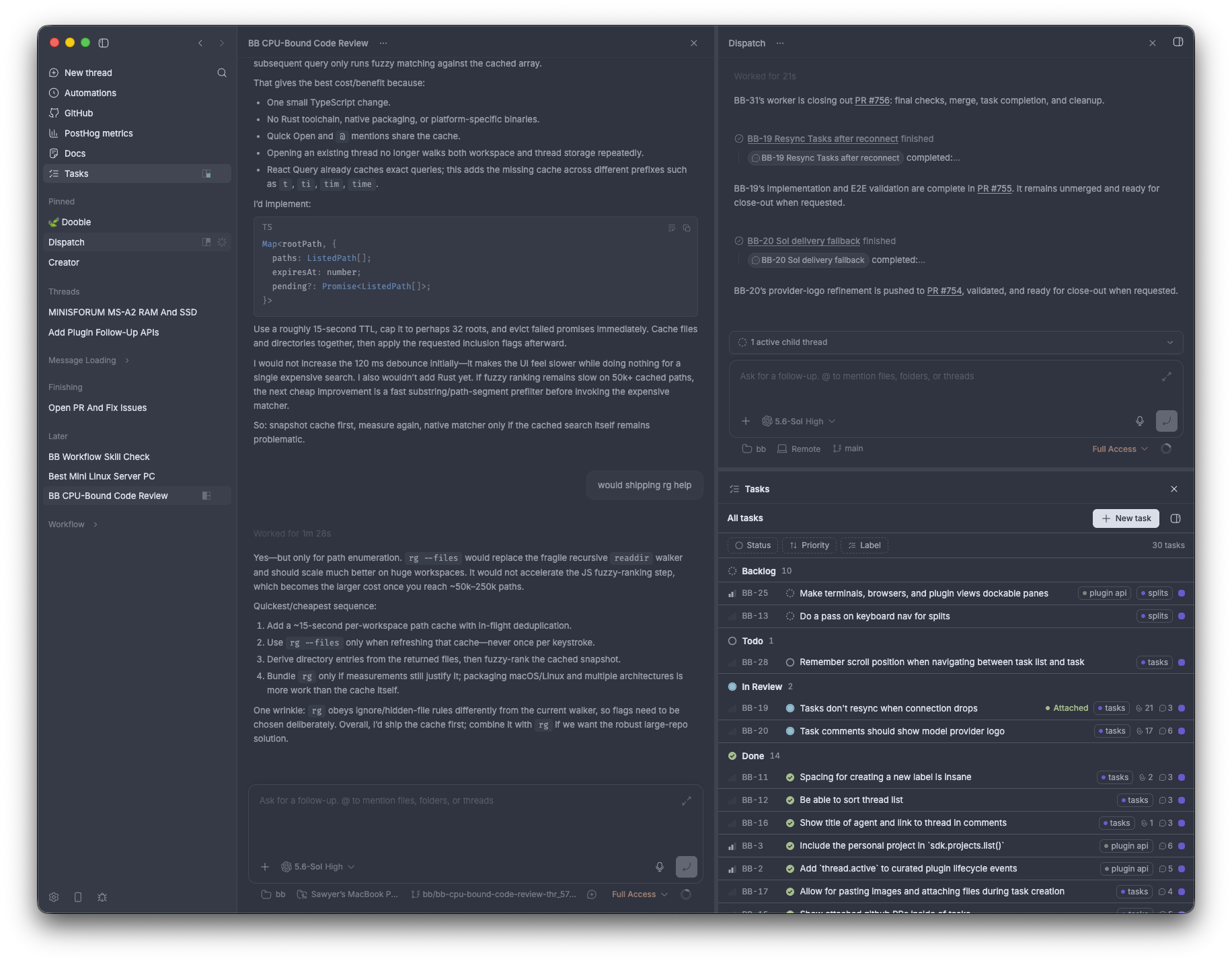
In the Tips AI Telegram channel, the author shared that they have long used Orca (orca.dev — an open environment for working with agents from Stably AI, which supports Claude Code, Codex, and 25+ other CLI agents) as their primary ADE, but after a stream on September 21, 2026, they noticed a second tool of the same class — bb by @sawyerhood, available at getbb.app. bb is positioned as an "IDE that builds itself": by default, the interface looks like Codex, but every element is a TypeScript component or plugin, and agents can rewrite them via prompts, assembling their own editor functions from these same tools. Everything available in the interface is duplicated in the CLI (bb spawn and bb pool commands), SDK, and HTTP API, so an agent can independently start threads, change the appearance, and expand the environment's functionality. bb has a built-in Account Pooler — an experimental plugin that automatically switches between Claude and Codex accounts when the current one runs out of its limit. The project is open under the MIT license: in the github.com/get-bb/bb repository, by the September 25, 2026 release 0.44.0, it had accumulated about 4,000 stars, 572 forks, and 6,264 commits, and the changelog for this version included experimental plugin APIs for aiServices, sidebarHeader, and sendMenu.
Context
ADE (agent development environment) is a young category: a development environment where the main work is done not manually in files, but through agents. Orca from Stably AI and bb give two different answers to the same question about what such an environment should be. Orca bets on an open environment that brings familiar CLI agents — Claude Code, Codex, and more than two dozen others — together in one place; bb, on the other hand, turns the interface itself into an editable artifact, relying on the Plugin SDK: access to UI slots (app.slots and derived APIs) allows extending the interface surface via prompts, and experimental points like aiServices, sidebarHeader, and sendMenu from the 0.44.0 changelog open up the system level of the tool to agents. Behind this is a broader shift in value from models to harnesses — wrappers that glue together models, CLI/SDK agents, and provider subscriptions. bb's key engineering hypothesis is that a "software factory that produces itself" is not a metaphor, but a real way to build tools; at the current stage, this is a testable but not yet measurement-confirmed idea, not a marketing promise without code.
Why this matters for the industry
For the industry, the emergence of bb confirms that the ADE category is forming as a separate market layer: the "model versus model" competition is gradually being replaced by a battle between environments. The moat is shifting from the editor itself to the plugin ecosystem and iteration speed, not to a list of built-in features. In bb, this is visible architecturally: the CLI bb spawn and bb pool, SDK, and HTTP API form a unified programmatic surface of TypeScript components, on top of which teams can orchestrate parallel agent threads and build their own tools on top of the harness — essentially, this is a ready-made framework for orchestration, not just "yet another IDE." There is also a flip side for builders: when the environment becomes a variable factor, it will have to be fixed and versioned as part of agent evaluation configurations, otherwise comparisons between different environments lose reproducibility. In the six-to-twelve-month horizon, it is realistic to expect replication of the "extensible agent UI" pattern by other environments, the Linux AppImage exiting alpha, growth in third-party plugins — and the first reports of user extension breakages when updating experimental APIs; if the Plugin SDK stabilizes, a market for widgets and workflow templates will form around it, modeled on the early editor extension market, and Orca and other ADEs will respond with their own mechanisms for a rewritable interface.
Why this matters for users
You can try bb for free and locally: download the build for macOS Apple Silicon from getbb.app or run npx bb-app@latest and open http://localhost:38886 in a browser; the Linux AppImage is still in alpha, and Windows is only supported via WSL2. The practical value today is custom widgets on top of the harness without a terminal UI: in the stream and post, an example is given where a small function like link preview in chat is assembled in about ten minutes, and Ratul Sarna's case demonstrates embedding a Grok bot directly into the editor interface (X post from August 25, 2026). For those working on Claude and Codex subscriptions, the built-in Account Pooler might be useful: an experimental plugin that shifts work to a free account when the current one's limit is exhausted, although it is still too early to rely on it for production tasks. Before launching, keep in mind that the project is in active development: the HTTP server starts by default without authentication, so it is only suitable for a trusted network or Tailscale, and telemetry is disabled by the environment variable BB_TELEMETRY=false. For those who prefer the classic workflow, Orca from Stably AI remains — an environment where Claude Code, Codex, and 25+ other CLI tools are already brought together.
What is still unknown / limitations
The evidence base is still demonstrative: the thesis that customization is getting cheaper from weeks to minutes relies on isolated demonstrations — the post author's personal example and Ratul Sarna's case with an embedded Grok bot (X post from August 25, 2026), and these are demonstrations of individual cases, not measurements, and they cannot be generalized into a pattern. There are no independent benchmarks or assessments of the impact on productivity or the quality of agent work; GitHub metrics (about 4,000 stars, 572 forks, 6,264 commits) signal development and distribution activity, but say nothing about the capabilities of agents or the quality of generated UI components, and mixing these levels is a methodological error. The experimental plugin APIs (aiServices, sidebarHeader, sendMenu) are unstable and will undoubtedly break user extensions when updated, and the HTTP server without default authentication limits application scenarios to trusted networks. Finally, the question of reproducibility is open: if the environment rebuilds itself for a task, comparing agents across different harnesses can only be done correctly when the environment itself is fixed and versioned.
Sources
- bb — official project website (The IDE that builds itself)
- GitHub — get-bb/bb: The agent IDE that builds itself (MIT, release 0.44.0)
- Stream "Getbb – the ideal harness for business users? AI-IDE that creates itself" (21.09.2026)
Author
Look at AI, editorial team