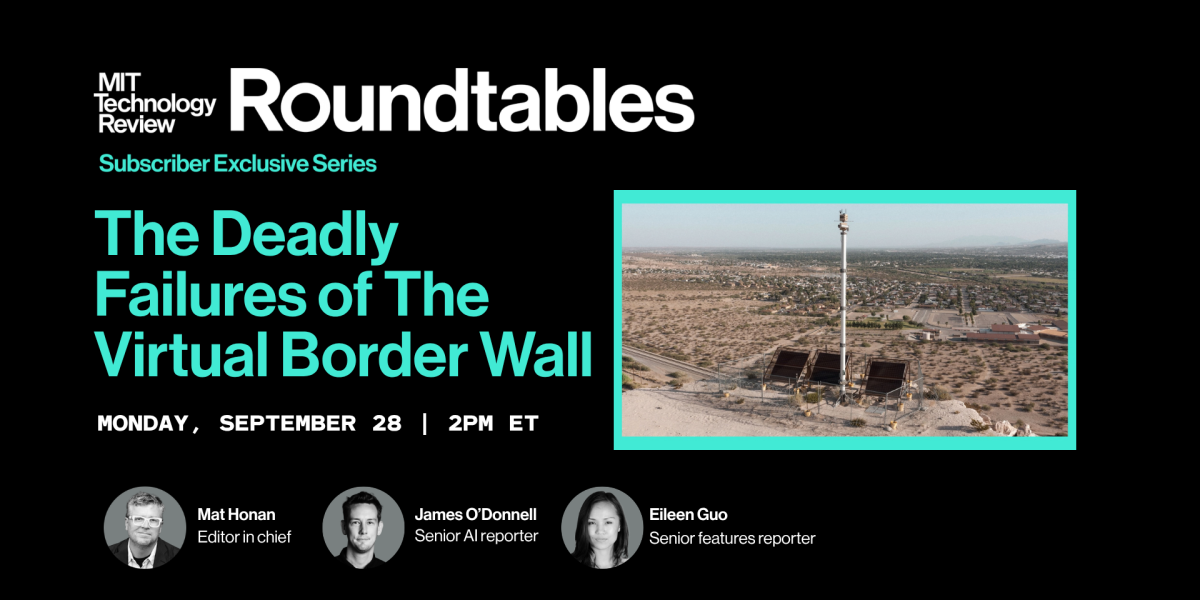
On September 28, 2026, MIT Technology Review published a roundtable recording dedicated to the results of the 'Dying on Camera' investigation: over 25 years, the U.S. spent billions of dollars on a 'virtual wall' of approximately 600–800 surveillance towers along the southern border, but only from 2015 to early 2026, more than 1,050 people died in the range of these towers. By matching body find records with the Electronic Frontier Foundation's tower database, journalists created the first complete map: deaths were recorded in the range of almost two-thirds of the towers, with most of the deceased not in 'blind spots' but where cameras should have had a direct line of sight. For the AI surveillance industry, this is the first systematic audit in real operation, not in a demo, and a new benchmark for acceptance criteria for such systems.


What happened
In a roundtable featuring editor-in-chief Mat Honan and journalists Eileen Guo and James O'Donnell, the results of the investigation were examined in detail. Journalists matched nearly 4,000 body find records — from the No More Deaths and Humane Borders project databases and from documents in 17 Texas counties — with the Electronic Frontier Foundation's surveillance tower database. For the second generation of Elbit Systems, 55 Integrated Fixed Towers in Arizona, deaths were recorded within the radius of 52 out of 53 analyzed towers. Anduril's AI towers with autonomous human recognition have been operating since 2021, and more than 110 people have died within their radius. One of the cases examined was José Morales Bernal, who died in April 2024 approximately 110 meters from an Anduril tower: the body was found by landfill workers, not the Border Patrol. Failures were documented in two types: 'the technology didn't see it' and 'the operator didn't react,' with one operator responsible for 30 screens and an area of over 850 square miles. According to the investigation, CBP has never checked mortality rates in the range of its towers; the authors provided four specific recommendations for correction.
Context
The 'virtual wall' is a network of autonomous surveillance towers along the U.S. southern border that has been expanding for over two decades; the RVSS program alone cost about $3.7 billion by 2020. The technology has changed generations and vendors: Elbit Systems' radar cameras, General Dynamics' solutions, and Anduril's latest-generation towers. Architecturally, such surveillance is a human-in-the-loop system: the camera only forms an alert, and the decision and dispatch of a response remain with the operator, so the result depends not only on the accuracy of the models but also on the interfaces, workload, and organization of the operator loop. A public cross-check of outcomes with system performance has not existed until now; the previous known episode of parliamentary oversight was the House of Representatives committee's assessment of RVSS in 2024. Reproducibility is built into the investigation's design: the methodology for creating the map is described in a separate MIT Technology Review article, so the calculations can be repeated using the same open databases.
Why this matters for the industry
For the industry, this is the first systematic audit of AI surveillance in real operation: billions of dollars and 25 years of work deployed equipment in the field, but no one measured the outcome, and the cross-check of the death map with camera zones was done for the first time. The failure is not reduced to a single model — it is divided into the loops of 'the technology didn't see it' and 'the operator didn't react,' where operator overload nullifies even a high-quality detector; until there is independent ground truth and an end-to-end metric for the 'camera → operator → response' chain, the word 'deployed' does not mean 'working.' For suppliers — Anduril, Elbit Systems, General Dynamics — this is a reputational and regulatory precedent: claims of the 'system saves lives' category can now be cross-checked with a public mortality map. It is expected (interpretation, not an established fact) that congressional inquiries and official CBP responses, vendor attempts to dispute the methodology, and the first independent replications of the map will appear; in procurement, a shift toward operational telemetry, escalation protocols, and outcome reporting is likely, as well as demand for triage UX for prioritizing alerts. If the methodology withstands scrutiny, mortality in the range of operation could become a standard acceptance metric for surveillance systems — similar to how open benchmarks have displaced demos in the evaluation of ML models.
Why this matters for users
For computer vision and perception researchers, this is the largest public case of the gap between demo metrics and the real outcome of deployed people detection systems. Engineers and product teams get an argument for internal requirements: before accepting such a system, to strive for outcome metrics, independent ground truth, and an audit, and for operating teams — to check whether they measure their reaction to alerts, not just recognition accuracy on a stand. For readers who work with procurement or integrations of surveillance systems, the open map and published methodology provide a verification tool: vendor claims about recognition quality can now be cross-checked with public data on outcomes. The topic is worth following because the reaction of CBP and regulators will show whether outcome reporting will become a mandatory part of AI surveillance contracts.
What is still unknown / limitations
The published data does not include detection logs for each tower, so the 'death in radius' statistics measure the system's failure by outcome, not the quality of the models: specific field recall/precision values cannot be attributed to this data. In the case of José Morales Bernal, it is unknown whether the Anduril tower recorded a recognition. The map matches deaths with camera view zones, but does not prove that a specific death could have been prevented: the outcome depends on terrain, weather, response protocols, and operator performance. Finally, congressional inquiries, official CBP responses, and possible vendor objections to the methodology are expected scenarios, not established facts, and they need to be awaited before considering the issue closed.
Sources
- MIT Technology Review — Roundtables: The Deadly Failures of The Virtual Border Wall
- MIT Technology Review — The US spent billions on border surveillance. Why can’t it catch people before they die?
- MIT Technology Review — How we made the first comprehensive map of deaths along the US border’s “virtual wall”
Author
Look at AI, editorial team