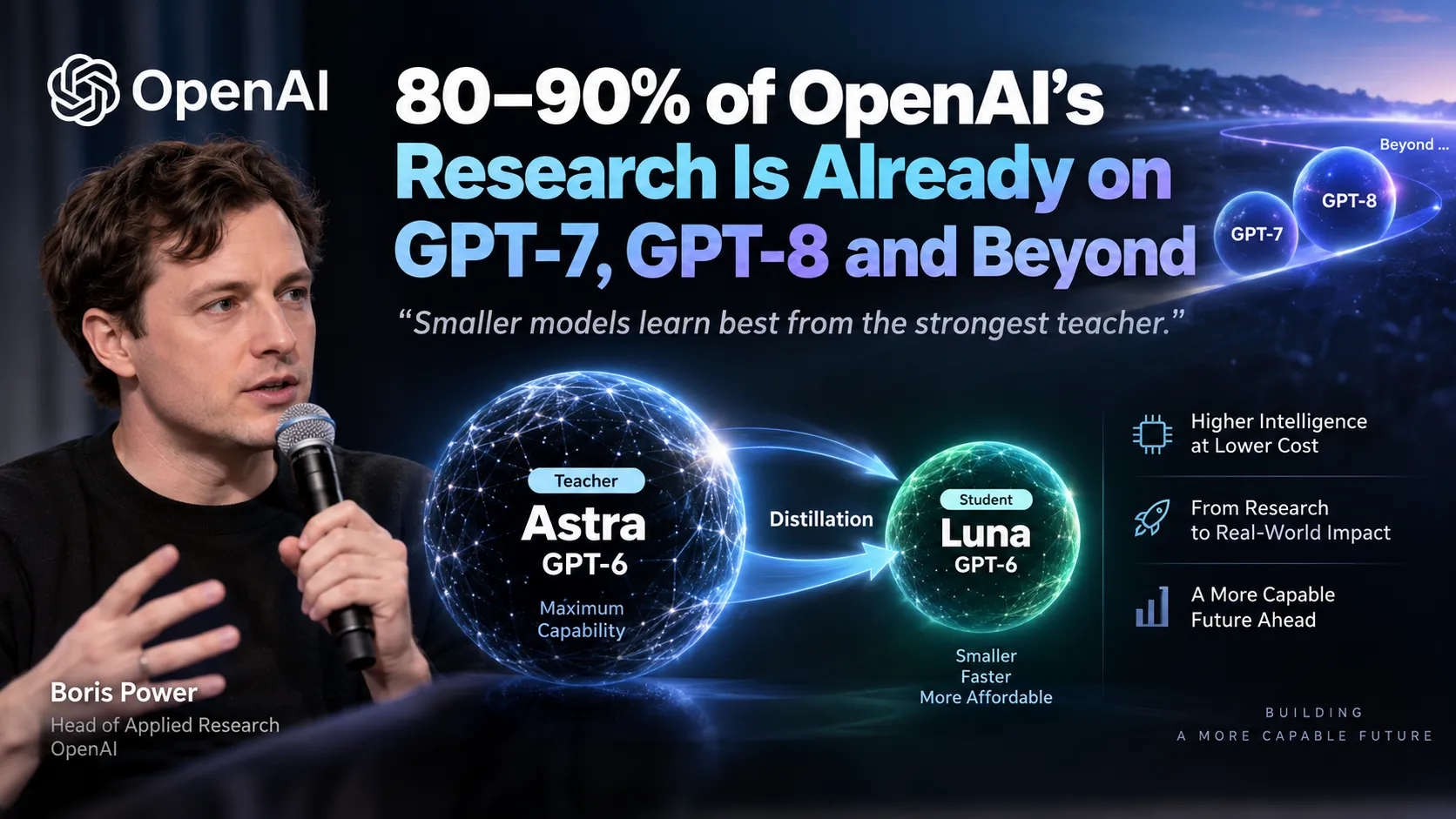
OpenAI's Head of Applied Research, Boris Power, stated that approximately 80–90% of the company's research work is already directed at GPT-7, GPT-8, and subsequent generations, because that is where OpenAI sees the primary value. Improvements within a single generation, such as the transition from GPT-5.1 to 5.2, the company calls short-term bets, while considering the transition to a new generation the main quality jump. At the same time, Power revealed the economics of the GPT-6 lineup: the flagship Astra acts as a "teacher" for cheaper models like Luna with a tenfold price difference, and he considers the main problem of modern AI assistants to be not model quality, but onboarding.

What Happened
On September 23, 2026, at the Fellows Forum 2026 session in Menlo Park, OpenAI's Head of Applied Research, Boris Power, in a conversation with Zachary Lipton, described how the company allocates its research resources. According to him, approximately 80–90% of this work is already directed at GPT-7, GPT-8, and subsequent model generations. He characterized pinpoint improvements within a single generation, such as from GPT-5.1 to 5.2, as short-term bets: they help iterate faster today but do not constitute a long-term strategy. Power also outlined the pricing architecture of the GPT-6 lineup: the flagship Astra costs $10 per 1 million input tokens and $50 for output, the cheap Luna — $0.10 and $0.50 for the same volumes, meaning 100 times cheaper, while Sol occupies the middle price tier.
Context
The described "teacher-student" scheme is an established pattern of distillation in the industry: an expensive frontier model generates quality and training data, and a cheap model is trained on them and goes into mass deployment. At OpenAI, this pattern is now directly formalized in the pricing of the GPT-6 lineup, where Astra serves as a data source for Luna. This logic also explains the allocation of resources: breakthrough quality is consciously deferred to generational shifts, and within a generation, the company only iterates quickly, keeping the current product up to date. Power's statement that the bottleneck of modern assistants lies in onboarding complements the picture: according to his assessment, most users utilize only a small fraction of the models' capabilities, meaning the problem lies in the interface and capability disclosure, not in the models themselves.
Why This Matters for the Industry
For the industry, the main signal is the publicly named proportion: 80–90% of OpenAI's research resources are working several generations ahead, so competitors should expect a jump in value precisely at generational shifts, not from incremental updates. The Astra and Luna pricing pair with a 100x gap makes routing architecture routine: the cheap tier takes the main traffic, and the flagship is connected only to complex cases, which can reduce inference costs by an order of magnitude. The "teacher-student" mechanism shows how a frontier company turns flagship models into the economics of cheap mass deployment. For building teams, this sets three practical directions: investing in their own evals and model-agnostic abstraction instead of tracking minor releases, recalculating the unit economics of agents for the cheap tier, and working on observability and product capability disclosure, because the value of the system is now determined not only by model metrics but also by how well the user understands what it can do.
Why This Matters for Users
Users should not expect breakthrough changes from intermediate versions like 5.2: they are consciously made as fast and unobtrusive bets, and the main quality jumps will come at the boundary of GPT-7 and GPT-8 generations, the dates of which have not been announced. The practical takeaway is to master the capabilities of already available models more deeply, because, according to Power's assessment, most people use only a small fraction of their capabilities. Astra in the GPT-6 lineup is already described as a "colleague" to whom you can simply set a goal and get a result, and the cheap Luna tier makes large-scale agent scenarios and active daily use noticeably more affordable.
What Is Still Unknown / Limitations
The statement about the allocation of 80–90% of research is an executive's estimate at a public session, not disclosed internal statistics, and it is not independently verifiable. The release dates for GPT-7 and GPT-8 have not been named, so the horizon for generational shifts remains unknown. For the GPT-6 lineup, sources have no data on latency, rate limits, and SLA, as well as on the quality gap between Luna and Astra on complex tasks; a 100x price savings does not make Luna a ready drop-in replacement for the flagship, and without its own eval harness, the cascade can silently lose quality. The prices named are based on Power's presentation and should be verified against current OpenAI documentation before use in calculations.
Sources
- OpenAI says 80 to 90 percent of its research already targets GPT 7 and beyond — The Decoder (Matthias Bastian)
- Fellows Forum 2026, Day 1 — session video with Boris Power (YouTube, Fellows Forum)
- OpenAI: 80–90% of Research Targets GPT-7, GPT-8 and Beyond — AIIDelist (analysis of Power's statements, Astra/Luna prices)
Author
Look at AI, editorial team