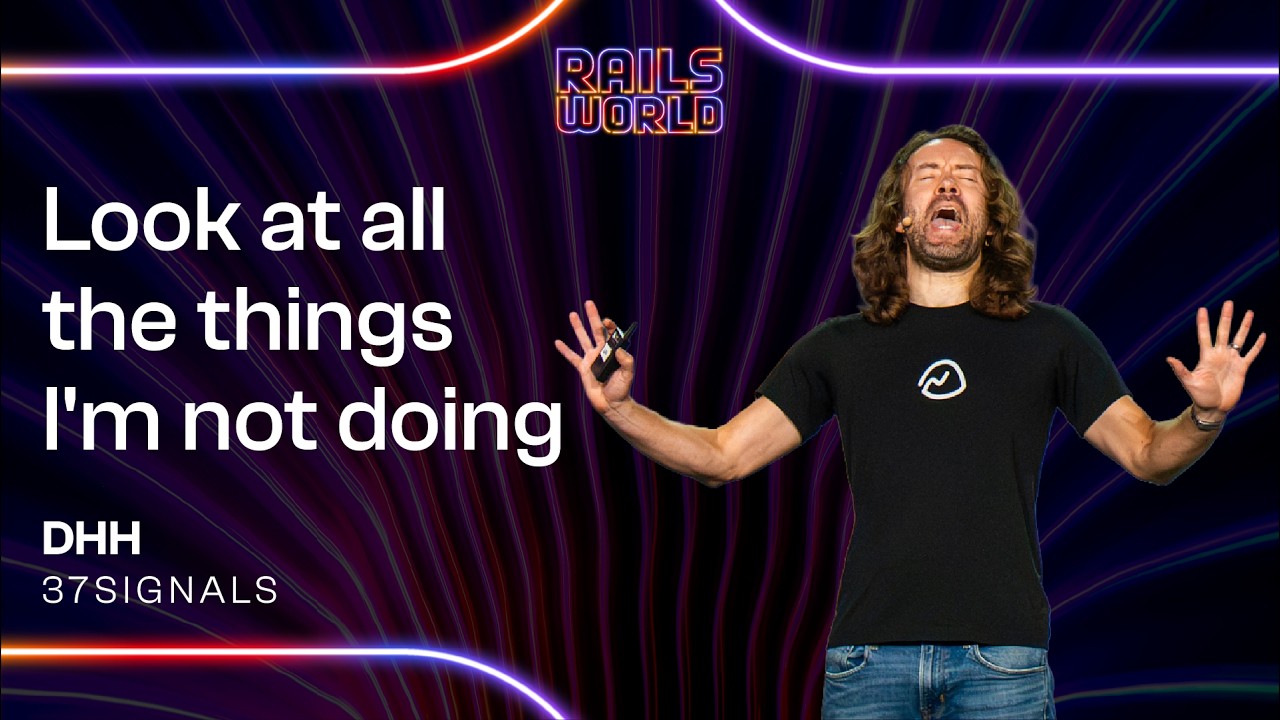
Ruby on Rails creator and 37signals (Basecamp) co-founder David Heinemeier Hansson (DHH) stated at the Rails World 2026 keynote that he has not written a single line of code by hand since March 2026 — after a 25-year career as a programmer. According to him, “English is the best programming language, better than Ruby”: now all the code in his work is created by AI agents, and Hansson himself acts as a reviewer.

What happened
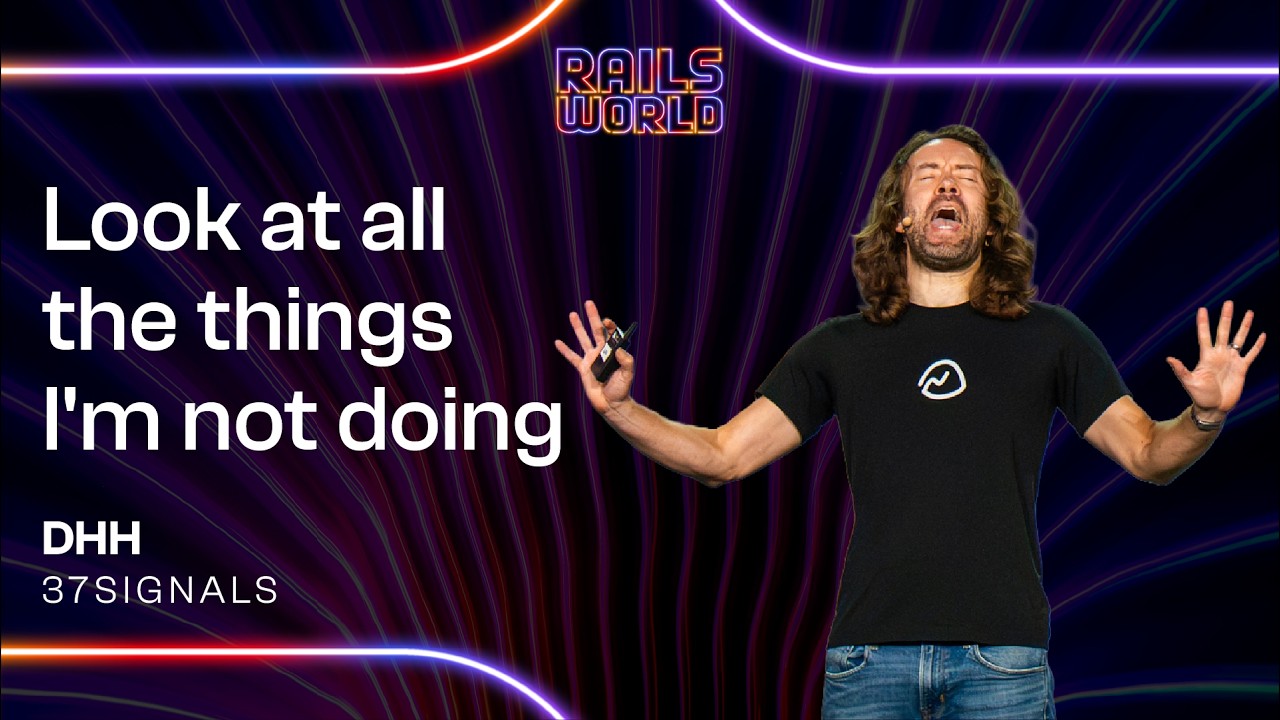
On September 23, 2026, at the opening keynote of the Rails World conference at the Palmer Center in Austin, Hansson announced that he has fully transitioned to agentic development and no longer types code by hand. Manual typing of code, in his formulation, “is no longer an economically productive activity for the vast majority of programmers in most companies,” and by the end of the year, such a mode, according to his forecast, will cover almost all areas of commercial development. He described his current workflow as follows: two agents with different roles work in the terminal — Gemini 2.5 for speed and Claude Opus for tasks requiring judgment — and diff checking is done manually in NeoVim and Lazygit. The 37signals course is confirmed by the restructuring of the HEY email service into native applications with a Rust backend; the company also announced a commitment to provide a CLI — an interface through which third-party agents will be able to work with its products.
Context
The turn looks all the more significant because as late as 2025, Hansson remained the most famous public skeptic of AI coding and continued to write code by hand; by April 2026, he explained the change by the fact that “it wasn't the philosophy that changed, but the tools caught up with it.” The chronology — from skepticism to a complete abandonment of manual code in about a year — indirectly points to a sharp jump in the quality of agentic programming, although the cause of this jump is not verifiable from available sources. The significance is reinforced by the company's status: 37signals has built its brand for decades on “craft” code — Ruby on Rails, Basecamp, HEY — so its transition turns the debate about agentic development from a vendor pitch into a signal from one of the industry's most authoritative practitioners.
Why this matters for the industry
For the industry, this is a legitimization of agentic development more significant than any vendor marketing campaign: a company whose reputation was built on manual code has officially made it the exception. Teams that still prohibit agentic tools by internal policy lose the argument that “this is not serious,” and the thesis that “agents are not ready yet” loses its main opponent; waves of agentic workflow pilots in commercial development are expected. For startups, the effect is twofold: product assembly, prototyping, and rebuilds become cheaper, and the advantage of those whose moat relied on the cost of manual programming is zeroed out. In parallel, CLI and API are becoming a new distribution channel — 37signals' competitors will most likely respond with their own CLI interfaces and agent-friendly improvements. If Hansson's forecast comes true at least partially, demand will shift from code generation to its review and verification: eval harnesses, regression test suites, and observability for code written by agents.
Why this matters for users
The practical meaning for developers: the described workflow is reproducible right now — two terminal agents with different roles plus manual diff review in NeoVim and Lazygit — but in such a setup, the bottleneck becomes not code generation, but the human's ability to check it, that is, the reviewer's own qualification. The role of the engineer shifts toward review, architecture, and verification, and here the open problem of entering the profession is revealed: the familiar path of a junior developer “learn by typing code by hand” loses its mechanism, and Hansson did not offer solutions other than enthusiasm. For LLM agent researchers for coding, the news sets an industry request for strict evals of agentic workflows — defectiveness, review throughput, maintenance cost — but such public data is not yet available.
What is still unknown / limitations
This is the testimony of one practitioner, not a measurement: the sources do not contain benchmarks, defectiveness metrics, speed and cost comparisons before and after the transition, so the result cannot be reproduced under controlled conditions (n=1). Possible confounders — motivated self-assessment after a public position and the effect of an exceptional verifier: Hansson is the author of Ruby on Rails with a high culture of testing and mature codebases, while on codebases with weak test coverage and strict domain constraints, the result may be fundamentally different. The thesis that “tools caught up with the philosophy” remains a self-assessment without control conditions, and quantitative retrospectives from 37signals — on quality, speed, and defects — have not yet been published.
Sources
- Rails World 2026 Opening Keynote — DHH (official recording, Ruby on Rails)
- Ruby on Rails creator DHH says he's done writing code by hand — The Decoder
- DHH says 37signals has gone pencils down on writing code by hand — Startup Fortune
Author
Look at AI, editorial team