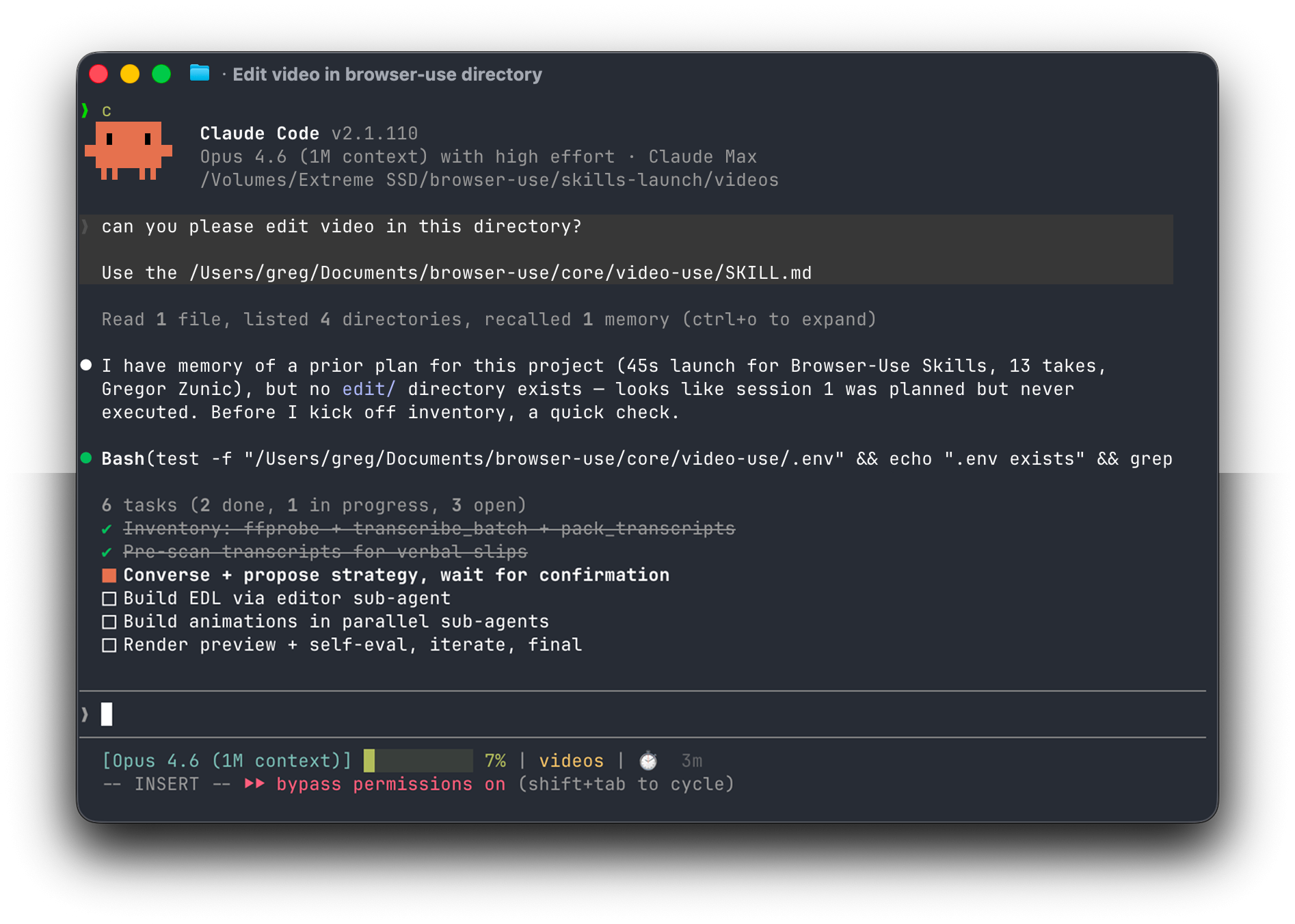
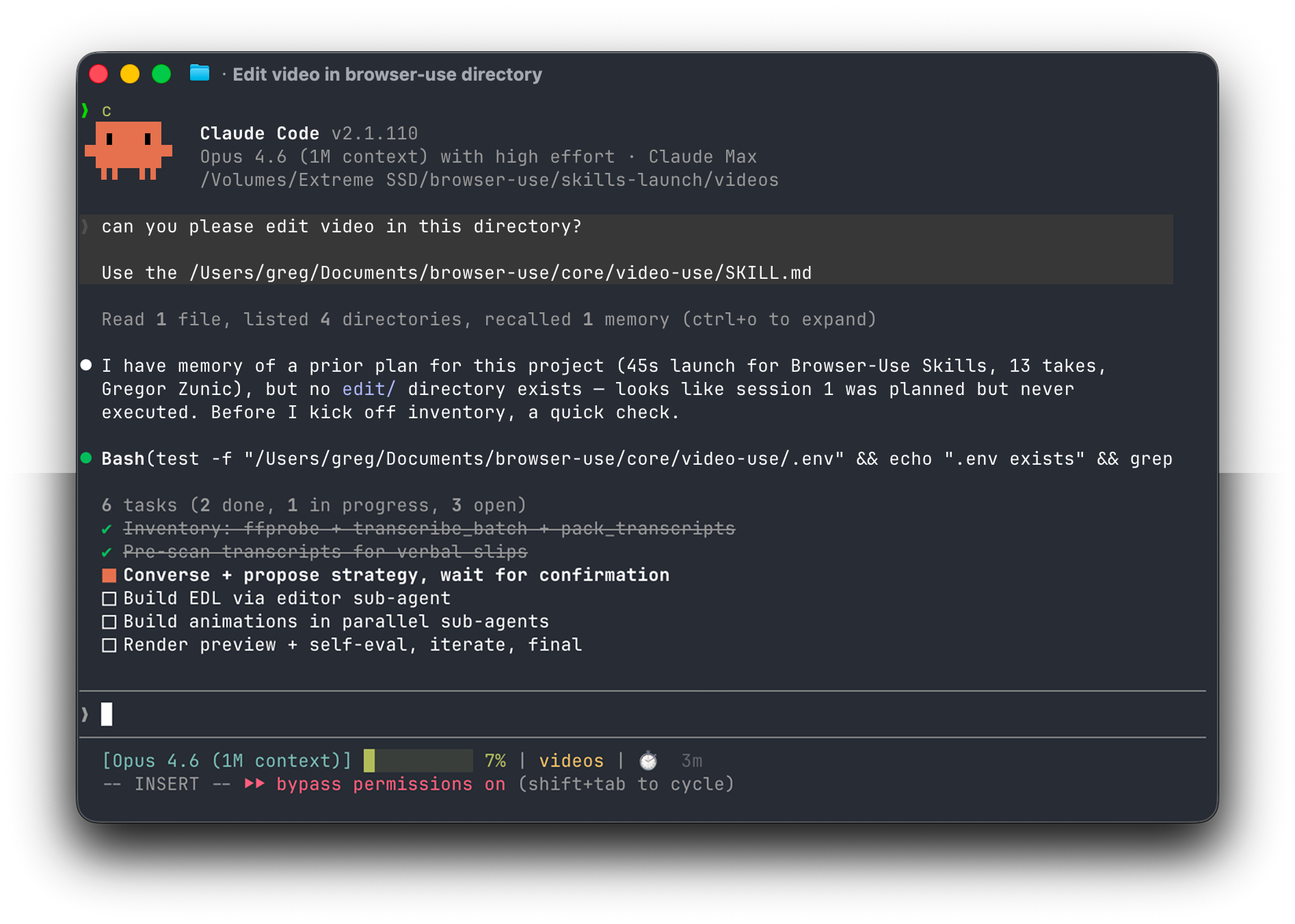
The author of the 'AI Marketing | Zhenya Korzhavin' channel showed a pipeline in which coding agents Claude Code, Codex, and Hermes edit vertical videos from raw phone takes. Instead of a timeline, the model reads a transcript with word-level timestamps, while rendering is left to ffmpeg and headless Chrome. The entire chain — video-use, HyperFrames, and add-zooms — is assembled from open components without SaaS subscriptions; you can try it today, but the quality of cuts is unstable, and the author advises finishing the first videos by hand.
What happened
The core of the setup is video-use from the browser-use team: a repository with 26.3k stars on GitHub and an MIT license. The LLM does not watch frames: it reads an ElevenLabs Scribe transcript with word-level timestamps, which takes up about 12 KB of text instead of roughly 45 million tokens of frames, cuts pauses and filler words, selects good takes, adds subtitles, and before showing self-checks every cut via timeline_view. The chain also includes HyperFrames from HeyGen, which converts HTML/CSS/GSAP animations into deterministic MP4 via headless Chrome and ffmpeg (52.6k stars, Apache 2.0, active commits dated 2026-09-23), and add-zooms from louisedesadeleer, which adds punch-zooms to accent words based on an OpenAI Whisper transcript via ffmpeg zoompan (11 stars). The post separately mentions the new Hypit: 15.1k stars on GitHub and release v0.2.13.
Context
The key to understanding the setup is a change in data representation. In the conversational 'talking head' format, the meaning of the video is almost entirely encoded in the speech, so a transcript with word-level timestamps serves as a cheap text proxy instead of frame-by-frame viewing: the editing task is compressed by orders of magnitude, and this is what makes agentic editing feasible on today's models. The technique has a downside: the agent does not see the visual composition of the frame and judges the material only by the speech, so only a human can notice visual editing mistakes. The pipeline pattern itself is also architecturally interesting, in which a language model makes non-deterministic decisions, while rendering and result control are moved to a predictable layer. Stars on GitHub measure community interest, not editing quality, and in the presentation of such setups they create a false sense of maturity of each component.
Why this matters for the industry
For the industry, editing conversational video is turning into a pipeline on top of coding agents, and this changes the economics of post-production: the cost of assembling a vertical video drops to the level of hours of setup plus API payments, because the video-use, HyperFrames, and add-zooms chain is assembled from open skills without SaaS subscriptions. Equally important is the portable framework: the scheme in which the model makes editing decisions, rendering is performed deterministically, and every cut passes a self-check is suitable for agentic pipelines beyond editing. Hypit works separately: it templates other people's videos, transferring structure, subtitles, effects, and B-roll to new material, which cheapens mass production of similar content; the author directly calls this mode 'heaven for AI sloppers' and does not recommend using it. For startups, this is the commoditization of post-production.
Why this matters for users
You can try the pipeline today: clone video-use, install ffmpeg, insert an ElevenLabs API key, and drop takes into a folder, while add-zooms is connected as a Claude Code skill with the ./install.sh command. The practical value is rough assembly of conversational videos with subsequent manual finishing: the agent makes cut decisions itself, the quality is unstable, so it is more reasonable to edit the first videos by hand. Separate caution is needed with Hypit: it is a factory for cloning other people's videos, not a tool for developing your own style.
What is still unknown / limitations
Claims of primacy are not confirmed by anything: the phrase 'first assembled as code' is not supported in the sources, there are no benchmarks confirming the capability claims of the setup — this is an engineering composition of known techniques like transcript proxy, deterministic rendering, and self-check, not a new model. By the stated signs, this is a demonstration, not a production system. The figure of $1.15 for cloning a 20-second video is the only demo point from the Hypit v0.2.13 release, not a measurement: the cost on long videos and other material is unknown, as is the speed of work and consumption per minute of video. The stability of cut quality is described only by the author's assessment, not a metric, and the question remains open whether the pipeline will withstand materials more complex than the conversational format.
Sources
- GitHub - browser-use/video-use: Edit videos with coding agents
- GitHub - hypit-ai/hypit: Clone any viral video with AI agents (release v0.2.13)
Author
Look at AI, editorial team