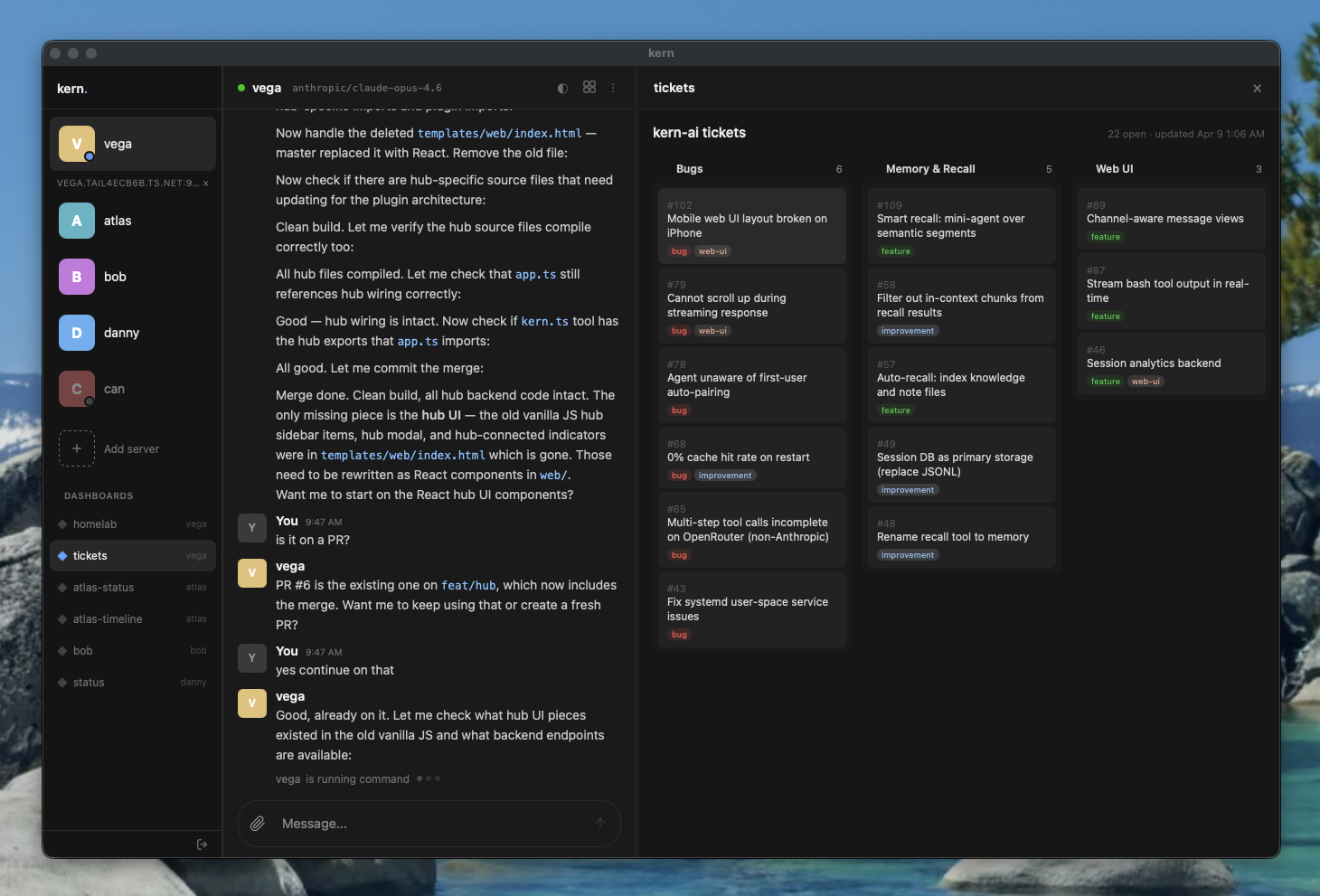
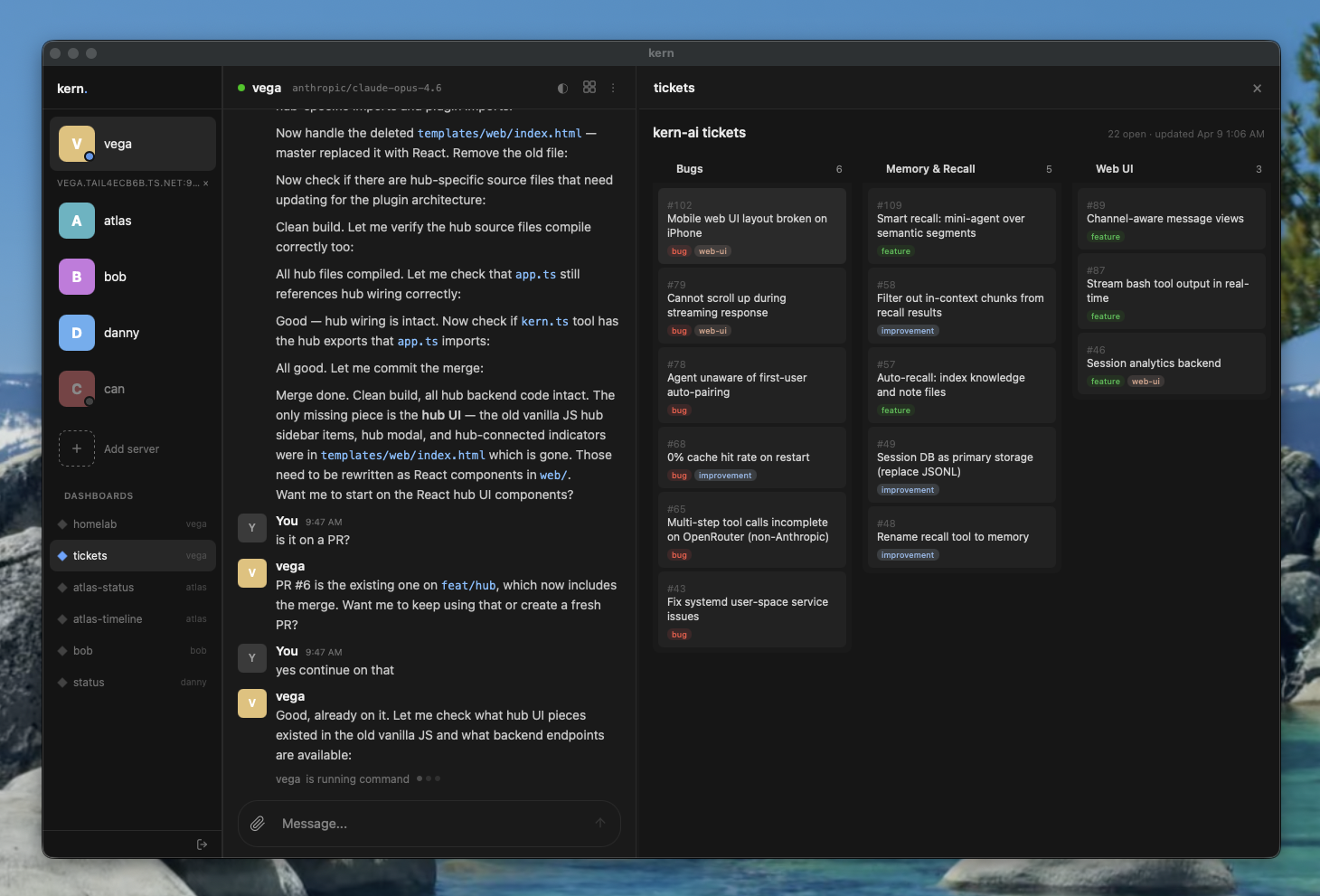
On Hacker News in the Show HN section, kern (npm package kern-ai) is presented — an open-source runtime for personal LLM agents by developer oguzbilgic. All interfaces — TUI, web UI, Telegram, Slack, Matrix, Nostr, and IRC — work with one persistent session, and the agent's memory is built on the agent-kernel pattern: conversations are compressed into a hierarchy of summaries L0→L1→L2 and are available for semantic search through the recall tool. The project is written in TypeScript, distributed under the MIT license, and works locally, including in a completely free mode via Ollama.
What happened
Developer oguzbilgic published the kern runtime and announced it on Hacker News in the Show HN section; on npm under the name kern-ai, version 0.41.0 dated September 23, 2026 was released. Each agent message is equipped with metadata about the author, channel, and time, and the agent itself can collect HTML dashboards in the form of files dashboards//index.html and data.json, generate read-only sub-agents through the spawn tool, run background bash commands, and install skills according to the AgentSkills specification. Models are connected via OpenRouter with the default variant anthropic/claude-opus-4.6, directly via Anthropic or OpenAI, or locally via Ollama. In addition to npm, the project is available as a Docker image ghcr.io/oguzbilgic/kern-ai. External signal is still minimal: the Hacker News post has one point and no comments, the GitHub repository has about 69 stars.
Context
kern formalizes a shift in perspective in agent development: instead of a chatbot that responds to a separate request, an agent is proposed as a long-running process that lives in one session across all of the user's messengers. The central engineering problem of such a scheme is maintaining context over tens of thousands of messages with a limited context window, and here it is solved by hierarchical compression: dialogues are divided into segments by topic and compressed into multi-level summaries, to which one can return via semantic search. The set of techniques itself is not new — dialogue segmentation, summary hierarchy, and semantic recall are already described in the literature on agent memory; the novelty of kern is that these patterns are collected into one working runtime. At the other pole of the market, a similar direction is being developed by proprietary stacks like OpenAI Operator and Anthropic Agent SDK, but they work on vendor infrastructure, while kern implements the approach of "agent as a git repository with memory" on the users' own machines.
Why this matters for the industry
For the industry, the release is indicative as a market signal: the layer of long-term memory for agents is quickly being commoditized, and the author released the agent-kernel pattern under the MIT license. After this, it is no longer possible to sell "an agent that remembers everything" as a separate product — startups will have to defend themselves with vertical solutions, not with memory itself. For builders, kern is interesting not as a finished product, but as a working example of the UX pattern "one long-running process with a persistent session across many channels": the practical value today is in reproducible architectural elements that can be transferred to their own projects. If independent measurements of the quality of hierarchical compression appear, the L0→L1→L2 scheme with recall can become a standard building block for open-source agents, and the open implementation will become a forkable point for studying and comparing trade-offs with proprietary stacks.
Why this matters for users
If you have long wanted a personal agent that remembers everything you wrote to it in Telegram and continues the same conversation in the terminal, kern is installed with two commands (npm install -g kern-ai; kern init) or launched via a Docker image with a ready-made Telegram bot. Everything works locally: you can connect paid models via OpenRouter, Anthropic, or OpenAI, or completely for free via Ollama. The agent can draw dashboards with its own data in the form of ready-made HTML pages and data.json files. For those studying prompt engineering of long-running agents, it is useful to open templates/KERN.md: there you can see how the author solves user identification with KERN-XXXX codes, stores memory in the USERS.md file, and disciplines behavior with the NO_REPLY rule.
What is still unknown / limitations
The key claim of the project — maintaining context over long horizons — remains unevaluated: there are no measurements of the quality of information retention, no comparison with baselines like a full context window, flat RAG, or other memory schemes, no published methodology. Each level of compression potentially loses details, and without data it is unknown how much exactly. There are no measurements of recall search latency and token cost estimates for long sessions, and the rules from templates/KERN.md are prompt heuristics, not guarantees of model behavior. There is no external verification at all, so in a production environment with SLA, load, and other users, there is no reason to rely on the project yet.
Sources
- GitHub - oguzbilgic/kern-ai: Agents that do the work and show it
- kern-ai/templates/KERN.md at master (system prompt template)
- kern-ai on npm — package kern-ai, latest 0.41.0 (published 2026-09-23T01:13:29Z)
Author
Look at AI, editorial team