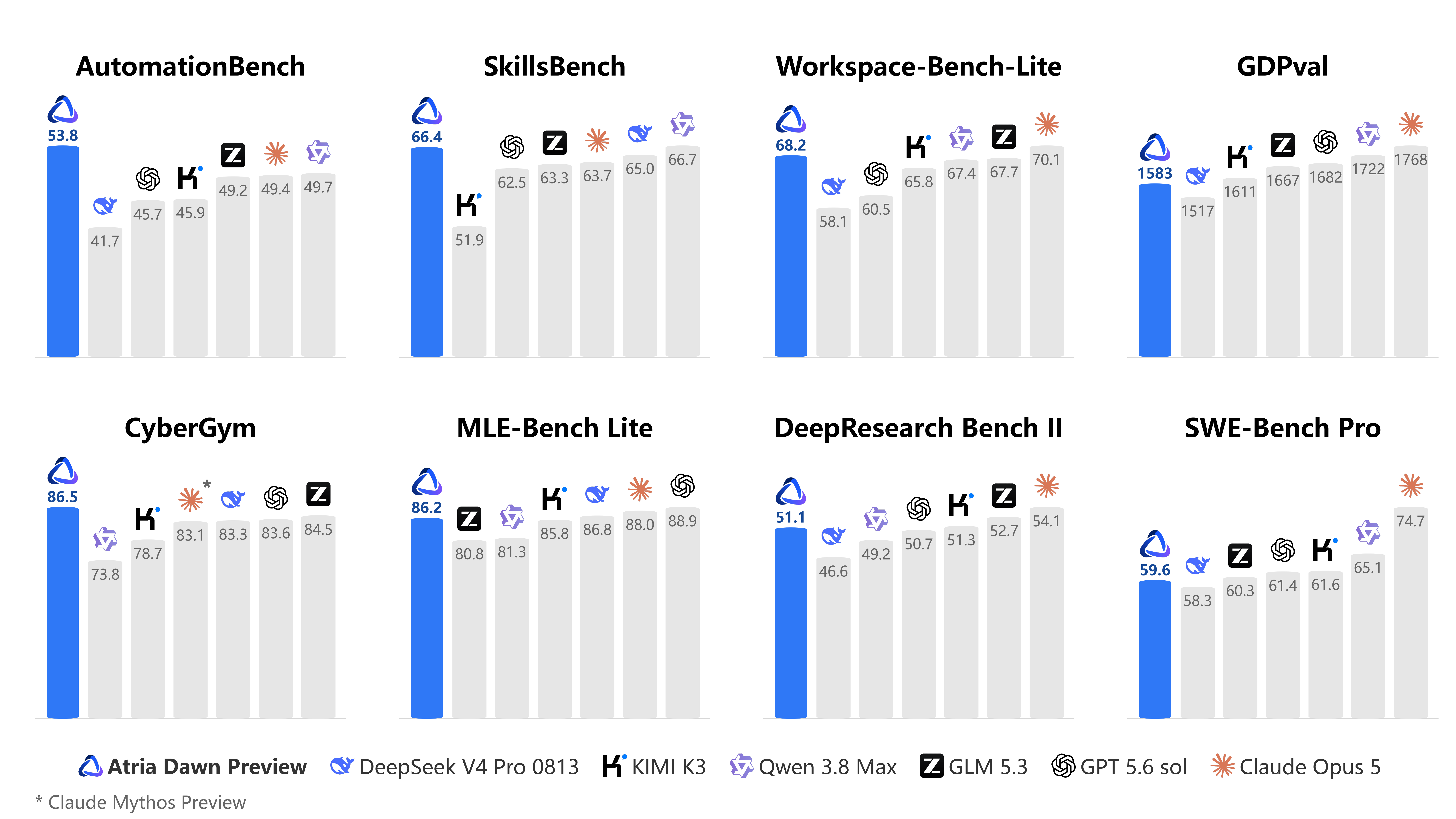
Shanghai AI Laboratory (Shanghai Artificial Intelligence Laboratory) released the Atria Dawn Preview agentic model: open weights under the MIT license, an API in two regions, and ready-made configs for Codex, Claude Code, and Kimi Code. The key difference from familiar agentic stacks is that agentic skills like multi-step planning, tool use, and recovery from failures are baked directly into the model's weights, not in an external framework; according to the developer's official figures, the model leads in search, tool-use, and cybersecurity benchmarks.


What happened
The model is built on GLM-5.2: 744B parameters, MoE architecture with 8 experts per token, 256K token context. Atria Dawn Preview handles open-ended tasks through the full cycle of "analysis → plan → code → experiment → error analysis → retry," with the correctness of the result at each step verified by external signals — tests, metrics, file state, and sources — and experience from such runs is baked into the weights via the Verifiable Experience Pipeline. According to the official benchmark table in the README, the model leads in BFCL v4 (77.0 vs. 71.4 for DeepSeek V4 Pro 0813 and 69.1 for KIMI K3), AutomationBench (53.8), CyberGym (86.5), DeepSearchQA (96.0), and BrowseComp (92.5), while on SWE-bench Pro (59.6) and Terminal-Bench 2.1 (78.3), Claude Opus 5 is ahead with 74.7 and 90.2. Input is text-only: images and PDFs are rejected by the API with a 400 error "is not a multimodal model." The technical description of the approach is published in the paper "Atria Dawn: The Dawn of Agentic Superintelligence" (arXiv 2609.15818).
Context
Until now, agentic behavior was most often assembled in an external framework: an orchestrator, skill libraries, and a runtime around the model handled planning, tool calls, and error recovery. Atria Dawn's bet is the opposite — skills are formed by training on verifiable tasks and transferred into the weights themselves, rather than living in the wrapper. The benchmark profile points to exactly this domain-specific approach: growth is concentrated in agentic scenarios (BFCL v4, CyberGym, BrowseComp, DeepSearchQA), while on general coding the model trails Claude Opus 5, meaning we are looking at an agentic fine-tune, not a universal leap. The second part of the context is positioning: Shanghai AI Lab offers the model not as a closed product, but as a swappable engine under already familiar CLI tools, with ready-made configs for Codex, Claude Code, and Kimi Code, and an API immediately available in international and Chinese regions.
Why this matters for the industry
An open MIT-licensed agentic model with 744B MoE parameters is the commoditization of the agentic layer: assembling agentic scenarios becomes cheaper, and startup defensibility shifts from "orchestration" to data, distribution, and vertical integration. The openness here is genuine, not cosmetic: the weights are published publicly, deployment is supported in standard runtimes SGLang and vLLM, so independent reproduction of the evaluation is technically possible — a rare case where a loud claim can be verified without contacting the developer. If independent labs confirm at least some of the figures (BFCL v4, CyberGym, BrowseComp), pressure on closed agentic models like Claude Opus 5, GPT 5.6, and GLM 5.3 will increase, and transferring skills into the weights will become a mainstream training method in open-source. The pattern of "swappable agentic engine plus connectors to third-party CLIs" turns model choice into a product feature with A/B switching of engines by task type.
Why this matters for users
You can try the model today. The quick path is the API console at api.atria-asi.ai with a /v1 endpoint and a separate region for China: connecting to Codex (CLI ≥ 0.154.0), Claude Code, or Kimi Code (≥ 0.43.1) using the ready-made examples from the README, while for Codex you must declare "input_modalities": ["text"] in the model catalog, otherwise image attachments will not pass. Local deployment is via SGLang (v0.5.13.post1+) or vLLM (v0.23.0+); BF16 and FP8 versions are on Hugging Face (internlm/Atria-Dawn-Preview) and ModelScope. FP8 reduces memory requirements, but 744B MoE still requires a node with 8 high-end accelerators plus headroom for the KV cache, so self-hosting is an option for teams with a GPU farm. A realistic first product is a text-first agentic scenario: research with verifiable sources, reports from documents, automation with result verification via tests and metrics; scenarios with screenshots, UI automation, and PDF processing in their original form will not work.
What is still unknown / limitations
All benchmark figures are the developer's own data from the official report, independent runs are not yet available, so the lead in BFCL v4 and CyberGym should be re-verified on your own tasks. The available sources (arXiv 2609.15818, README, model card) do not include ablations comparing Atria Dawn Preview with the base GLM-5.2, so the contribution of the Verifiable Experience Pipeline to the result is not quantitatively established. For production, there are no public API prices, SLAs, or latency data yet; the preview status means that a stable release with confirmed third-party evaluations is still far off.
Sources
- Atria Dawn: The Dawn of Agentic Superintelligence (arXiv 2609.15818)
- GitHub repository atria-asi/Atria-Dawn-Preview (README, evaluation table, deployment guides)
- Model card internlm/Atria-Dawn-Preview on Hugging Face (MIT license, FP8 version)
- Official Atria project website
Author
Look at AI, editorial team