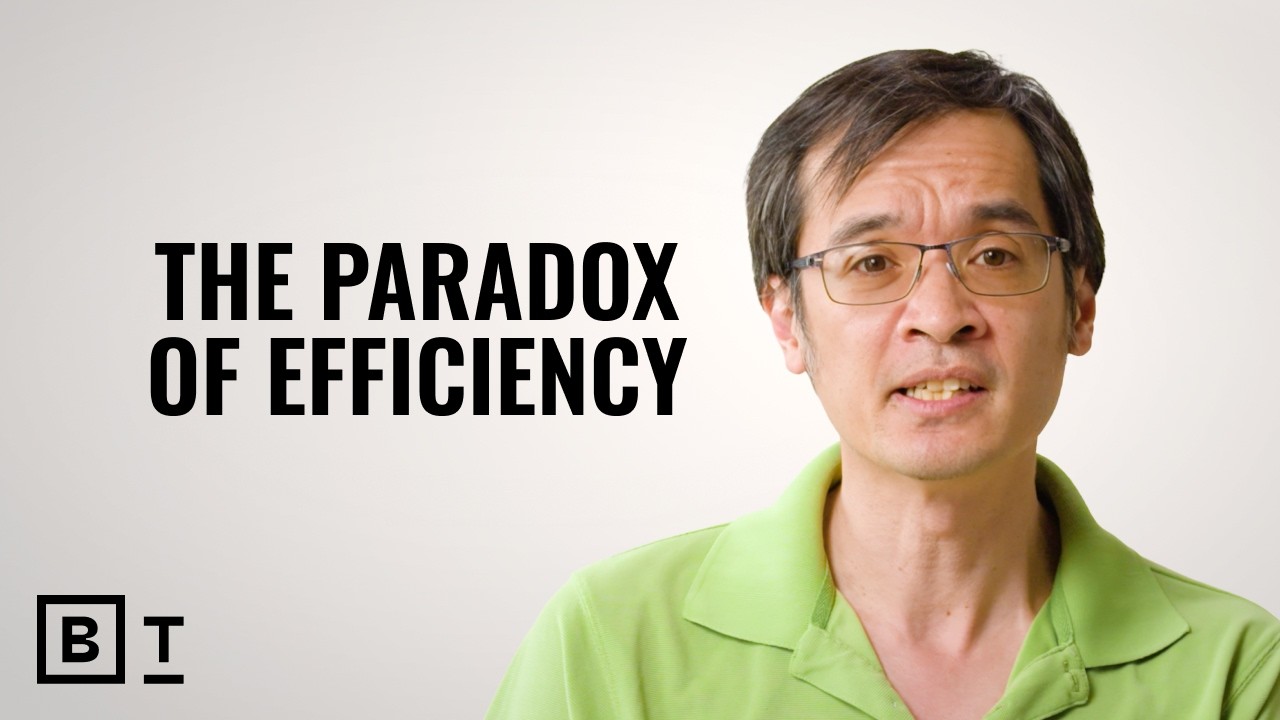
Big Think Clips published a 30-minute interview, 'The paradox at the heart of AI and science,' with Terence Tao — Fields Medalist and UCLA mathematics professor — on September 3, 2026. Key thesis: AI already conducts experiments, analyzes data, and generates proofs, but this stream of results does not automatically translate into human understanding of science. Tao explains where the gap between the speed of producing scientific artifacts and actual knowledge comes from, and what it means for researchers and developers.


What happened
The video was released on the Big Think Clips YouTube channel, lasts about 30 minutes, is recorded in English, and includes subtitles. This is an interview, not a product launch: there is no API, pricing, or latency data, so the publication does not create a direct market effect. In terms of content, Tao did three things. He broke down machine learning into two basic mechanisms: regression is fitting a curve to data, and a language model is predicting the next word based on the pattern 'Roses are red, violets are ___'; both mechanisms imitate hidden patterns without grounded understanding, so a plausible but incorrect LLM answer is not a random glitch, but a direct consequence of the architecture. He defined a productive mode of working with such models: an LLM as an idea generator of a 'tipsy polymath,' which is only useful with mandatory verification cycles. And he unfolded the central comparison: traditional research is like a hike, where wandering brings side discoveries and groundwork for future researchers, while AI is like a helicopter, delivering you to the result by bypassing the process.
Context
The resonance is logical: research automation has turned from an exotic idea into a working practice, and the question has shifted from 'can AI help science' to 'what is lost when it does it instead of a human.' Tao builds his position on the asymmetry of breadth and depth: AI is strong in brute force and can close 50 out of a thousand tasks, especially where key ideas are hidden in unpopular literature or where established opinion is wrong, while a human is strong in depth on a small number of problems. Hence his formulation of the main open challenge: to combine both modes into a single proof cycle, where machine generation and verification are complemented by human interpretation of the result. The weight of the position is added by the speaker's status: the Fields Medal and UCLA professorship make this opinion authoritative for the scientific community, and the tone of the conversation is technically sober, without hype and without apocalypticism.
Why this matters for the industry
For the industry, the interview formulates a specific risk mechanism, not an abstract warning. If automated scientific pipelines optimize output metrics — the number of papers, experiments, proofs — rather than understanding, science will get models overfitted to 'successful-looking' artifacts, and a stream of results that the community cannot digest in time; Tao himself calls this 'proof indigestion.' His historical illustration with Kepler shows the price of such optimization: a model that was correct in the long run could have been discarded due to worse-looking short-term predictions. An architectural principle for builders can also be extracted from the interview: an LLM remains a candidate generator, not a source of ready-made truth, so a reliable system is built as generation plus mandatory verification, and the scaling limit becomes the throughput of verification, not generation. According to Tao, candidate generation and machine verification are already being automated, but integrating the result into human knowledge is not yet, so the deficit shifts from generation tools to filtering, ranking, and digest systems. A practical step for product teams is to build an explicit 'generation — verification — integration' loop into PRDs, UX, and workflows: to move verification out of the fine print into a separate step and not to optimize evals for volume or 'successful-looking' results.
Why this matters for users
This video gives the reader several practical things at once. It is half an hour from one of the strongest mathematicians of our time, who explains the workings of ML and LLMs 'on the fingers' — from curve fitting to next-word prediction — in English with subtitles and free on YouTube. The reader also gets a filter for news: any statement about an 'AI scientific discovery' is checked with two questions — was there verification and was the result integrated into human knowledge, or are we just looking at plausible candidates. Finally, a ready-made vocabulary for debates about AI is in hand: 'hike versus helicopter' explains why a result without a process does not create understanding, 'tipsy polymath' — why a bot cannot be let go without verification, and 'breadth versus depth' — where machine brute force is really stronger than a human. There is nothing to install or configure: the value is not in the tool, but in a sober perspective without hype.
What is still unknown / limitations
First of all, this is an expert opinion in a video conversation, not a study with data and not a product launch, so the publication has no immediate market consequences. A common compression of Tao's conclusion to 'the bottleneck is verification' distorts the source: machine verification of candidates is precisely being automated, and what remains unautomated is the integration of the result into human knowledge, and substituting one term shifts the entire statement. The '5% of 1000 tasks' example is illustrative, not a benchmark result; expectations of demand for digest tools and eval tooling in the coming months and years are interpretations, not statements from the interview. In addition, the detailed facts of the conversation partially rely on a third-party retelling by youtubesummary.com, so the primary English video should be watched in full to separate Tao's direct quotes from the retelling.
Sources
- The paradox at the heart of AI and science | Terence Tao (YouTube, Big Think Clips)
- Video Summary - The paradox at the heart of AI and science | Terence Tao (youtubesummary.com)
- [The paradox at the heart of AI and science – Terence Tao [video] (Hacker News)](https://news.ycombinator.com/item?id=49768111)
Author
Look at AI, editorial team