
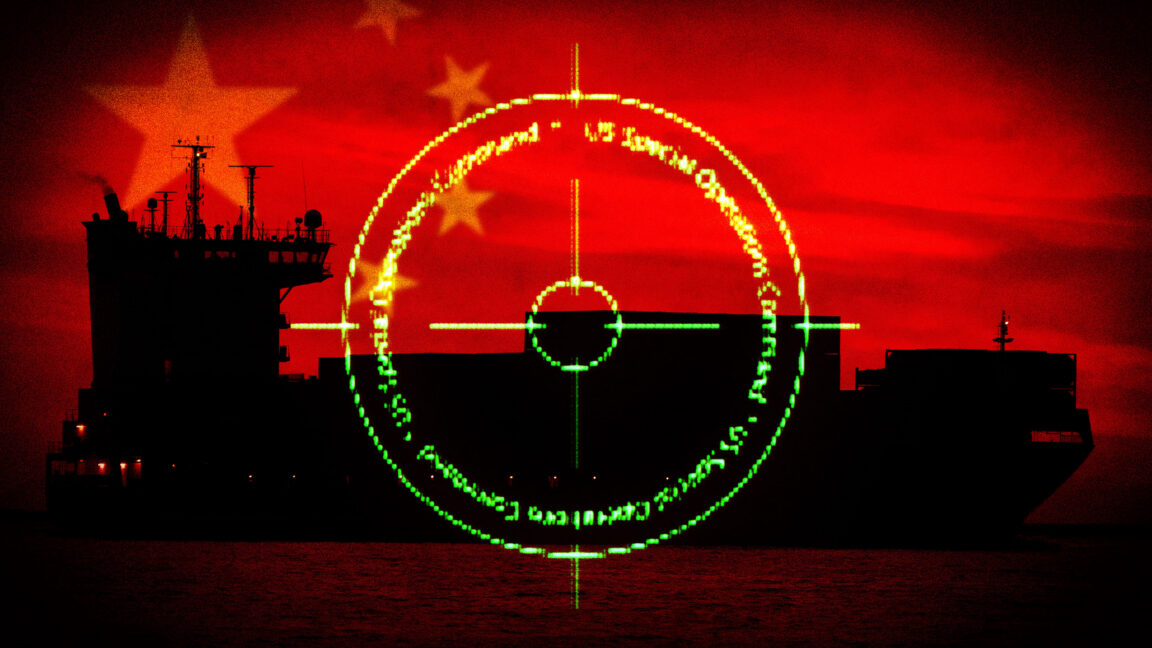
In the spring of 2026, during the war with Iran, US military officials began preparing to intercept a Chinese cargo ship in the Middle East, believing an intelligence report that the ship was carrying components for a nuclear weapons program. The report turned out to be entirely fabricated: its basis was a chatbot output that mixed open sources with secret signals intelligence. An armed boarding team and military aircraft were stopped at the last moment. CNN reported the incident on September 18, 2026, in an exclusive by correspondents Katie Bo Lillis and Zachary Cohen.

What happened
According to CNN, it all started with a routine request: an analyst from the US Special Operations Command Pacific (US Special Operations Command Pacific, Hawaii) asked a chatbot to analyze data from a cargo manifest. The model mixed open sources with secret signals intelligence (SIGINT) and mistakenly “identified” the cargo as components for a nuclear weapons program. The error then became entrenched: the analyst used the same AI to format the conclusion into a standard intelligence report, and the document circulated through military structures. The military began preparing the operation: an armed boarding team and military aircraft were activated. The operation to intercept the ship of a nuclear power was held back only at the last moment. CNN sources called the report “entirely false” and said it “nearly started a war.”
Context
The incident must be understood against the backdrop of how AI is being deployed in the Pentagon: in a decentralized manner and without a single set of rules. Different agencies and commands use different tools, and there are no unified standards for verifying AI-generated information. In January 2026, Defense Secretary Pete Hegseth presented the Artificial Intelligence Acceleration Strategy, which deliberately puts models “in the hands of three million military and civilian personnel at all levels of access.” Models are already being used in the US military for intelligence analysis, target selection for strikes, logistics, and budgeting, while the reliability of available tools, according to CNN, “varies widely.” From an engineering standpoint, the failure itself is typical: in retrieval systems, mixing heterogeneous sources without marking their origin is an expected failure mode, not an exotic case. Speed pressure adds to the risk: according to a CNN source, “AI allows you to arrive at a bad idea faster,” meaning that accelerating generation without a proportional acceleration of verification reduces the number of checkpoints per unit of content, and uncritical trust by some analysts turns a single query into a high-stakes operation.
Why this matters for the industry
For the industry, the case became a public precedent of a cascading LLM pipeline failure in critical infrastructure: a raw chatbot output without source attribution and a mandatory human control point became an official document and entered the military decision-making pipeline. The CNN material will likely accelerate internal audits and discussions of protocols for verifying AI-generated information in the US defense sector. AI providers in sensitive domains will face questions about the verifiability of outputs: line-by-line references to sources, “AI-generated” labeling, logging of prompts and responses, and an immutable audit trail are already feasible now, without waiting for new models. Accordingly, demand is shifting toward the verification layer: provenance and attribution tools, uncertainty assessment and hallucination detection, cross-checking by a second model or deterministic rules. Over the next few years, formalization of requirements is likely: mandatory hallucination evals for domain tasks, source tracing for each output, separation of contexts by access levels, and a second verification loop for reports that enter operational decisions; if incidents continue, the market may split into auditable and non-auditable deployments.
Why this matters for users
For readers, the story is a clear argument to re-verify chatbot conclusions against primary data, especially when the model combines sources that are closed to you: such a combination cannot be verified independently, and the cost of error here was measured not in corrupted text but in the risk of a collision between nuclear powers. An officially looking document does not guarantee the quality of its content: as the case shows, a standard intelligence report form could have been entirely built on a hallucination. The incident suggests simple habits: ask the model to explicitly indicate the origin of each fragment, separate facts from sources you can open from data you have not seen, and do not turn a chatbot draft into an official or public document without independent verification against primary data.
What is still unknown / limitations
The story relies on anonymous CNN sources, and the identity of the chatbot — a commercial tool or a government system — remains undetermined. The case is confirmed as a single incident, so broad conclusions about demand for a verification layer, future regulations, and market consequences remain plausible interpretations, not established facts.
Sources
Author
Look at AI, editorial team