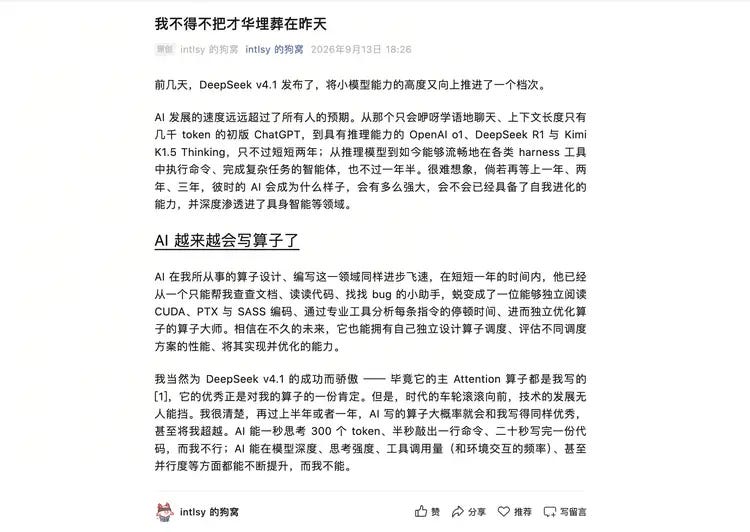
DeepSeek engineer Liu Shengyu, who wrote the core attention kernels for the new DeepSeek V4.1 model, published a viral essay titled “I Have No Choice but to Bury My Talent in Yesterday” on his public WeChat account. In his observation, over the course of one year, AI has grown from a documentation search assistant into an agent that independently reads GPU code and optimizes software operators, and in a 6–12 month horizon, according to his forecast, will write such kernels no worse than he does. The post sparked lively discussion on Reddit and Hacker News and intensified the public debate about the pace of the race to superintelligence.
What happened
Liu Shengyu, an engineer at the Chinese lab DeepSeek, published the essay post “I Have No Choice but to Bury My Talent in Yesterday” on his public WeChat account. The text spread quickly: on Reddit, a discussion opened in r/artificial under the title “A DeepSeek engineer just said the thing I've been feeling about AI for months,” and Hacker News picked up the discussion as well. In the essay, the author describes a year-long leap in his own workflow: AI has transformed from a documentation search assistant into a system that reads GPU code at the CUDA, PTX, and SASS levels, analyzes stall time by instructions, and autonomously optimizes software operators. It was Liu who wrote the core attention kernels for the DeepSeek V4.1 model, and his authorship and the context of the viral post were confirmed by specialized publications, including Business Insider.
Context
The value of the document lies in the fact that it comes not from an analyst, but from a frontier engineer who was responsible for the most performant components of the current model: attention kernels largely determine the speed of a transformer. Liu explains why he consciously continues to accelerate the automation of his own craft: “if the revolution is inevitable, I prefer to revolutionize myself.” He compares himself to a master knitter whose manual work is taken away for the speed of the machine. The text also contains political statements: distrust of Anthropic and OpenAI as possible AGI leaders and a harsh historical comparison about who will first gain decisive superiority — this is the author's position, not a technical argument, but it is precisely this that added virality to the post. The publication fits into the public discussion about the pace of the race to superintelligence, which began after Jacob Coxon's (ex-Anthropic/OpenAI) departure, with the participation of Dario Amodei, Sam Altman, and Elon Musk.
Why this matters for the industry
For the industry, this is a rare primary signal from the frontier: agentic development, according to the observation of an engineer actually working on a frontier model, has reached the most scarce layer of system optimization — performant code for GPUs. Demand, according to his forecast, is shifting from “those who write high-performance kernels” to “those who make AI write them faster.” If the observation is at least partially correct, in a 6–12 month horizon, public reproducible benchmarks of agentic kernel generation should be expected — comparisons of an agent and a human on fixed CUDA/PTX/SASS tasks, which do not currently exist and would become a verifiable marker. If the trend is confirmed, manual optimization will shift to a niche of verification, critical paths, and exotic architectures, and the cost of serving frontier models will begin to fall faster. However, there is no immediate technical shift: the essay is not a product, it contains no API, benchmarks, or cost and latency data, so its current impact is discursive.
Why this matters for users
For readers, the post gives an honest inside look at a Chinese frontier lab on what it is like to build technology that will likely soon surpass you in your favorite job. A specific practical takeaway for developers: restructure the workflow for orchestration — set tasks for agents, check their code, and develop an understanding of the entire stack from hardware to serving, not just manual coding, because it is precisely these skills, according to the author's forecast, that demand is now shifting to. A separate reason to follow the development of events is the question of open access to advanced models: Liu's position strengthens the open-weights camp, and how labs resolve this will determine what opportunities will be available not only to corporations but also to independent developers.
What is still unknown / limitations
The main caveat: the figure “6–12 months” is a personal extrapolation by one engineer without metrics, without specifying the tasks on which the agent's level was measured, and without comparison with a human on a fixed set of kernels, so such precision creates false certainty. The essay is not a publication with methodology: it contains no API, benchmarks, or cost and latency data, so there is no immediate product or tool behind this signal. The statement about the shift in labor market demand is the author's assessment, not a measured fact: there is no data on the actual scale of this process in the sources. The political and ethical statements in the text do not carry evidentiary weight regarding the capabilities of the models. Finally, all observations remain the personal experience of one engineer: authorship and context have been confirmed externally, including by Business Insider, but the assessment of the pace is currently supported only by the author's word.
Sources
- DeepSeek Engineer's Viral Post Offers Glimpse Inside China's AI Race — Business Insider
- Why a DeepSeek Engineer Is Helping AI Replace Him — Geopolitechs
- Discussion: A DeepSeek engineer just said the thing I've been feeling about AI for months — Hacker News
- Discussion in r/artificial: A DeepSeek engineer just said the thing I've been feeling about AI for months — Reddit
Author
Look at AI, editorial team