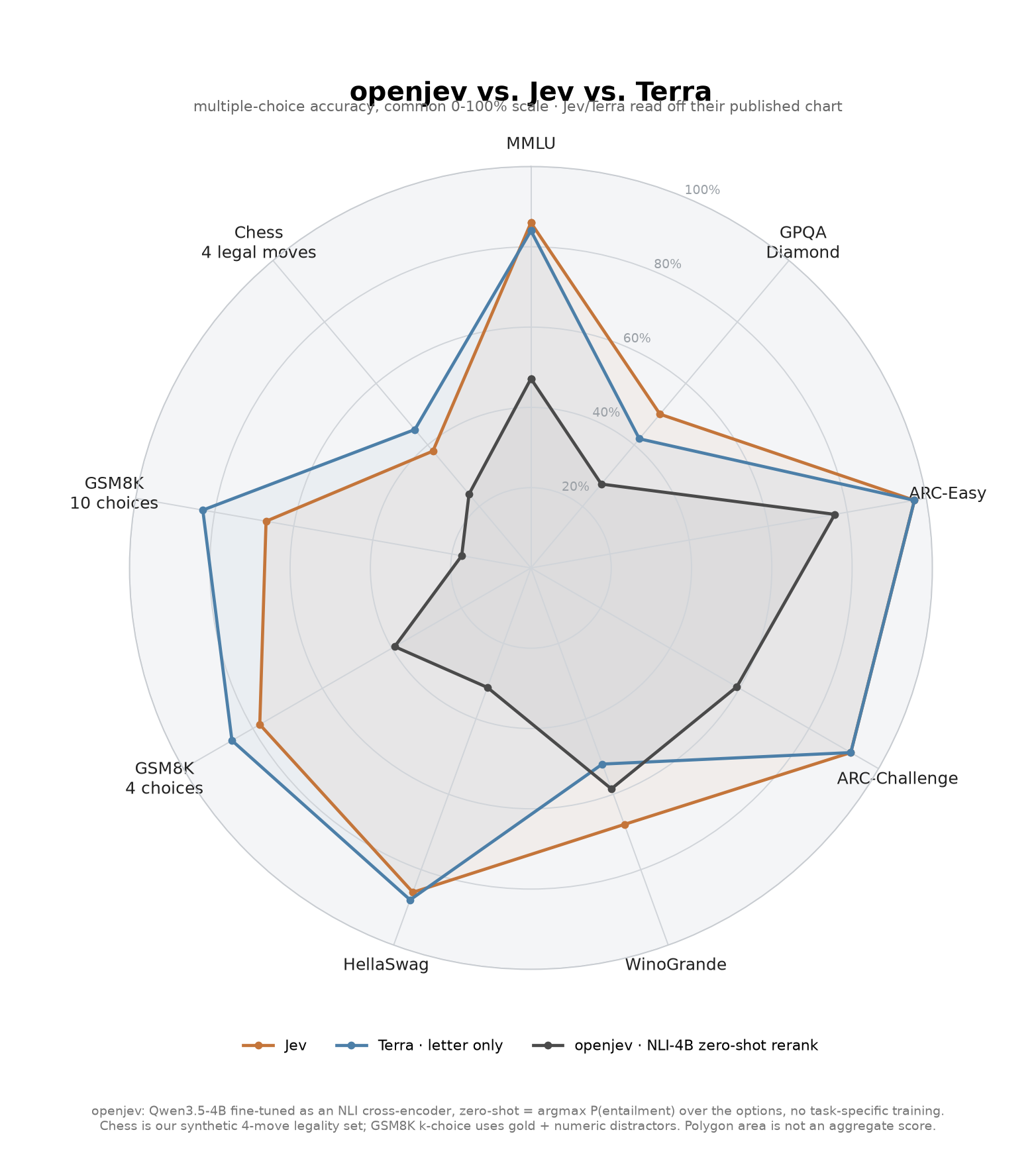
Author AlexWortega (Alexander Wortega) released the openjev model on Hugging Face: a ready-made Qwen3.5-4B decoder fully fine-tuned as an NLI cross-encoder. The model does not generate answers but checks statements: it reads a 'premise — hypothesis' pair and outputs probabilities that the hypothesis follows from the premise, contradicts it, or is neutral. Without a reference, such an encoder reranks answer options; with a reference, it checks them against the correct answer; and without any additional training, it acts as a game agent policy in Flappy Bird and Doom. Weights are open under MIT along with training code and raw results, but all figures are currently author-reported and await independent verification.

What happened
The openjev release by author AlexWortega (Alexander Wortega) was published on Hugging Face: the Qwen3.5-4B decoder was fully fine-tuned for the NLI verification task in the Qwen3_5ForSequenceClassification class, and for a 'premise — hypothesis' pair it returns probabilities for three classes: entailment (follows), contradiction (contradicts), and neutral. In rerank mode without a reference, the model scores 0.472 on MMLU and 0.769 on ARC-Easy; in grading mode with a reference — 0.974 on MMLU, 0.996 on GSM8K, and 0.997 on a chess task of choosing a legal move from four options. The same encoder without any task-specific training is used as an agent policy: Flappy Bird is cleared perfectly, 28 out of 28 pipes versus 24.5 for the heuristic oracle, in approximately 55–65 ms per decision with flash-linear-attention kernels; in ViZDoom on the Defend the Center scenario, the model scores 11.0 frags out of 18.8 for the oracle when playing from text state and 5.2 when playing directly from pixels via the Qwen3.5 vision tower. Along with the weights, modeling_openjev.py with predict, rerank, and grade helpers, training code train.py, and raw JSON for all tables were published.
Context
The approach itself is not new: NLI cross-encoders have long been used as cheap verifiers and rerankers, and the point of comparison in the openjev card is a typical representative of this family — dleemiller/ModernCE-large-nli, a compact ModernBERT with 395M parameters. The difference is that the classification head was trained on top of an already ready large decoder, rather than training a small encoder from scratch, and one set of weights serves multiple scenarios at once. Metrics should be read with a correction for task type: grading is discrimination of an 'answer — reference' pair, a priori an easier task than generation, so values of 0.97–0.99 are expected and do not mean that the 4B model 'knows' the correct answers; more meaningful is the gap between rerank without a reference (0.472 on MMLU) and grading with a reference (0.974). The quality of the artifact itself is above average for a viral release: the card separates zero-shot results from non-zero-shot MLP probes, moved to an appendix, making the measurement verifiable rather than marketing.
Why this matters for the industry
For the industry, the meaning lies in the economics of calls: one forward on a pair takes about 57 ms, while rerank and moderation via LLM calls are more expensive and slower, so a 4B cross-encoder is a price arbitrage in cost-sensitive parts of pipelines. The same set of weights covers reranking of answer options, grading against a reference in evals, and an agent game policy via argmax P(entailment), showing the primitive's move beyond purely text tasks. A caveat is significant: the guardrails and content filter scenario is not confirmed by any measurement in the available materials and remains a hypothesis, not a result. If independent reproductions confirm the zero-shot figures, an NLI head on top of a ready decoder could become a standard cheap component of production pipelines and trigger a wave of reproductions on other bases and sizes, especially at 0.5B–1.5B, where the economics against LLM calls are even more favorable; in the long term, the release argues for a 'generator — verifier' architecture, where a large generator proposes options and a medium cross-encoder cheaply selects and validates them against a reference or rules.
Why this matters for users
For practitioners, the release provides a working tool, not just news: qwen3.5-4b-nli weights are open under MIT, and in one evening you can clone the repo, run the predict, rerank, and grade helpers from modeling_openjev.py on your own pairs via transformers or sentence-transformers, and compare results with dleemiller/ModernCE-large-nli without spending anything on training. For those building agents, a useful side insight from the game demos: the request to 'name an action' does not work, but verification of a statement about the environment state with linking the statement to an action gives perfect play in Flappy Bird, and this 'ask for verification, not selection' recipe transfers beyond games. Visual demonstrations — videos of Doom play from text state and directly from pixels — are available in the model card, and raw JSON tables allow rechecking every number without taking it on faith.
What is still unknown / limitations
All figures are self-reported by one author: there are no independent measurements yet, and no one has checked the quality with their own hands. Model behavior on out-of-distribution and adversarial inputs is not characterized, the guardrails scenario is not confirmed by measurements, and the stated latency of 55–65 ms per decision was obtained on specific demos and requires re-measurement on your own data and hardware. Game results should be perceived as a demonstration of the approach, not as a production benchmark. In addition, the MIT license on the weights inherits the terms of Qwen3.5, which needs to be considered when commercially embedding.
Sources
- openjev — Qwen3.5 trained as jev model (official model card)
- openjev full_report.md — full report with zero-shot results tables
- dleemiller — NLI cross encoders: ways to use them (methodology and ModernCE-large-nli reference)
Author
Look at AI, editorial team