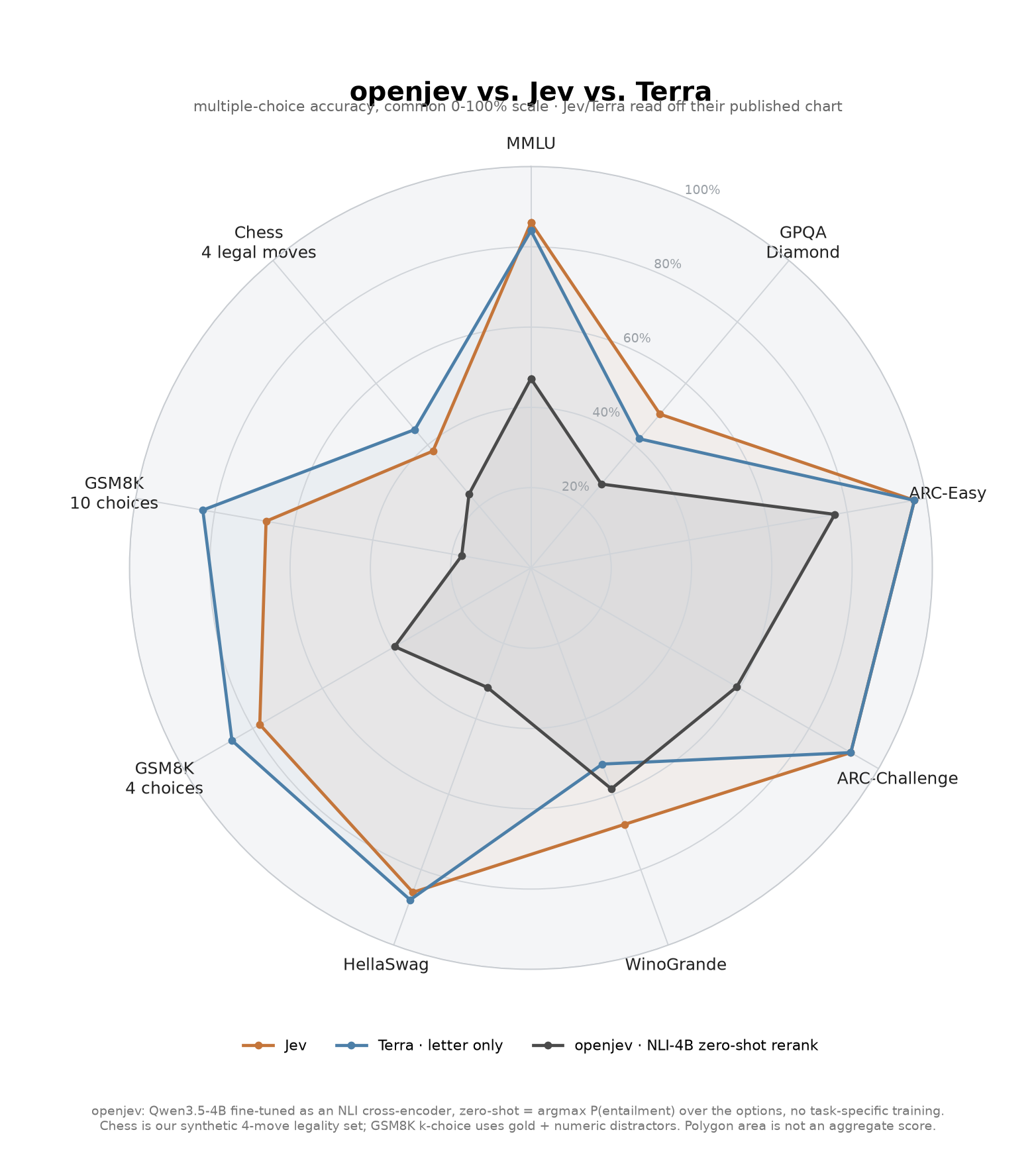
Alex Wortega (AlexWortega) has published the openjev model on Hugging Face: the base Qwen3.5-4B is fine-tuned as an NLI cross-encoder that, for a pair of “input — statement,” outputs one of three verdicts — entailment, contradiction, or neutral. According to the author’s design, this single primitive is sufficient for several tasks at once — from reranking answers and reference-based grading to content moderation and zero-shot Doom gameplay, while the qwen3.5-4b-nli checkpoint and training code are distributed under the MIT license.
What happened
The model is built as a Qwen3_5ForSequenceClassification classifier with three labels (entailment/contradiction/neutral), trained with cross-entropy on top of the latent representations of the Qwen/Qwen3.5-4B base. The repository contains the qwen3.5-4b-nli checkpoint, the OpenJevCrossEncoder wrapper with predict, rerank, grade, and latents methods, training code, Flappy Bird and Doom benchmarks, video replays, and raw JSON results from runs. The demos show how openjev selects actions in Doom zero-shot: both from a textual description of the state and directly from pixels via the Qwen3.5 vision tower, without training for a specific game. The author’s announcement on X was accompanied by a video of a Doom run.
Context
Turning an NLI verdict into a universal solution is a known idea: cross-encoders with entailment/contradiction/neutral labels have long been used for checking text consistency, so the scientific novelty here is moderate. The value of the work lies elsewhere: this is an open replication of the JEV approach (the jev model, which became known thanks to a viral tweet) with weights, code, and benchmarks under MIT, and such replications have so far been more often discussed than fully released. The acceptance logic is as follows: instead of expensive fine-tuning of a separate model for each task, a single cross-encoder is taken on top of the latents of a ready-made LM, and any decision is reduced to the question of whether the hypothesis confirms the input, contradicts it, or is neutral.
Why this matters for the industry
A single NLI cross-encoder based on a ready-made 4B model can replace a set of narrow head models: a reranker in RAG, an LLM-answer grader, a moderation classifier, and even a Doom game agent — without per-task training. Inference is reduced to a single forward pass with argmax over three classes, making this a cheap alternative to reward models and separate moderation classifiers. For teams building RAG pipelines and agentic systems, this is a ready-made building block: pre-ranking before generation, grading in eval-CI, and pre-moderation on a single checkpoint. The open MIT replication is also a price signal for the category of reward models and narrow classifiers: if the approach is confirmed, defending in it will have to be done with product, data, and distribution, not a closed model.
Why this matters for users
The qwen3.5-4b-nli checkpoint can already be downloaded from Hugging Face under the MIT license and run via transformers (AutoModelForSequenceClassification) or the ready-made OpenJevCrossEncoder wrapper. In the evening, it is really possible to check on your own data whether openjev replaces the current reranker or grader: an A/B comparison on your own sample is enough. The practical value now is a cheap verdict filter where the error is not critical: preliminary selection of candidates, grading assistant answers against a reference, and primary moderation. The training code and raw JSON results are located next to the weights, so the author’s results can be reproduced independently, rather than taken on faith.
What is still unknown / limitations
This is still the author’s demonstration, not a proven production component. The materials do not include accuracy on standard NLI datasets, ranking quality compared to existing rerankers and LLM-judges, as well as data on latency and throughput. There is also an inconsistency requiring verification in the training code: the author’s text says “trained an MLP on top of qwen 4b,” while the repository description features a Qwen3_5ForSequenceClassification classifier on top of latents, meaning it is unknown exactly where the head is located. Claims about zero-shot Doom and replacing production components should be considered experimental until independent runs on your own data.
Sources
- AlexWortega/openjev — Qwen3.5 trained as jev model (Hugging Face model card)
- X: @justALEXWORTEGA — “Typesafe: pnewed 💨 Jev: liberated 🫡” (author’s announcement with demo video)
Author
Look at AI, editorial team