
On September 14, at the All-In summit in Los Angeles, Donald Trump, during a video call with Nvidia CEO Jensen Huang on the main stage, called AI safety concerns a 'hoax' and stated that the US will not slow down the industry for the sake of perfect regulation. In one frame with the head of the largest chipmaker, the president presented the AI race as a decisive competition and bet on data centers.

What happened
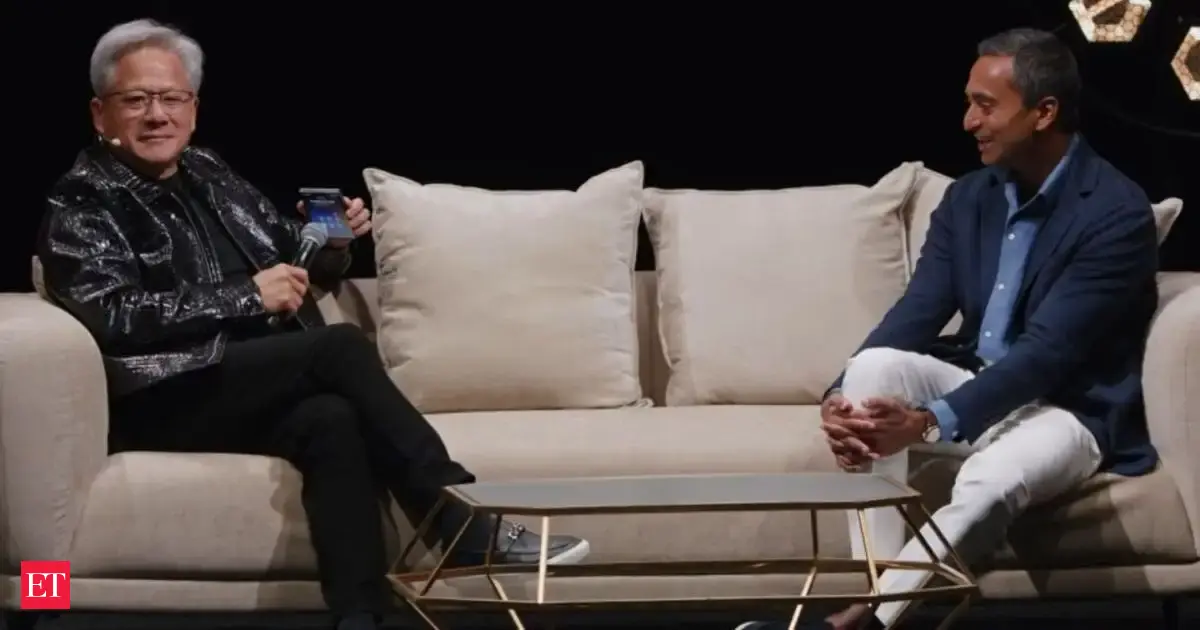
Trump was connected to the All-In stage via video link, and Jensen Huang's smartphone was brought on stage on speakerphone. The president said that 'robots will not take over the world, and AI will not take over the rest of the world,' and emphasized that the US will not 'slow down an entire industry' for the sake of perfect regulation. According to his formula, 'whoever wins the AI race will win everything,' and the scale of the competition is 'bigger than the internet.' Trump called data centers 'the oil of the next 20-25 years,' which turns depressed counties into wealthy ones. In the context of the statement, he attributed calls to slow down the industry to the tools of politicians and, possibly, China. Huang publicly supported the president: 'We will ensure that in the AI race in America everyone wins — every industry, every company, every state.'
Context
The speech took place the day after a statement by Anthropic CEO Dario Amodei, who the day before called for stronger regulation and mandatory pre-certification of the most powerful models, similar to aircraft inspection. The initiative received support from Sam Altman and Elon Musk and, if adopted, would have created an external layer of verification for frontier models. Against the backdrop of this statement, Trump's remarks on the main stage of the industry sounded like a direct response: the evaluation regime in the US remains voluntary and self-declared, and the obligation to check models remains with the developers.
Why this matters for the industry
The position of the incumbent US president, voiced on the main stage of the industry in front of Huang, effectively fixed Washington's course on non-interference in AI development: regulatory 'brakes' were declared a tool of China and political opponents, and the infrastructure bet was made on data centers. The Anthropic initiative on pre-certification of frontier models received a clear public rebuke, which reduces the likelihood of strict mandatory requirements for model verification and auditing in the US in the foreseeable future. The entire verification contour — evals, red-teaming, observability, guardrails — is effectively shifted from the regulator to engineering teams, and the voluntary evaluation regime retains known risks: cherry-picking benchmarks, undisclosed methodology, non-reproducibility. For product teams in the US market, the regulatory risk of launching aggressive features — autonomous agent actions and new integrations — decreases: releases can be planned without waiting for certification, and priorities shift inside the product — user action control, logging, request economics.
Why this matters for users
For readers, this is the first case where Trump, in one frame with the CEO of Nvidia, simultaneously devalued AI safety risks and confirmed the maximalist US bet on AI leadership against China. For those who follow where the rules of the game for LLM companies will go, this is a benchmark: no regulatory 'brake' from Washington should be expected, and the state's main argument remains infrastructure and the economic effect from data centers. Technically, nothing changes for end users today: no new APIs, no new prices, no latency data have appeared. The practical conclusion for teams working with LLMs is to stop waiting for external regulatory 'gates' and build their own control loops: regression evals on each model upgrade, observability of response quality, guardrails and rollback mechanisms. For end users, a more likely consequence is a faster pace of new models and features without mandatory external checks.
What is not yet known / limitations
One public speech is not proof of a verified deregulatory environment: the sources contain not a single document about the cancellation or weakening of existing requirements, so the thesis of the absence of mandatory certification in the US in the foreseeable future is an interpretation, not a confirmed fact. The statement contains no technical claims: neither a model, nor a benchmark, nor an article is named, and the formulations 'bigger than the internet' and 'data centers are the oil of the next 20-25 years' are political-commercial rhetoric, not verifiable technical evidence. The specific steps by which the administration intends to implement the announced course are not specified in the sources.
Sources
Author
Look at AI, editorial team