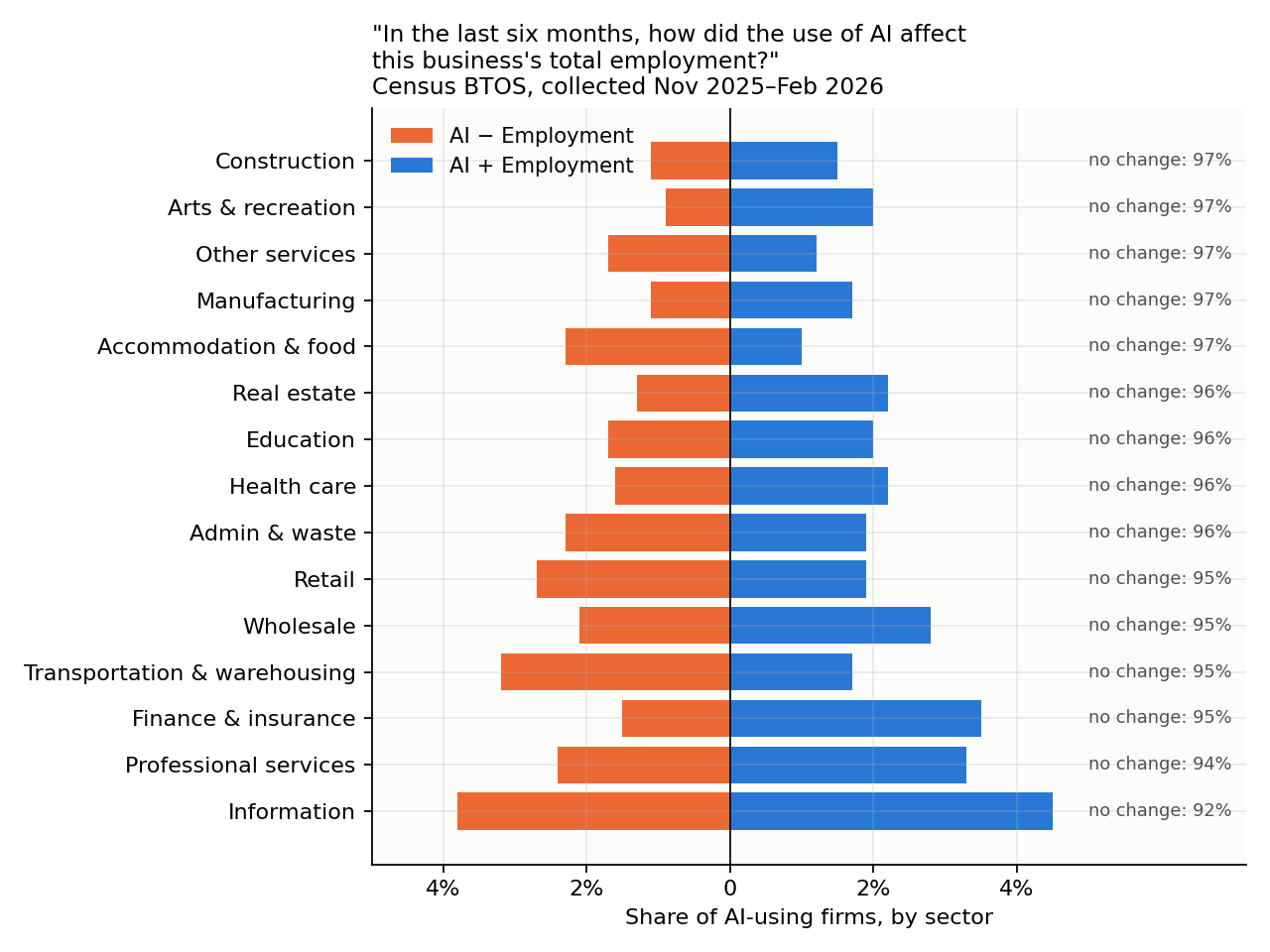
Economist Alex Tabarrok analyzed data from the Business Trends and Outlook Survey (BTOS) on Marginal Revolution, a survey the U.S. Census Bureau has conducted among hundreds of thousands of companies since September 2023. The share of firms using AI has grown from 3.7% to roughly 18%, yet in response to a direct question about AI's impact on employment, 95.7% of respondents answered "no change"—and this picture has barely shifted over two years. Meanwhile, within firms that have already adopted AI, task displacement is gradually increasing, and the main practical scenario remains written routine—letters and documents, not code.

What happened
Alex Tabarrok published an analysis of the latest waves of the U.S. Census Bureau's Business Trends and Outlook Survey (BTOS) on Marginal Revolution. In the November 2025–February 2026 wave, in response to the question "how has AI affected your company's overall employment over the past six months," 2.3% of firms answered "increased," 2.0% "decreased," and 95.7% "no change." For comparison, in the December 2023–February 2024 wave, the distribution was nearly identical: 2.8%, 2.6%, and 94.6%, respectively. Meanwhile, the share of companies using AI grew from 3.7% in September 2023 to roughly 10% by the end of 2025, and then jumped to roughly 18% after the question wording was expanded in November 2025. Among firms using AI, 44% say it complements employee work, 10% say it performs a task previously done by an employee, and another 11% note that AI added a new task to the business.
Context
BTOS is the largest longitudinal survey of firms on the topic of AI: since September 2023, the U.S. Census Bureau has regularly asked hundreds of thousands of companies whether they used AI in the past two weeks, making these data one of the most direct and large-scale measurements of the debate over whether AI is taking jobs. A methodological detail is important for interpreting the dynamics: in November 2025, the wording of the question about AI use was expanded, causing the indicator to jump to roughly 18%—this is a break in the series, and values on either side of the break cannot be directly compared. Within the group of adopting firms, a quiet structural shift is underway: the share of companies reporting that AI took over a "large number" of tasks grew from 2.4% to 7.1%, and a "moderate number" from 13% to 22%. Hence the key conclusion about the nature of the process: pressure on employment is cumulative, not instantaneous—the aggregate effect across all firms is currently zero, but displacement within adopters is already underway.
Why this matters for the industry
For the industry, BTOS data is factual telemetry of generative AI's real-world deployment, and it does not match the hype. The actual demand profile is led by writing and editing documents and letters (85%), information search (50%), and summarization (45%), while coding is only 13%, meaning the discourse around coding agents significantly outpaces actual deployment. Meanwhile, 64% of adopters have changed nothing in their business, and hiring employees with AI skills barely exceeds 1%, so the barrier to entry is low: builders can assemble targeted tools for documents, letters, corporate search, and summarization within already existing applications with immediately measurable value, and sales arguments should rely on the economics of time and money. The Information sector is the only one where less than 92% of firms report no changes in employment, so it will be the first to show whether accumulated task displacement becomes visible at the hiring level. The market is currently in a phase of "adaptation without transformation": adoption is growing, but most firms are not restructuring processes, and the window for products targeting assist scenarios in written routine is open right now.
Why this matters for users
For readers, the figures refute both extremes: panic about mass AI layoffs is not confirmed, but denying AI's pressure is also impossible—it accumulates imperceptibly, task by task. The main scenario for generative AI is letters and documents, which almost any office worker encounters, not programming, despite the noise around coding agents. Most adopting firms describe AI as a complement to human work, not a replacement, so the practical meaning for a person in the workplace is to treat it as a tool for written tasks, search, and summarization, without expecting an instantaneous revolution in their own career. The raw BTOS data is open on the Census Bureau's website, so any of these figures can be verified independently.
What is still unknown / limitations
All figures are self-reports by firms over a six-month horizon with a built-in attribution problem: a "no change" answer from the overwhelming majority of companies means the effect is not detected by this instrument at the firm level, not that there is no effect. Slow task displacement and the lag in technology diffusion mean that a noticeable impact may accumulate for a long time before it appears in companies' responses. The roughly 18% indicator cannot be directly compared with the previous 3.7% and 10% due to the change in question wording in November 2025, so conclusions about "explosive growth in adoption" require caution, and a comparable series will only begin to form within the new methodology. Going forward, it is worth watching whether the share of firms where AI took over a large number of tasks continues to grow, and whether the actual level of use stabilizes.
Sources
- AI and Employment: So Far, So Good (Marginal REVOLUTION, Alex Tabarrok)
- Business Trends and Outlook Survey (BTOS) Data — U.S. Census Bureau
Author
Look at AI, editorial team