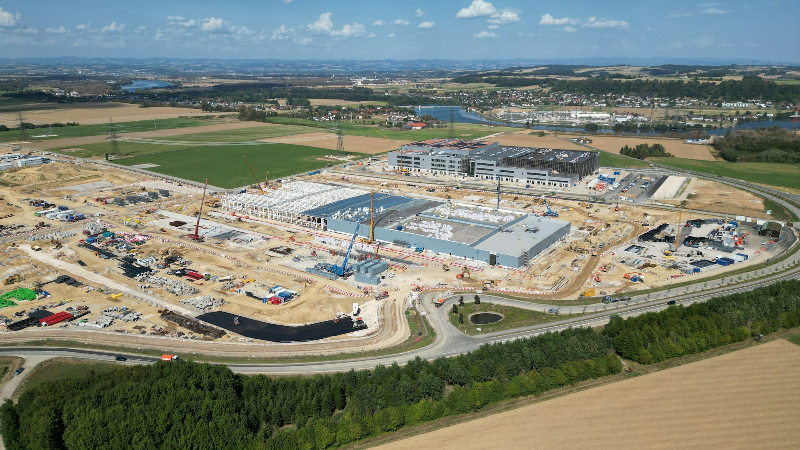
In an article by Isabella Simonetti and Meghan Bobrowsky, published on August 20, 2026, the Wall Street Journal describes how Big Tech is urgently restructuring its public policy against the backdrop of mass protests against AI data centers: companies have begun paying for local community consent with money, jobs, and infrastructure guarantees.

What happened
In August 2026, Meta announced the Future Is For Everyone fund, worth $1 billion, aimed at the areas where its data centers are located. According to Meta's Vice President of Public Policy, Lindsey Ellin, the money will be distributed based on specific community requests, and the company plans to negotiate directly with school superintendents and police chiefs. The fund is the most concrete example of the measures listed by WSJ: companies are holding listening sessions with residents, offering job guarantees, investing in clean water, and making multi-million dollar payments to communities. The industry is simultaneously promoting the thesis that data centers are shifting part of the tax burden from local households onto themselves.
Context
The AI boom has triggered a wave of data center construction, and local residents have begun openly opposing the construction: the result was a mass protest movement, as reported by WSJ. The resistance is not a formality — according to the article, local protests are already delaying and disrupting data center projects, so resident consent has become a real constraint on construction schedules. Against this backdrop, companies' promises carry special weight and special skepticism. In a Hacker News discussion, the closure of the free Primary School in East Palo Alto is cited as a precedent for the withdrawal of social commitments after CZI (Chan Zuckerberg Initiative) shifted its priorities toward biomedicine and AI, which reduces the evidentiary value of promises like Meta's fund.
Why this matters for the industry
For the industry, the signal is that local community consent has become a binding constraint on the compute infrastructure on which the future scaling of models depends. AI capex plans now depend not only on money and chips, but also on social consent, so deals have to be packaged with incentives: funds, investments in water infrastructure, and employment guarantees. Data center construction has acquired a new line item in the budget — the price of social permission, and Meta's fund is its visible marker. For teams dependent on the expansion of cloud providers' capacity, construction schedules now carry a social risk of delays.
Why this matters for users
For the reader, the article shows a new set of arguments in the debate around data center construction: the industry is offering funds, jobs, and tax promises, while critics point to reputational campaigns and precedents of the abrupt scaling back of social programs. This helps to separate companies' real commitments from PR when evaluating projects in your own region: tax promises, employment guarantees, and water investments can be checked against documents and first payments, and against this backdrop, social permission can be distinguished from marketing.
What is still unknown / limitations
The source does not specify the selection criteria, distribution schedule, independent audit, or first recipients of Meta's $1 billion fund, so this is a marketing statement, not a verifiable commitment. There is no public data on the impact of such incentives on compute prices, and the $1 billion fund is a one-time signal, not a systemic surcharge on the cost of capacity. The article contains no content on models, APIs, or benchmarks, and the impact on technology is limited to the risk of construction schedules.
Sources
- Wall Street Journal, Inside Big Tech's Frantic Race to Quell the Growing Backlash to AI (Isabella Simonetti, Meghan Bobrowsky)
- Threat Beat, mirror of the WSJ article
- Discussion of the WSJ article on Hacker News
Author
Look at AI, editorial team