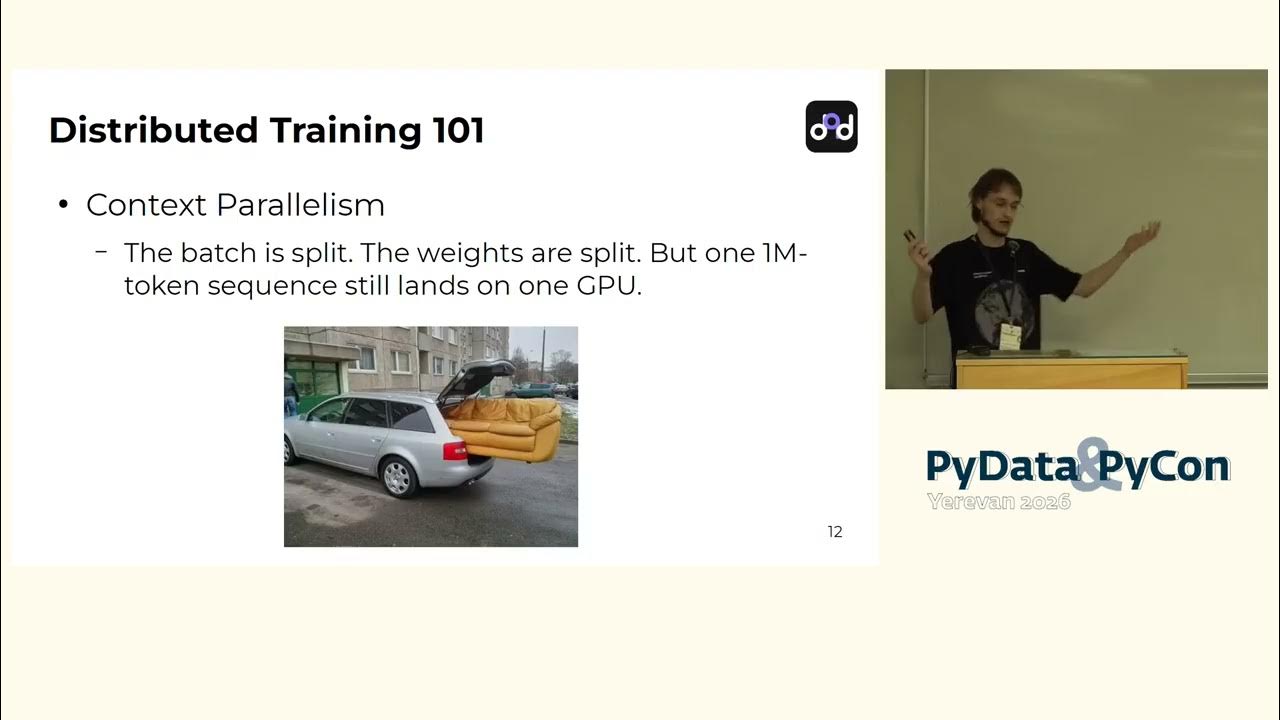
PyData's official YouTube channel uploaded the recording of the 50-minute talk 'The d9d Project: Building an extensible and scalable distributed training framework for LLMs' from the PyData & PyCon Yerevan 2026 conference on August 23. Maksim Afanasyev from Tochka discusses d9d — an open framework for distributed training of large language models, built natively on PyTorch 2.0 primitives.

What happened
The PyData & PyCon Yerevan 2026 conference took place on July 24–25 in Yerevan; the d9d session took place on July 24 and lasted 50 minutes. The speaker was Maksim Afanasyev, Lead Research Engineer and engineering manager at Tochka, leading a 15-person team for foundation model development. He walked through the framework from the basics to the API: scaling from single-GPU debugging to 6D parallelism on a cluster, a streaming engine for distributed checkpointing with graph transformations of model state, reworked pipeline parallelism based on torch.distributed.pipelining, and integration of Triton/CUDA extensions. The d9d source code is published on GitHub under the Apache-2.0 license.
Context
This is not a release or a new version: the framework was already available on GitHub before the talk, so publishing the recording is not a business event but a market signal. In LLM training infrastructure, a gap has formed between two poles: monolithic frameworks such as Megatron-LM, which are hard to extend for experimental workflows, and building a distributed environment from scratch, which requires deep expertise in low-level primitives. There is no new architecture or training method in d9d: 6D parallelism, pipeline parallelism, and distributed checkpointing are long-known techniques, and the project's contribution is their white-box composition directly on PyTorch 2.0 primitives instead of wrappers such as DistributedDataParallel. The framework grew out of the Tochka team's production experience in training large foundation models.
Why this matters for the industry
For the industry, d9d is an open 'middle ground' in LLM training infrastructure between Megatron-LM and building a distributed stack from scratch: the entry barrier to distributed training becomes cheaper and lower for teams training their own models, and those whose experimental workflows run into the rigidity of monolithic frameworks get a working alternative that can be explored and integrated into a research pipeline. Whether d9d becomes a comparable alternative in small research teams' pipelines will be shown by the emergence of reproducible performance and MFU benchmarks on fixed topologies and stable CI; over a two-year horizon, the outcome will be determined not by architecture but by support speed and release cadence.
Why this matters for users
For readers, this is a practical breakdown of how large LLMs are currently trained in a distributed manner, from the basics of parallelism to specific framework APIs. The d9d-project/d9d repository can be cloned, its implementation read, and tests run on their own hardware, and engineering practices for complex Python systems can be borrowed: strict linting, static typing, and testing of local and distributed configurations. There are no significant immediate changes for production systems.
What is still unknown / limitations
Available sources do not include public efficiency benchmarks, data on use outside the authors, or framework maturity metrics. The phrase 'tries to be efficient yet hackable' in the repository description is a self-characterization, not a benchmark result, and the claimed properties are supported by neither methodology nor numbers. The quality of the key component — the streaming engine for distributed checkpointing — is currently confirmed only by the code itself, and fault tolerance has not been verified by fault-injection tests. The Tochka team's experience scaling MoE models to 235 billion parameters confirms the authors' competence, but it is not explicitly stated that d9d was used in that run, so this does not validate the framework itself.
Sources
- The d9d Project: Building an extensible and scalable distributed training framework for LLMs — PyData YouTube
- The d9d Project — PyData & PyCon Yerevan 2026 program (pretalx)
- d9d-project/d9d — distributed training framework based on PyTorch (GitHub, Apache-2.0)
Author
Look at AI, editorial team