Citizen science platforms eBird, Macaulay Library, and iNaturalist faced systematic distortion of bird photos by built-in smartphone AI tools. In response, the platforms introduced strict rules: AI generation and editing are prohibited, and identified artifacts are tagged and excluded from scientific research.


What happened
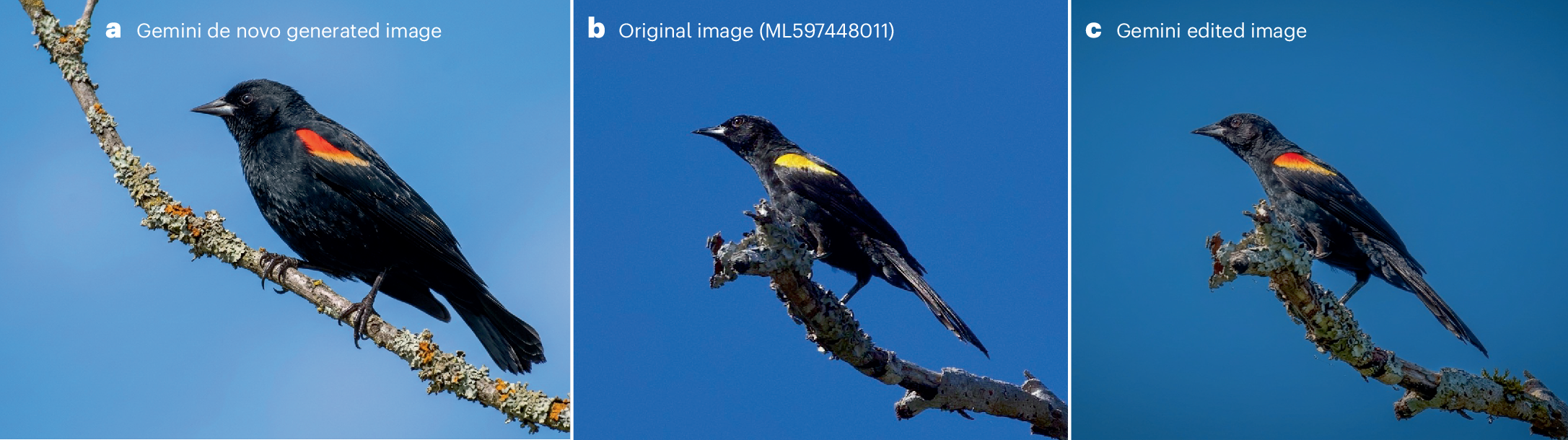
A paper by Lees et al., published on July 13, 2026, in Nature Ecology & Evolution (DOI: 10.1038/s41559-026-03141-y), documented a reproducible problem: Google Gemini's built-in AI editor turned a photo of an ordinary South American oriole (Icterus cayanensis) into an image of a North American red-winged blackbird (Agelaius phoeniceus), generating a false scientific record of an introduced species in Brazil. On iNaturalist, 1,400 flagged AI images have already been found. In response, eBird and Macaulay Library introduced a two-tier moderation system: the Artificial tag means complete hiding of the media, and the Over-edited tag — exclusion from scientific research. AI generation and editing of photos are now explicitly prohibited by the platforms' policies.
Context
Citizen science platforms process hundreds of millions of observations, which are used in peer-reviewed papers on ecology, biogeography, and conservation. This data forms the basis of long-term biodiversity monitoring, climate change tracking, and training specialized AI tools such as Merlin Photo ID and Merlin Sound ID. The paper by Lees et al. became the first peer-reviewed analysis of the threat of scientific media resource contamination by AI editing. The problem is architectural: generative models for image enhancement are optimized by visual metrics — attractiveness and sharpness — rather than by preserving domain-specific taxonomic features. This means that the distortion is not a bug of a specific model, but a fundamental property of the approach.
Why this matters for the industry
Contamination of datasets with AI artifacts threatens the reliability of the entire citizen science ecosystem. Studies published using data from before 2026 may require re-validation of visual evidence. For the ML community, this is a signal: datasets from crowd-sourced sources can no longer be considered automatically reliable. A cascading reaction is expected — iNaturalist and similar platforms will implement similar policies. Demand will arise for automatic AI redistribution detection tools and media authentication standards such as C2PA. Existing detectors based on Glow/CLIP approaches are insufficient — specialized models sensitive specifically to taxonomic distortions are needed.
Why this matters for users
If you use AI enhancement or upscaling features on your phone and upload animal photos to scientific platforms — you may inadvertently falsify data. AI editors work as a black box: they do not just improve sharpness, but can add non-existent feather details, change the animal species, and remove diagnostic features. After the introduction of new policies, eBird and Macaulay Library automatically mark such photos and remove them from scientific databases, which means: your photos may be excluded from research without warning.
What is still unknown / limitations
The true scale of contamination is unknown: on iNaturalist, out of more than 610 million records, only 1,400 flagged AI images have been found, which indicates the inefficiency of current detection methods. eBird and Macaulay Library introduced a manual policy with binary tags — this is a workaround, not an automated ML system in production. It is unclear whether a review or retraction of already published papers using data from before 2026 will be required.
Sources
- Citizen science platforms must mitigate against the threat of generative AI — Nature Ecology & Evolution
- From Truth to Fake: The Threat of AI to Media Archives — eBird
- AI-altered images on birdwatching forums putting research at risk — The Guardian
Author
Look at AI, editorial team