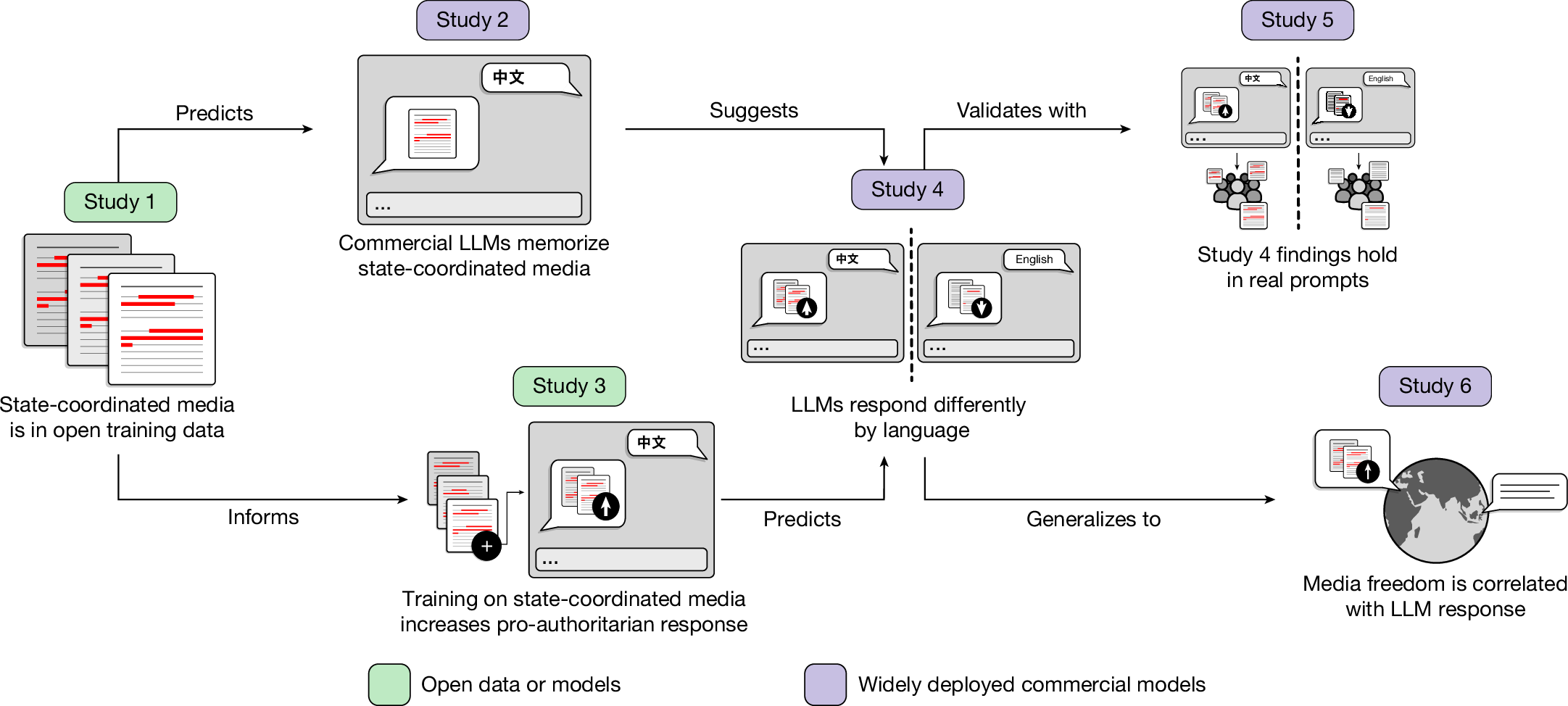
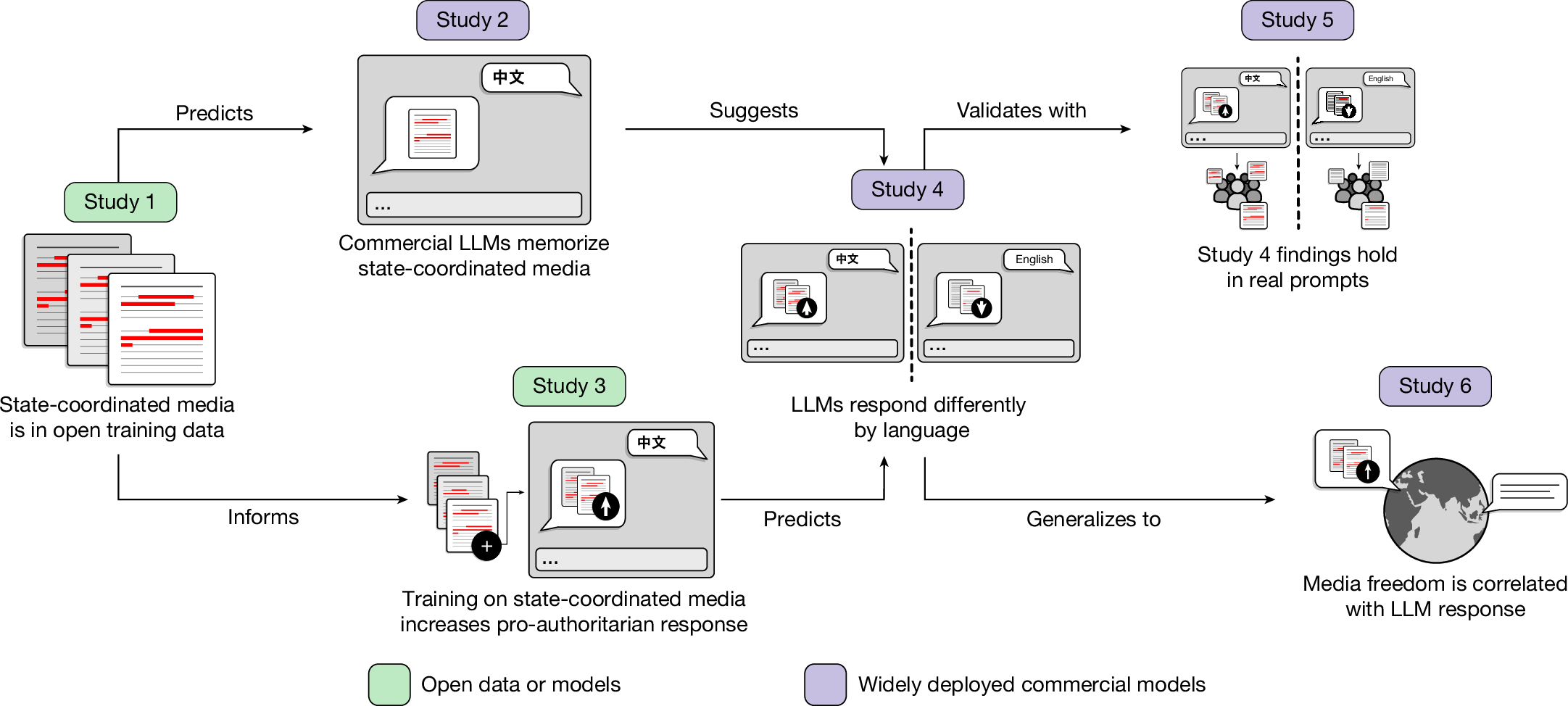
A study published in the journal Nature showed that ChatGPT, Claude, and Gemini models generate more favorable responses about China and other authoritarian regimes when queries are formulated in the respective languages. The cause is a structural skew in training data: state media occupy a disproportionately large place in the language corpora of authoritarian countries.

What happened
The authors of the article in Nature (Waight et al., DOI: 10.1038/s41586-026-10506-7) conducted a study of language bias in OpenAI, Anthropic, and Google models. Tests showed that the same political question, asked in English and Chinese, returns fundamentally different answers. A similar pattern was confirmed for 37 countries with restricted press freedom. A separate report by Meta's Oversight Board recorded a 45% refusal rate for chat models on politically sensitive prompts, with China being one of the main triggers.
Context
The root cause of the bias lies at the pre-training data level, not fine-tuning or RLHF. Chinese state media — the Xinhua agency and the Xuexi Qiangguo app — make up a disproportionately large part of the Chinese-language training corpus. In the CulturaX dataset, government documents are 41 times more common than Chinese Wikipedia articles. The problem is not tied to a specific architecture: all three tested models — ChatGPT, Claude, and Gemini — demonstrate the same pattern, confirming the scale of the systemic data composition problem.
Why this matters for the industry
For the industry, this is the first empirical evidence in a peer-reviewed journal that state control of the media space directly determines LLM outputs through the composition of training corpora. OpenAI, Anthropic, and Google are faced with the requirement to review their data filtering and balancing strategies. Product teams need to implement cross-lingual bias checks in eval pipelines: test sets should include the same questions in different languages with an assessment of answer consistency. Without this, valid evaluation of models in multilingual production environments is impossible. Specialized benchmarks for cross-lingual bias are expected to appear, similar to MMLU.
Why this matters for users
The prompt language turned out to be not a neutral parameter, but a factor influencing the content of the answer. Users of ChatGPT, Claude, and Gemini receive different answers to the same political questions depending on the language in which they ask the query. For readers, this means: when working with sensitive topics, it is necessary to check answers in multiple languages to identify hidden bias. Product teams can design multilingual checkpoints — agents that ask one question in different languages and compare the answers.
What is still unknown / limitations
The claim that "prompt language acts as a hidden parameter influencing the content of the answer" requires caution: the Nature study compares answers in different languages, but does not prove that the bias is caused exclusively by the query language. It is possible that different models or their versions participated in the tests in different languages. Researchers acknowledge that developer companies are doing little to correct this bias — but it is not yet clear what specific measures are planned.
Sources
- State media control influences large language models (Nature)
- Chinese Censorship Is Leaking Into Answers From American AI (WSJ)
- AI Chatbot Responses Mirror Government Censorship — Meta Oversight Board (CNET)
Author
Look at AI, editorial team