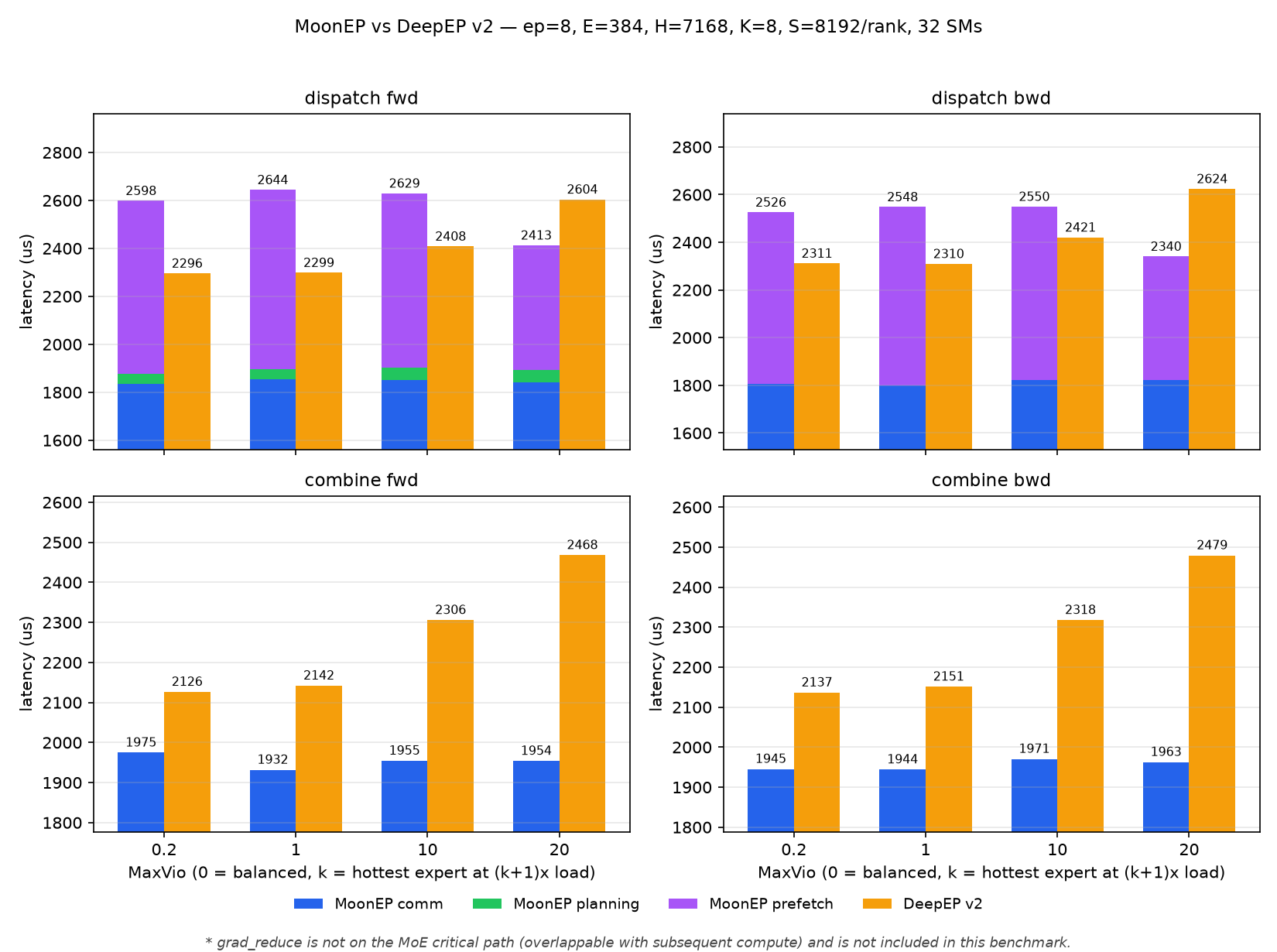
MoonshotAI has released MoonEP, a specialized library designed to ensure perfectly balanced Expert Parallelism (EP) in Mixture-of-Experts (MoE) architectures. Through innovative mechanisms of dynamic redundant experts and online scheduling, the library enables efficient computational load distribution across GPU clusters, even in cases of severe routing imbalance.


What Happened
MoonshotAI introduced the MoonEP library, optimized for NVIDIA GPUs. Key technical features include the use of dynamic redundant experts, online scheduling mechanisms, and support for Zero Copy data transfer. These solutions aim to maintain stable GPU rank utilization and improve communication efficiency, making the library competitive with existing solutions such as DeepEP v2.
Context
In Mixture-of-Experts (MoE) architectures, a routing imbalance problem often arises, where certain experts receive significantly more requests than others. This leads to inefficient use of computational resources, GPU idling, and critical Out of Memory (OOM) errors when scaling training and inference across large clusters.
Why It Matters for the Industry
MoonEP provides the necessary infrastructure layer for effectively scaling ultra-large-scale MoE models. The technology helps prevent performance degradation and reduces the risk of sudden cluster failures, which is critical for developers of SOTA models. In the long term, the use of such dynamic redundancy management mechanisms could become an industry standard for next-generation frameworks.
Why It Matters for Users
For machine learning researchers and engineers, MoonEP serves as a tool to increase the stability of training and inference processes on existing NVIDIA GPU clusters. This allows for more efficient utilization of available computing power, minimizing hardware downtime and reducing the overall cost of training through even load distribution.
What Is Not Yet Known / Limitations
Technical specialists may evaluate the solution based on the scientific novelty of its algorithms, while product managers and founders will primarily assess it as a tool for reducing operational costs and increasing infrastructure stability.
Sources
Author
Look at AI, Editorial Team