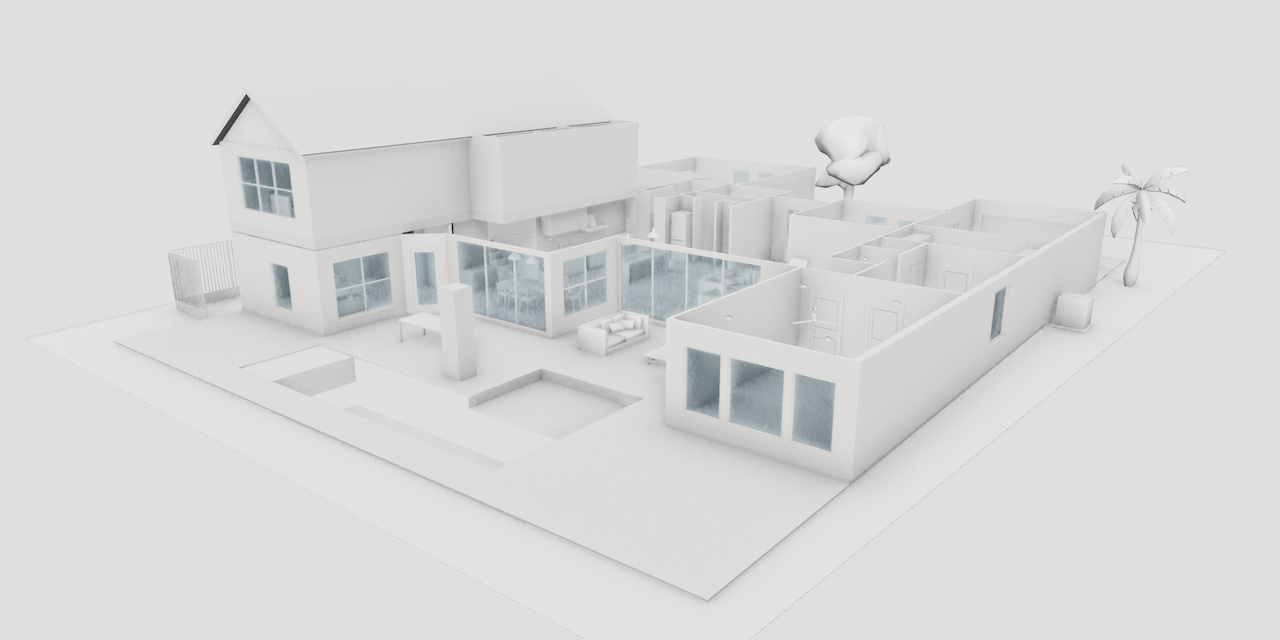
Pascal Editor has been introduced—an open-source architectural 3D editor that allows you to create and edit interiors and exteriors using text prompts directly in your browser.
What Happened
Pascal Editor has been developed, an architectural design tool built on a modern stack of React 19, Next.js 16, and WebGPU (via React Three Fiber). The project enables the generation of 3D scenes based on text queries while ensuring the topological consistency of objects. The editor uses a node-based system to describe the scene hierarchy—from the general plot to fine details—and supports export to standard formats.
Context
The project demonstrates the possibility of migrating resource-intensive 3D computations from heavy desktop software to a browser environment. Thanks to the use of WebGPU, complex tasks are executed directly on the client side with high performance, and the integration of generative models allows for a shift toward Natural Language UI.
Why It Matters for the Industry
The transition to WebGPU-based browser tools lowers the barrier to entry for architectural design and allows companies to seamlessly integrate generative AI into geometry creation processes. This accelerates the iterative development cycle and replaces traditional desktop software for rapid concept prototyping.
Why It Matters for Users
For users, this means the ability to create professional 3D layouts and concepts without installing complex software or having deep knowledge of 3D modeling. The tool is available directly in the browser and operates through simple text commands.
What Is Not Yet Known / Limitations
At the current stage, experts view the project as a PoC (Proof of Concept), which indicates a need to verify inference scalability and the reliability of generating topologically correct geometry.
Sources
Author
Look at AI, Editorial Team