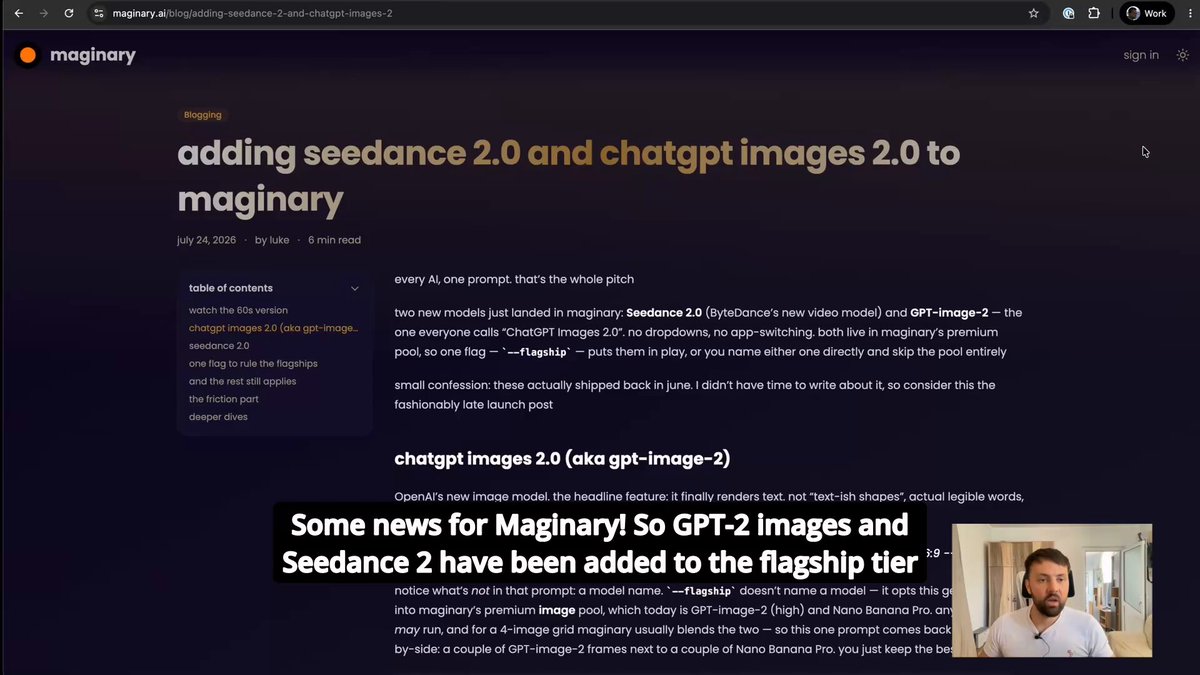
The Maginary.ai platform has introduced a major update, adding support for ByteDance's advanced Seedance 2.0 models and OpenAI's GPT-image-2, enabling the creation of high-quality multimedia content through a unified interface.


What Happened
Maginary.ai has integrated support for the Seedance 2.0 model, which is capable of generating videos ranging from 4 to 15 seconds in length with native audio support and lip-syncing in up to 1080p resolution. Support for OpenAI's GPT-image-2 has also been added, significantly improving the rendering quality of legible text within images. The service provides an abstraction over multiple models through a unified prompt syntax and special flags, such as --flagship or --seedance2pro.
Context
The service positions itself as the "OpenRouter for multimedia," creating an abstraction layer over disparate SOTA (State-of-the-Art) models across video, photo, and audio categories. Instead of working directly with dozens of different APIs, users and developers can use a single interface to access more than 40 models.
Why It Matters for the Industry
This update advances the concept of a multimodal aggregator, which lowers the barrier to entry for developers of multimodal AI agents and automated content pipelines. Creating a single abstraction layer over heterogeneous models simplifies cost and architecture management, eliminating the need to maintain dozens of separate integrations.
Why It Matters for Users
For content creators, this means the ability to generate complex media files (video with voiceovers or photos with clear text) in a single window without switching between different services. Developers gain a tool for rapid prototyping of multimedia features using a unified syntax instead of setting up complex infrastructure for every individual API.
What Is Not Yet Known / Limitations
For production-level use, critical data regarding latency, pricing models, and data security protocols is currently missing.
Sources
Author
Look at AI, Editorial Staff