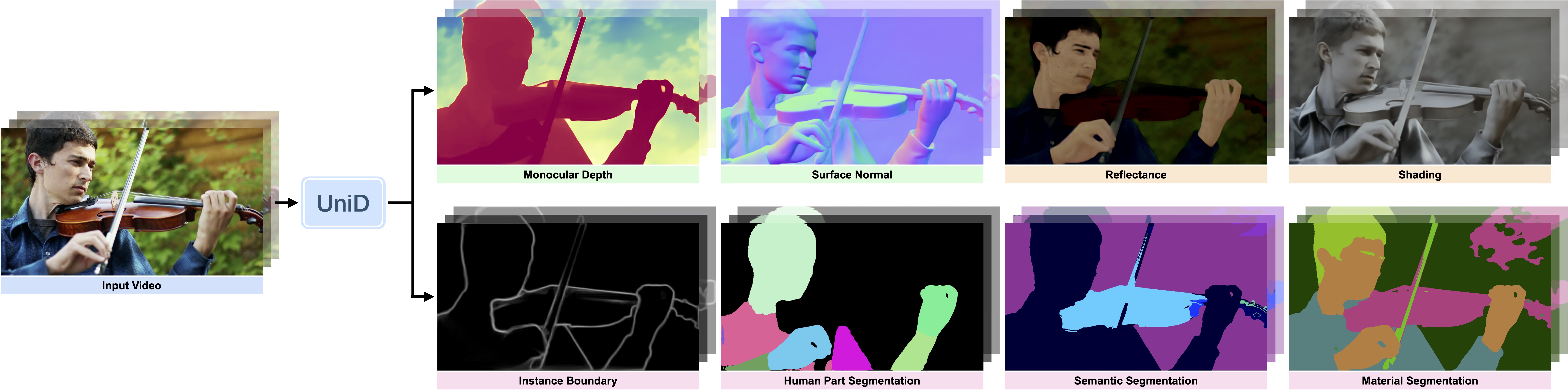
UniD has been introduced—an innovative model for dense video annotation capable of simultaneously predicting eight different scene properties in a single pass. By utilizing knowledge distillation methods, the model effectively integrates the capabilities of specialized expert systems into a single backbone.

What Happened
Researchers have presented UniD, a model that performs comprehensive video analytics by predicting depth, surface normals, semantic segmentation, object boundaries, human body parts, albedo, shading, and materials. A key feature is its ability to learn from disjoint datasets by using knowledge distillation from specialized models into a single architecture.
Context
Traditionally, computer vision tasks for video require an ensemble of disparate models, each specializing in a single aspect (e.g., only depth or only segmentation). This creates problems with data fragmentation and high computational complexity. UniD utilizes visual priors from pre-trained diffusion models to ensure temporal consistency between frames and eliminate flickering effects.
Why It Matters for the Industry
For the industry, UniD solves the fundamental problem of data fragmentation, allowing for the creation of powerful multi-task models based on existing specialized datasets without the need for expensive joint labeling. This significantly reduces data preparation costs and accelerates the development of comprehensive scene understanding systems.
Why It Matters for Users
For developers and users, this means a transition from a cascade of complex neural networks to a single efficient model, which simplifies pipelines and potentially reduces inference latency. This opens up new possibilities for creating stable real-time systems, such as advanced robotics and augmented reality (AR) technologies.
What Is Not Yet Known / Limitations
At this time, detailed data regarding the model's operational performance, such as latency, throughput, and specific hardware requirements, is missing, which is critical for assessing its feasibility for real-time applications.
Sources
- Unified Video Dense Prediction from Disjoint Data (Project Page)
- arXiv:2607.21592
- GitHub Repository - YihongSun/UniD
Author
Look at AI, Editorial Staff