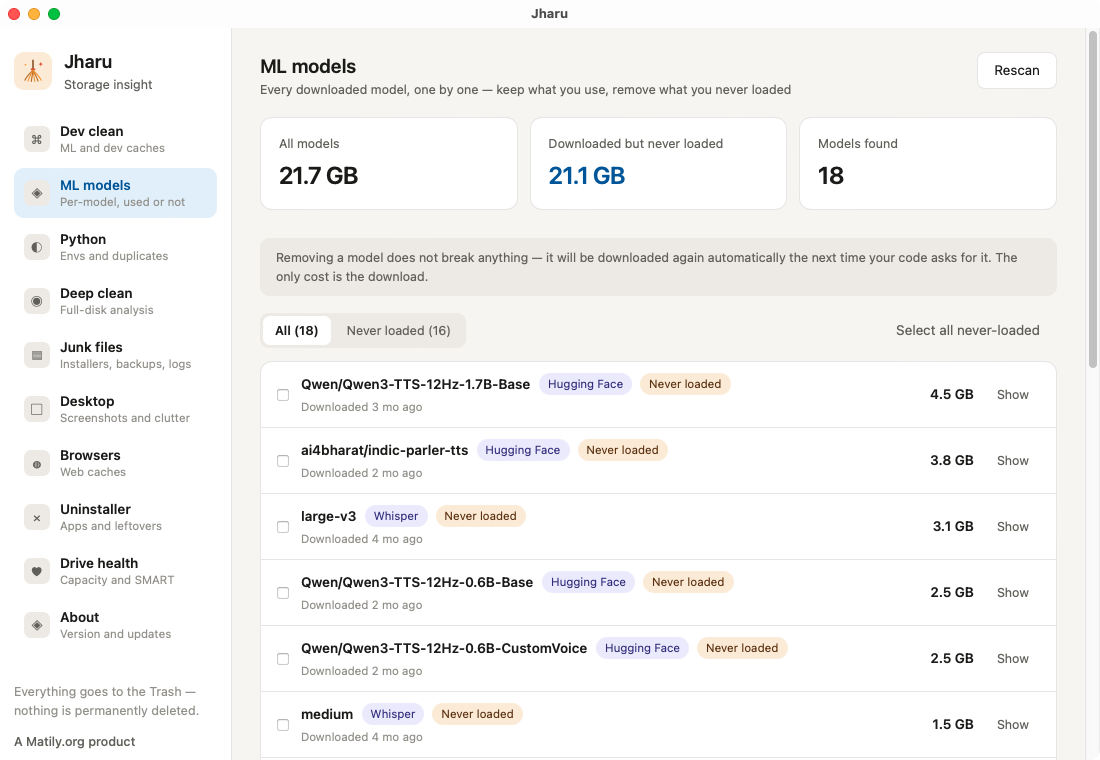
Jharu has been introduced—a free open-source utility designed specifically to optimize the local workstations of developers and ML engineers. The program supports macOS and Windows and is capable of effectively managing specific caches and heavy machine learning artifacts.


What Happened
The Jharu utility, built on Tauri, has been released, specializing in cleaning disk space from specific software junk. The tool can analyze and delete Hugging Face, Ollama, PyTorch, and Whisper model caches, as well as manage data from package managers (npm, pip, conda, Cargo) and Docker environments. A key technical feature is its ability to distinguish between downloaded model weights that have never been run and those actively in use, allowing for the safe release of significant amounts of memory.
Context
When working with local Large Language Models (LLMs) and ML infrastructure, developers face the problem of rapid disk space "bloating" due to the storage of heavy model weights and scattered virtual environments. Standard system cleaning tools often do not account for the specifics of machine learning artifact storage, creating a risk of either leaving unused gigabytes of data or accidentally deleting necessary working weights.
Why It Matters for the Industry
The emergence of Jharu signals the formation of a new niche for specialized tools to manage local ML infrastructure. This opens opportunities for creating intelligent automation systems for the data lifecycle on workstations and may contribute to the standardization of ML cache hygiene approaches within the open-source community.
Why It Matters for Users
For engineers and developers, Jharu allows for effective disk space management without the need to manually search for model weights or risk deleting active environments. This reduces cognitive load and solves technical issues regarding lack of space when working locally with heavy models.
What Is Not Yet Known / Limitations
There are doubts regarding the tool's applicability in corporate environments without additional verification of security mechanisms and compliance with internal company policies.
Sources
Author
Look at AI, Editorial Team