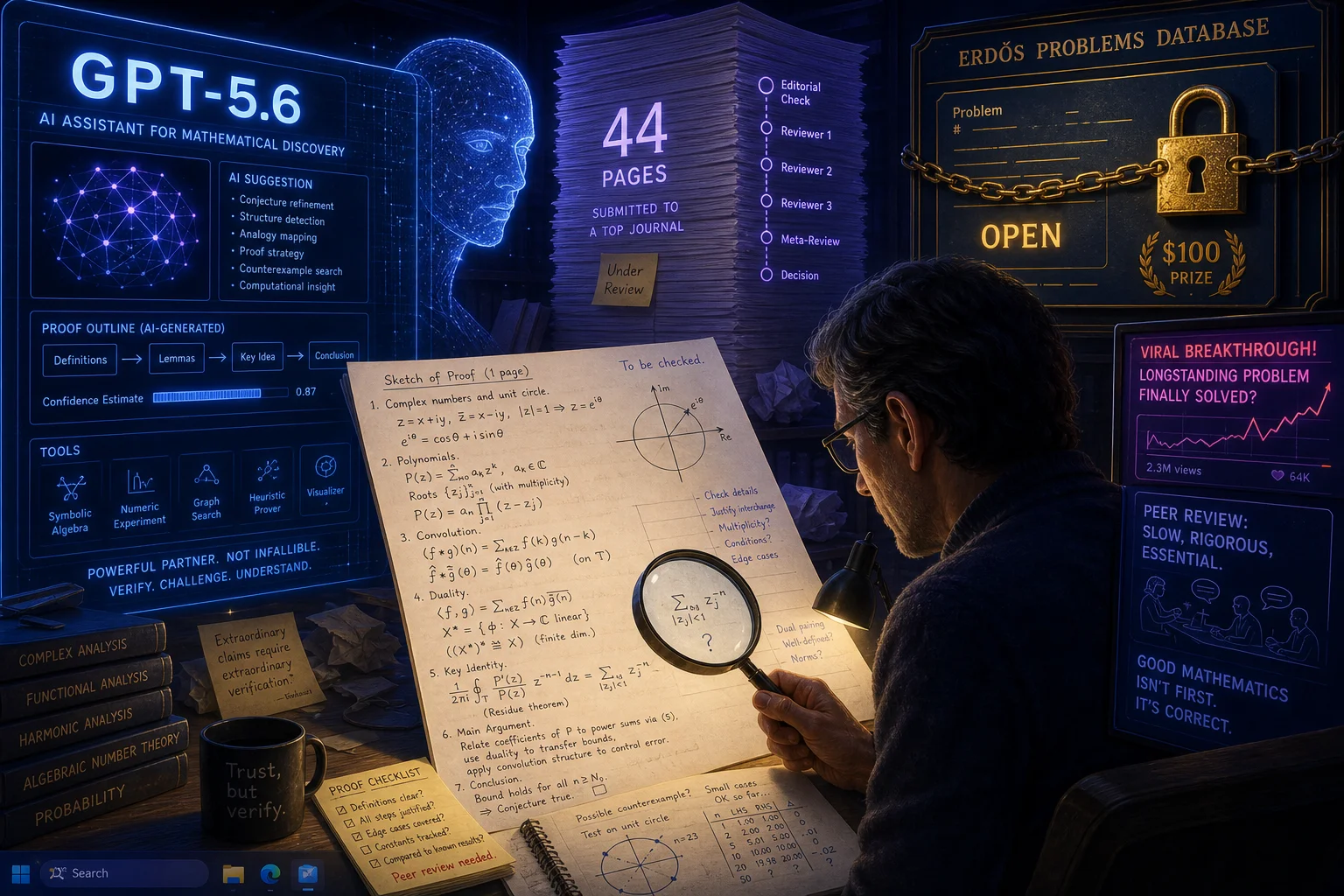
Researcher Shouqiao Wang has claimed a significant breakthrough in the automation of science, solving 6 open mathematical problems by Paul Erdős in just 5 days using the OpenAI GPT-5.6 Sol model.
What Happened
By applying the Codex workflow method, the researcher was able to structure the process of searching for mathematical proofs in high-dimensional spaces. This allowed the OpenAI GPT-5.6 Sol model to successfully tackle a series of problems previously considered unsolved within an extremely compressed timeframe.
Context
This case demonstrates the evolution of neural network architectures: the transition from simple text chatbots to specialized research agents. The method is based on multi-agent orchestration and long-horizon reasoning capabilities, which are critical for scientific activity.
Why It Matters for the Industry
For the industry, this is a signal of a paradigm shift toward architectures focused on Reasoning and Agentic workflows, rather than simple next-token prediction. This stimulates the development of multi-agent system frameworks and automated verification tools (evals) to check complex logical chains.
Why It Matters for Users
Even for specialists outside of mathematics, this signifies the approaching era of autonomous AI assistants capable of integrating into scientific pipelines. AI is becoming a full-fledged tool for hypothesis generation and proof verification, which could radically accelerate the pace of technological and scientific progress.
What Remains Unknown / Limitations
The technical validity of some results, including the solution to problem №119, has not yet been confirmed by the expert community and remains a subject of debate.
Sources
Author
Look at AI, Editorial Staff