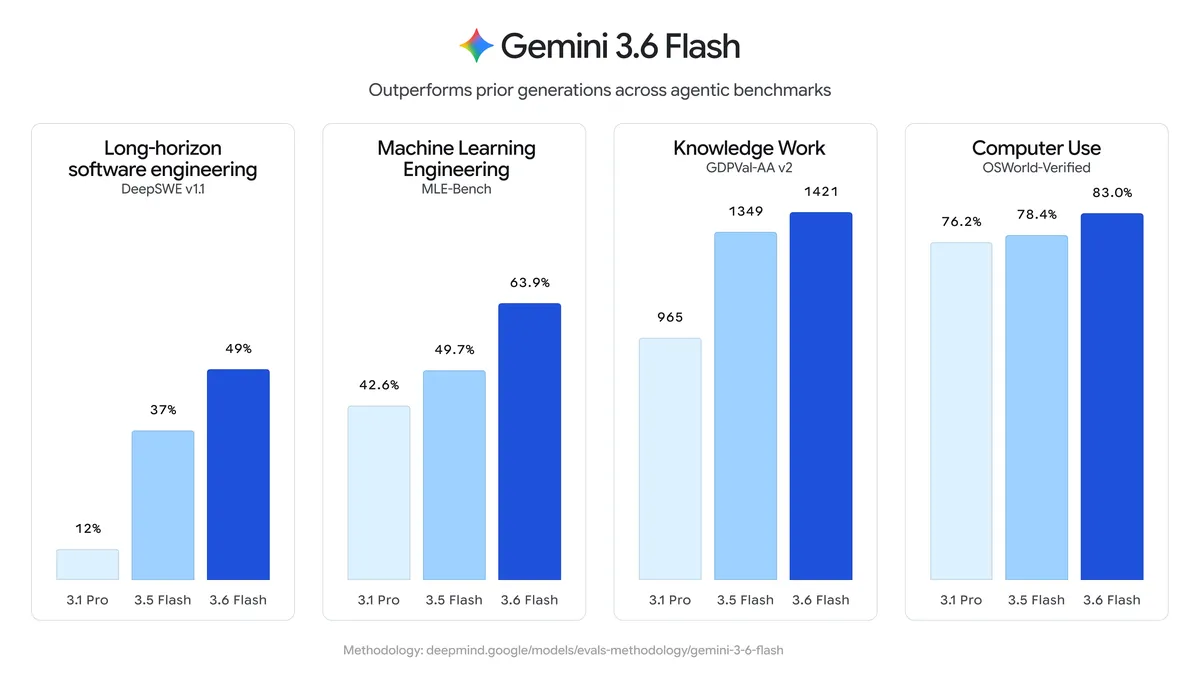
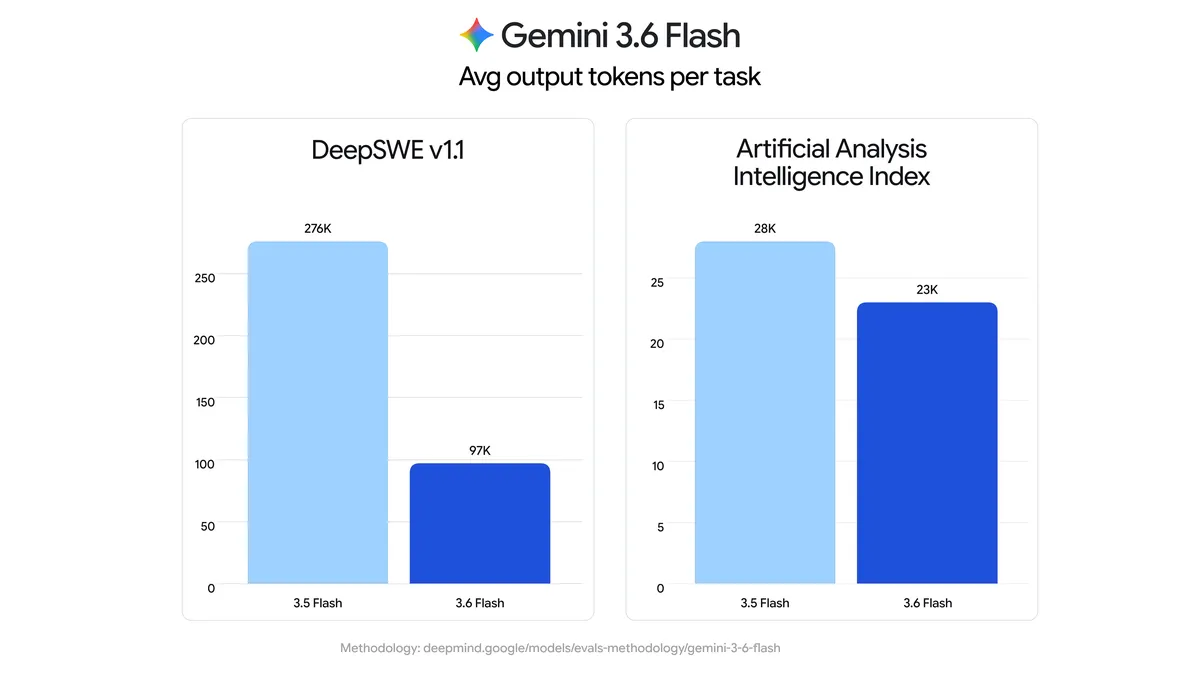
Google is expanding its Gemini model lineup with the release of new versions: Gemini 3.6 Flash and Gemini 3.5 Flash Lite, optimized for operation in agentic workflows. These updates are designed to improve token efficiency and reduce task execution costs while maintaining high speeds.

What Happened
Google released Gemini 3.6 Flash, which is 17% more efficient in output token usage compared to the 3.5 Flash version, with generation costs dropping to $7.5 per 1 million tokens. Also introduced is Gemini 3.5 Flash Lite, optimized for high throughput (350 tokens/sec) with a price of $2.5 per 1 million output tokens and $0.3 per 1 million input tokens. Additionally, a specialized model, Gemini 3.5 Flash Cyber, was announced for cybersecurity tasks.
Context
The launch of these new models comes amid anticipation for the flagship Gemini 3.5 Pro, prompting Google to shift its focus from pure performance to the scalability and economic efficiency of autonomous systems. The primary emphasis is on supporting features such as tool use and computer use, which are critical for modern AI agents.
Why It Matters for the Industry
Google is moving toward an "agentic economy" strategy, where key metrics are not just intelligence levels, but also throughput and cost per task. This intensifies competition in the small/fast models segment, setting new standards for autonomous services such as automated customer support and coding assistants.
Why It Matters for Users
Developers gain tools to create cheaper and faster agentic chains; however, using Lite versions requires careful auditing. For example, according to estimates from Artificial Analysis, the cost per task when using Gemini 3.5 Flash Lite may increase from $0.04 to $0.09, necessitating a review of architecture and a choice between the efficiency of 3.6 Flash and the speed of the Lite version.
What Is Not Yet Known / Limitations
For certain segments, using Lite versions may lead to an increase in real task-based pricing due to changes in pricing policy, which could complicate the unit economics of simple agents.
Sources
Author
Look at AI, Editorial Team