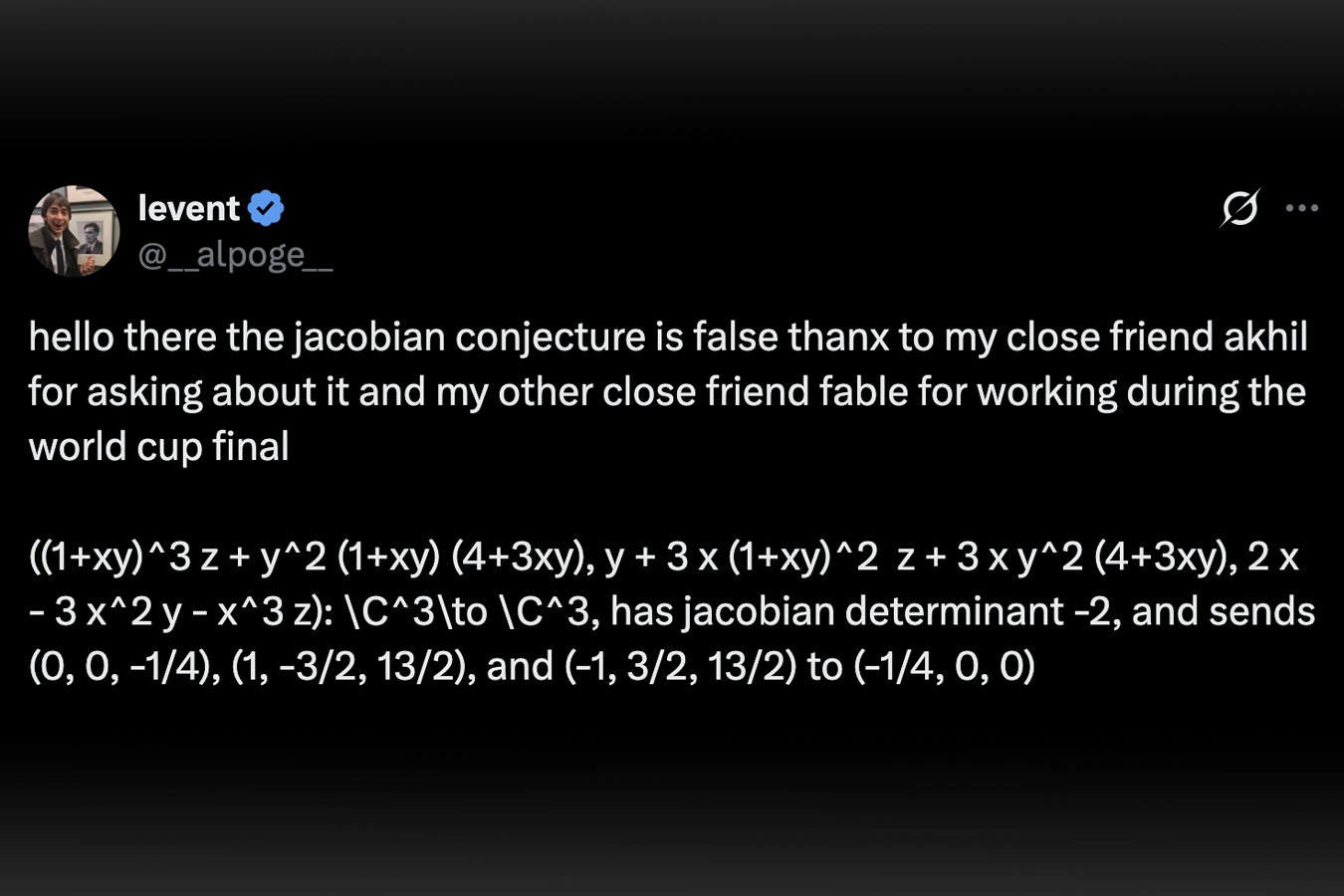
Harvard mathematician Levent Alpöge, with the help of artificial intelligence, has found a counterexample to the Jacobian conjecture, which had remained unsolved for 87 years. The use of AI to solve this fundamental problem marks a qualitative shift from text generation to solving complex logical problems in abstract sciences.

What Happened
Using AI, researcher Levent Alpöge was able to disprove the Jacobian conjecture by presenting a concise proof only 216 characters long. This breakthrough in mathematical reasoning allowed for the discovery of a specific counterexample to a proposition that had defied solution since 1939.
Context
The Jacobian conjecture has been considered one of the most difficult unsolved problems in mathematics for decades. Alpöge's achievement demonstrates the ability of modern models to operate in areas with an extremely high degree of abstraction and strict requirements for logical correctness, where error is unacceptable.
Why It Matters for the Industry
For the AI industry, this is a signal of the transition from content creation to the creation of full-fledged scientific agents. This paves the way for the development of DeepTech startups focused on the formal verification of hypotheses and changes the economics of R&D by using AI as an adversarial agent to test scientific theories.
Why It Matters for Users
For scientists and researchers, AI is becoming a true scientific co-pilot, capable of finding flaws in long-standing hypotheses and proposing compact mathematical structures. This changes the paradigm of LLM usage: they are now viewed as reliable tools for working in fields requiring ultra-high rigor of reasoning.
Sources
Author
Look at AI, Editorial Team