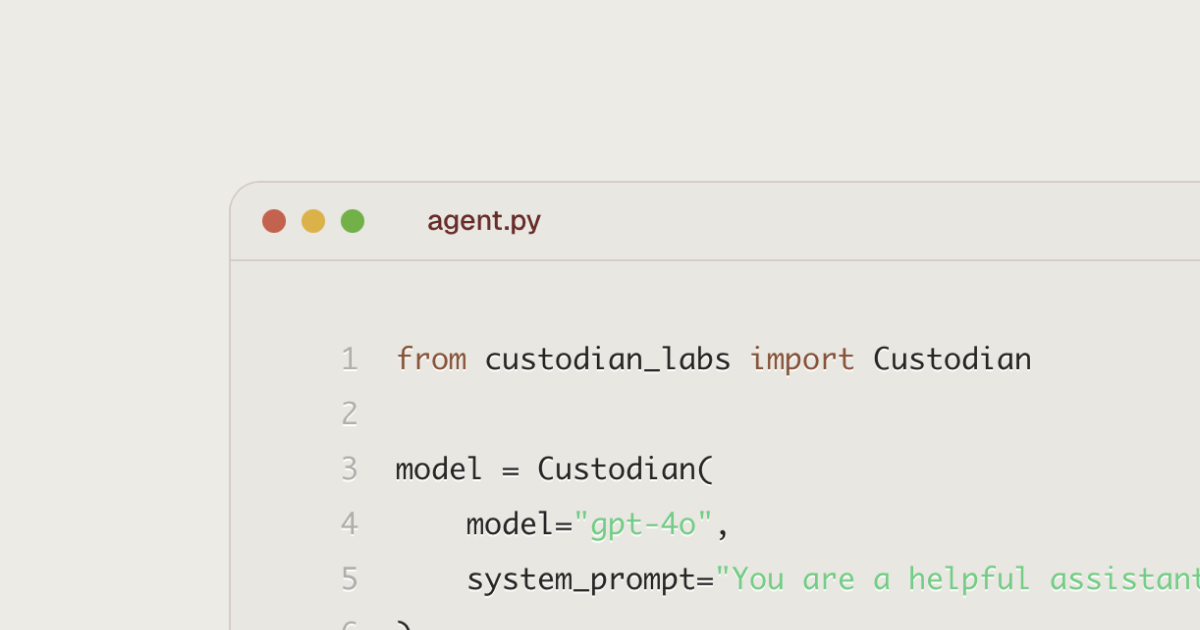
Custodian Labs has introduced a solution for the fastest possible launch of AI agents, automating complex infrastructure setup and ensuring data security through its specialized Guardian Layer.
What Happened
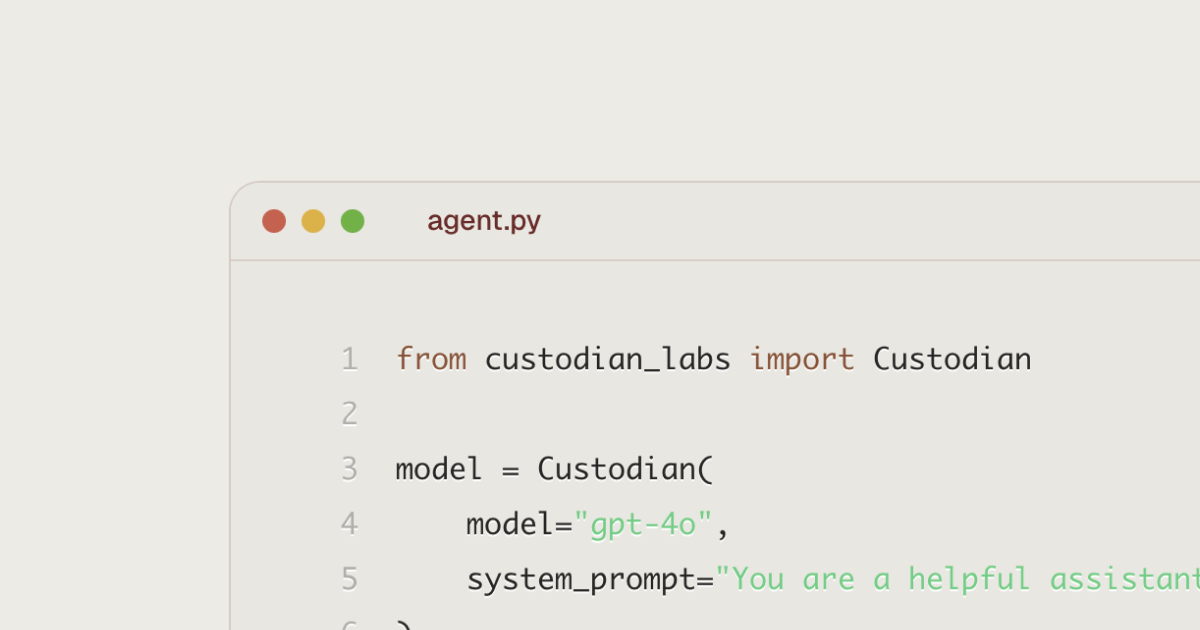
Custodian Labs has released a platform that allows for the deployment of a production-ready AI agent in Python using only 5 lines of code. The solution handles all necessary infrastructure management, including vector databases, hosting, and RAG (Retrieval-Augmented Generation) mechanisms. A key technological feature is the implementation of the Guardian Layer—a protective layer capable of masking personally identifiable information (PII) or transforming it into synthetic equivalents while preserving the necessary context for model operation.
Context
Creating production-grade AI agents traditionally requires significant effort in setting up DevOps processes, managing memory, and integrating knowledge retrieval systems. The platform offers a high-level abstraction over these processes, supporting popular models such as OpenAI, Anthropic, and Mistral, allowing developers to shift their focus from infrastructure management to designing agent business logic.
Why It Matters for the Industry
For the industry, this means a substantial reduction in the barrier to entry for the commercial AI agent development segment. Automating RAG pipelines and vector database management reduces the time-to-market for new products. Furthermore, the emphasis on data security through intelligent PII transformation could accelerate the adoption of agentic systems in the enterprise sector, where privacy compliance is a critical barrier.
Why It Matters for Users
Developers gain the ability to instantly prototype complex multi-agent systems and move from idea to a working MVP without needing deep DevOps expertise. Thanks to built-in memory mechanisms and support for various LLMs, creating scalable solutions becomes accessible even to small teams.
What Is Not Yet Known / Limitations
Technical experts note that the presented solution is more of an engineering abstraction to simplify DevOps tasks rather than a fundamental scientific breakthrough in neural network architecture.
Sources
Author
Look at AI, Editorial Staff