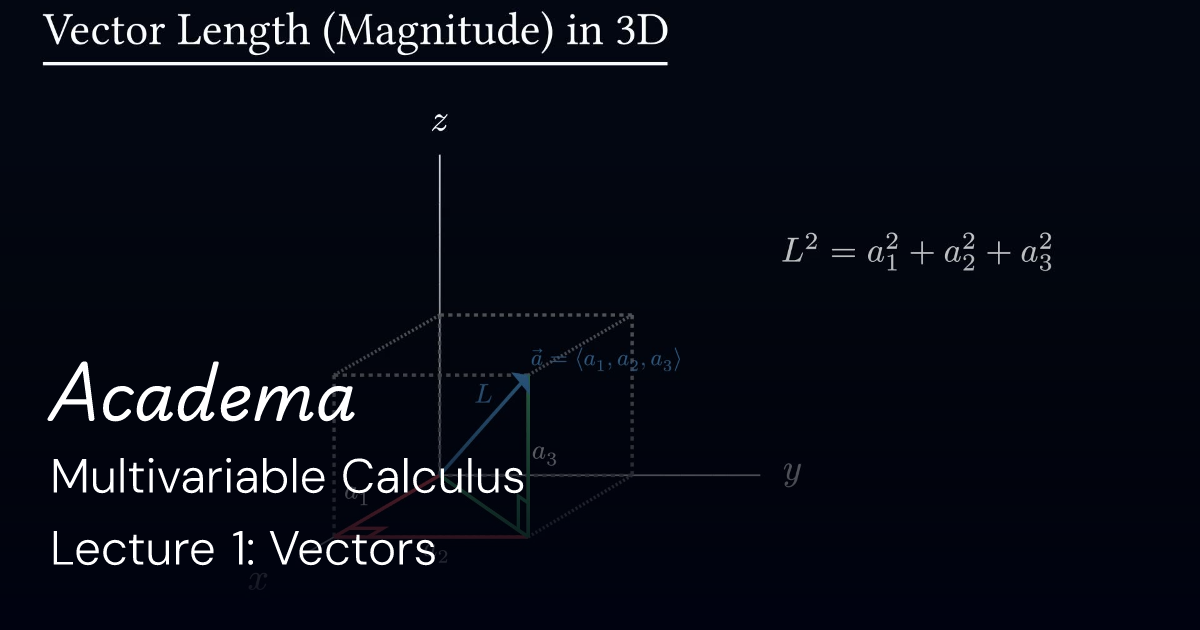
Startup Academa.ai has introduced the first computer-animated course on Multivariable Calculus, built upon deep integration with large language models. The platform transforms the learning process, allowing students to interact with video lectures through contextual questions and receive instant explanations of complex mathematical concepts.
What Happened
Academa.ai has launched a specialized educational course on multivariable calculus that utilizes LLMs to provide interactivity. Students can ask questions directly regarding the video content, receive detailed explanations for specific steps in formulas or visualizations, and study the material in English, German, and French. The platform combines animated visual content with text and semantic layers driven by artificial intelligence.
Context
Traditional EdTech platforms are oriented toward passive consumption of video content, where the user simply watches lectures. The emergence of solutions like the project from Academa.ai marks a transition toward the concept of AI-native learning, where the LLM acts not just as an external chatbot, but as a full-fledged contextual assistant integrated into the very structure of the educational material.
Why It Matters for the Industry
For the industry, this is an important case study of the transition from standard video courses to interactive environments where AI understands visual and mathematical context. This stimulates the development of RAG (Retrieval-Augmented Generation) technologies capable of mapping video timestamps to semantic content, and creates demand for smart indexing tools for multimodal content in STEM disciplines.
Why It Matters for Users
Students and researchers gain the ability to study complex disciplines at a personalized pace. AI helps reduce cognitive load by breaking down complex calculation steps in real time, making the study of high-level mathematics more accessible and interactive.
What Is Not Yet Known / Limitations
There are concerns regarding the technical implementation of response precision in STEM disciplines and the reliability of RAG mechanisms when mapping mathematical formulas to video sequences.
Sources
Author
Look at AI, Editorial Staff