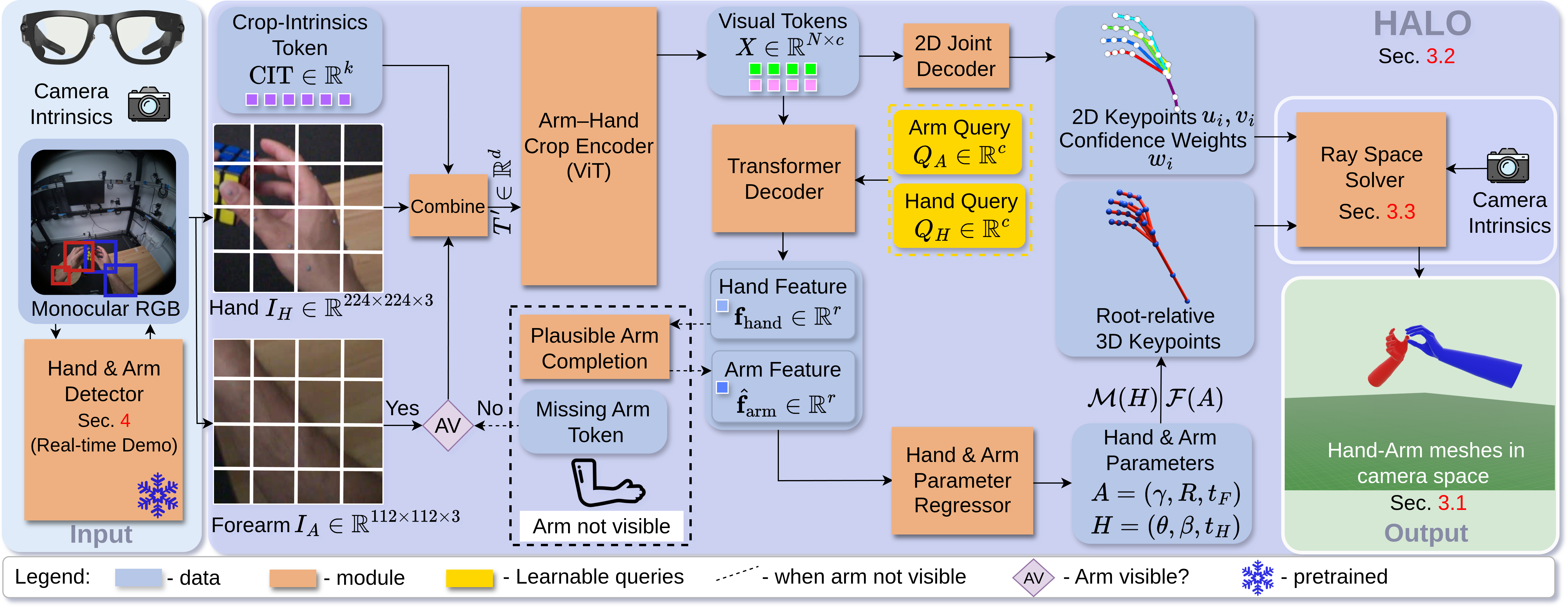
EgoForce has been introduced—an innovative framework for 3D reconstruction of hand pose and forearm geometry based on monocular video from first-person cameras, such as smart glasses. The system utilizes a unified transformer capable of working with various lens types, including fisheye and wide-angle, ensuring high accuracy even in challenging filming conditions.

What Happened
The EgoForce framework has been developed, significantly increasing 3D reconstruction accuracy on the HOT3D dataset (28% higher than existing analogs). The technology addresses scale ambiguity and occlusion issues using a "missing-arm tokens" mechanism and a variational prior distribution, allowing it to predict hand position even when the forearm is not within the camera's field of view.
Context
Traditional high-precision tracking systems often rely on expensive sensors such as LiDAR or stereo cameras, which increases device cost and bulk. EgoForce offers a software-based solution for monocular video, eliminating the need for specific calibrations for every lens type thanks to its unified transformer architecture.
Why It Matters for the Industry
For the industry, this paves the way for creating cheaper and more compact AR/VR devices, as the need for expensive depth-sensing hardware is reduced. This simplifies the development of consumer wearables and telepresence systems, allowing the use of standard monocular cameras instead of complex sensor systems.
Why It Matters for Users
Developers of metaverses, robotics, and augmented reality systems gain a tool to transform ordinary video from a wearable camera into precise 3D data regarding hand movements. This enables the creation of more natural control interfaces and the prototyping of human-computer interaction (HCI) systems using Unity and standard cameras.
What Is Not Yet Known / Limitations
There are concerns regarding the technology's readiness for real-world industrial use, specifically regarding latency, computational requirements (compute), and stability in real-world environments.
Sources
Author
Look at AI, Editorial Staff