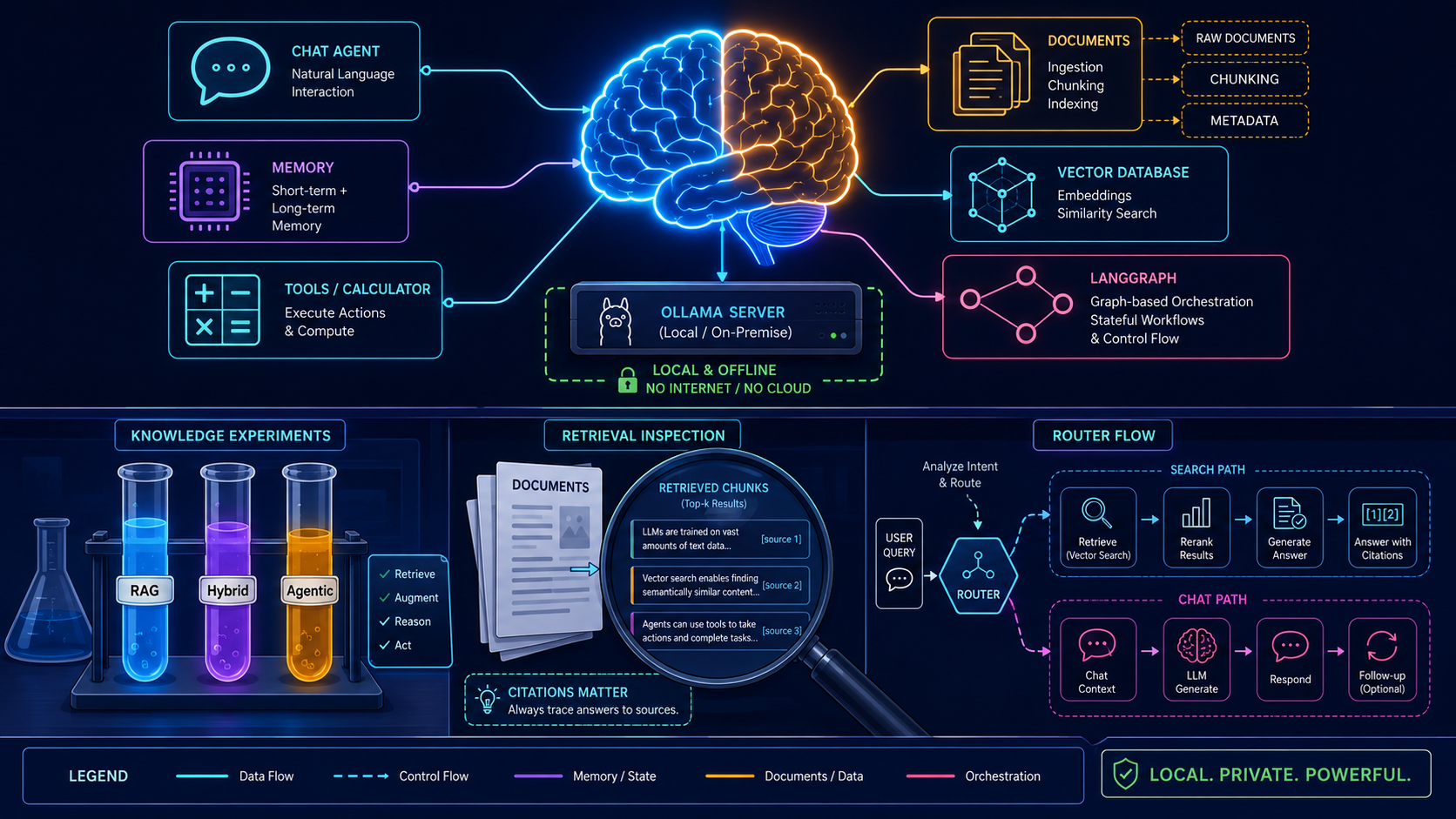
A new educational project, Agents-Sandbox, has been introduced, allowing for detailed investigation of various AI agent architectures within a single modular environment.

What Happened
Developer Ilia Rudnik has released Agents-Sandbox—a platform based on LangChain and Ollama for the comparative analysis of AI agent operational mechanisms. The tool allows for testing various memory strategies (buffer, summary), function calling methods (ReAct, native bind_tools), and RAG system operations (Chroma, LlamaIndex, Haystack, NumPy) through a unified command-line interface (CLI).
Context
Developing modern agentic systems requires a deep understanding of how a model makes decisions regarding tool selection or information retrieval. Agents-Sandbox provides an environment for local testing of these processes without the need to write large amounts of boilerplate code or use expensive proprietary models.
Why It Matters for the Industry
The project promotes the standardization of the R&D process in the field of agent architectures. The use of a modular approach and the ability to compare the effectiveness of different retrieval (RAG) and routing methods on local models helps accelerate the development cycle and lower the barrier to entry for creating complex systems.
Why It Matters for Users
Developers and researchers gain a tool to 'look under the hood' of agentic systems. This allows for visual study of execution traces and understanding why an agent chooses a particular path, which simplifies debugging and the transition from simple chatbots to complex autonomous systems.
What Is Not Yet Known / Limitations
The tool is intended for education and prototyping and is not a production-ready solution, as it lacks security and management mechanisms.
Sources
Author
Look at AI, Editorial Team