
ProxyPose has been introduced—an innovative framework for high-precision 6-DoF pose tracking from monocular video, utilizing generative AI capabilities to solve tasks in complex visual environments.

What Happened
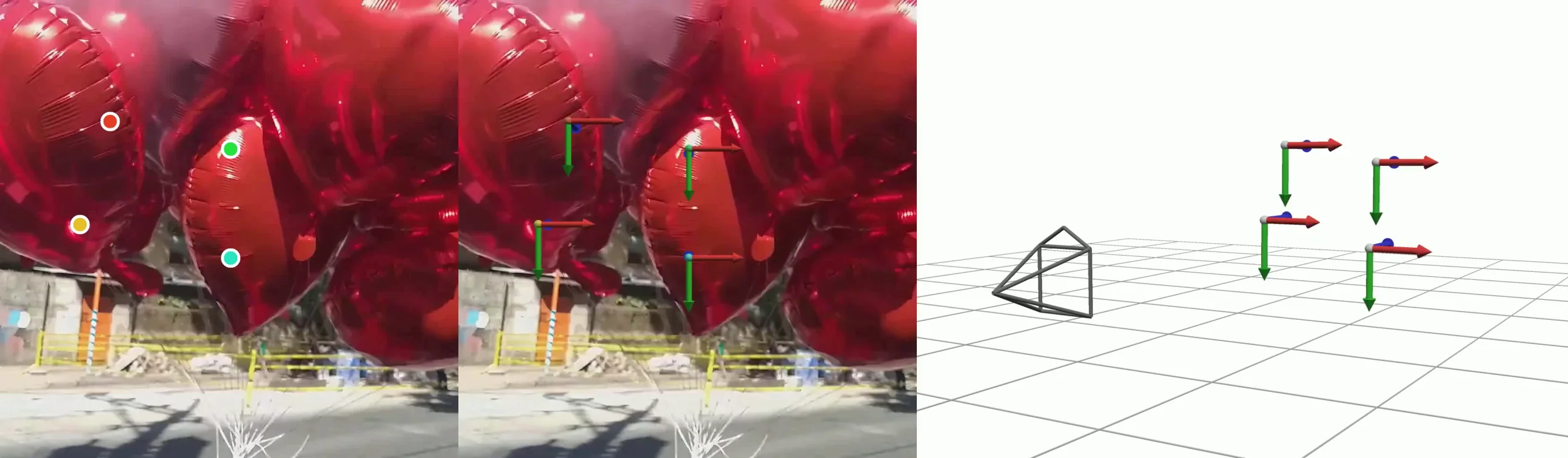
A method called ProxyPose has been developed, which combines LoRA-based generative video-to-video transformation for the Wan2.1-T2V-14B model with classical geometry (PnP and contour matching). The system creates "proxy videos" featuring a synthetic object that mimics the movement of a selected pixel, allowing for the extraction of an accurate 3D motion trajectory. The method demonstrated SOTA results on the HO3D and YCBInEOAT datasets, successfully handling reflections, transparent objects, and occlusions.
Context
Traditional computer vision methods, such as COLMAP, often struggle when working with objects that have complex textures, poor lighting, or mirrored surfaces. ProxyPose addresses this issue by using a generative model to create visual context that "fills in" missing details for subsequent mathematical analysis.
Why It Matters for the Industry
ProxyPose offers a new hybrid approach that combines generative AI with classical computer geometry. This opens up possibilities for creating more stable AR/VR systems and robotic vision, allowing high-precision tracking to be integrated into existing video analytics pipelines without the need for specialized sensors.
Why It Matters for Users
For end users and application developers, this means the ability to obtain an accurate 3D motion trajectory of an object simply by selecting a point in an ordinary video. This significantly simplifies motion capture and AR tasks, eliminating the need for expensive motion capture equipment.
What Is Not Yet Known / Limitations
There is a significant computational barrier: the use of the heavy Wan2.1-T2V-14B video model makes real-time use of the method difficult at the moment without additional optimization or model distillation.
Sources
Author
Look at AI, Editorial Staff