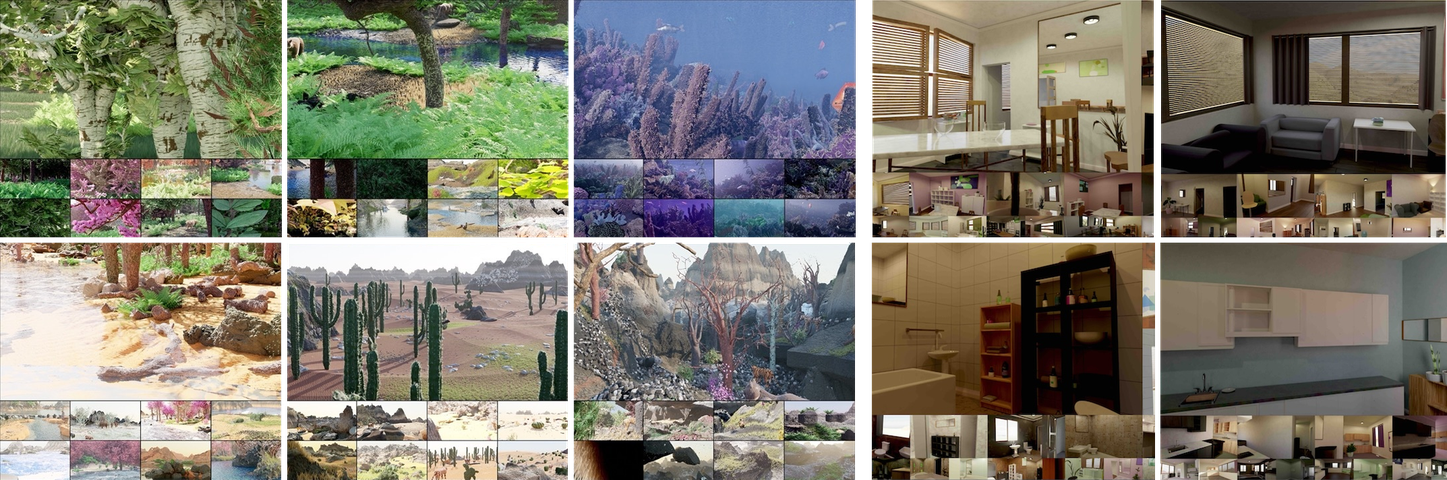
An updated version of the Infinigen tool (Infinigen 2.0/Indoors) has been introduced, expanding the capabilities of procedural 3D scene generation by allowing the creation of detailed indoor environments based on mathematical rules.


What Happened
Developers have released Infinigen 2.0, which focuses on the generation of indoor spaces (Indoors). The system allows for the creation of objects, materials, and geometry by controlling the process through a Python API. Generation can be performed on a CPU in just one minute and integrates fully with Blender via the Cycles renderer.
Context
Unlike traditional methods, where detail is often achieved through the use of "fake" maps (bump/normal maps), Infinigen uses mathematical algorithms to create real geometric precision. This enables a transition from manual modeling to a Code-to-Scene approach.
Why It Matters for the Industry
For the AI and robotics industry, this tool becomes an efficient way to create high-precision synthetic datasets for training Computer Vision. The use of a procedural approach allows for the generation of infinite volumes of data without visual artifacts, which is critical for training visual perception models in complex environments.
Why It Matters for Users
Game developers and 3D project creators gain the ability to create unique, high-quality scenes using software code, which is significantly faster and cheaper than manual modeling. The tool lowers the barrier to entry for creating basic datasets and prototyping complex game worlds.
What Is Not Yet Known / Limitations
At the current stage, functionality is limited: the tool is in a preview version and offers a limited set of room types.
Sources
Author
Look at AI, Editorial Staff