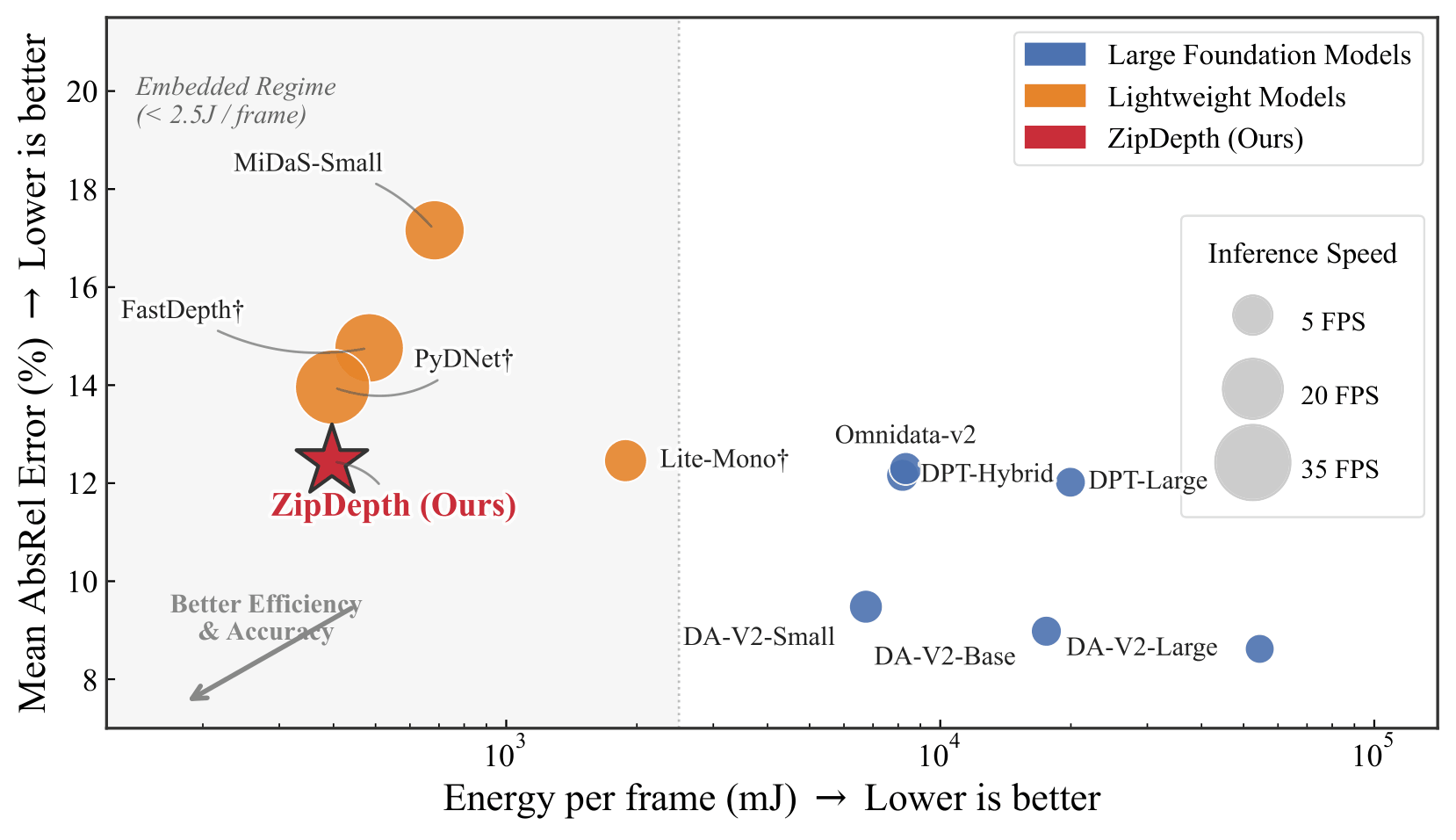
ZipDepth has been introduced—a compact neural network for monocular depth estimation, optimized for mobile devices and Edge platforms. The model contains only 6.1 million parameters and was trained using knowledge distillation from the heavy Depth Anything v2-Large on a dataset of 14.1 million images.


What Happened
Developers have presented ZipDepth, which achieves high accuracy on NYUv2 and ScanNet benchmarks thanks to an architecture featuring reparameterizable convolutions (RepVGG) and adaptive upsampling. The model demonstrates exceptional performance: up to 715 FPS on iPad Pro M4 and 375 FPS on iPhone 12.
Context
The technology is based on the knowledge distillation method, where the capabilities of giant foundation models are transferred into ultra-lightweight architectures. This eliminates the need for powerful cloud servers for computer vision tasks.
Why It Matters for the Industry
ZipDepth demonstrates the possibility of effectively transferring knowledge from large-scale models to Edge solutions without critical loss of quality. The use of reparameterizable blocks allows complex structures to be simplified into standard convolutions during inference, which is critical for compatibility with mobile NPUs and DSPs.
Why It Matters for Users
High-precision scene depth estimation from a single photo or video is now available in real-time directly on smartphones and embedded systems, such as Jetson Orin. This opens new possibilities for creating mobile AR and autonomous robotics without the latency associated with network requests.
Sources
Author
Look at AI, Editorial Team