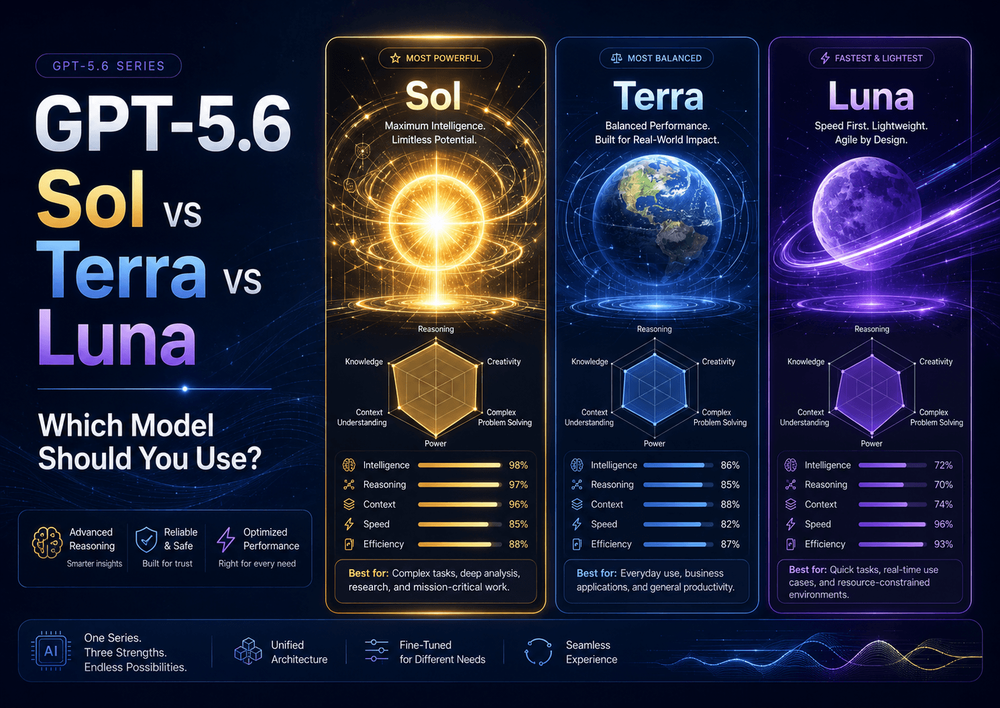
OpenAI has announced the release of the next generation of GPT-5.6 models, offering a three-tier architecture for task optimization, and introduced ChatGPT Work—a tool designed for the autonomous, long-term operation of neural networks on complex projects.
What Happened
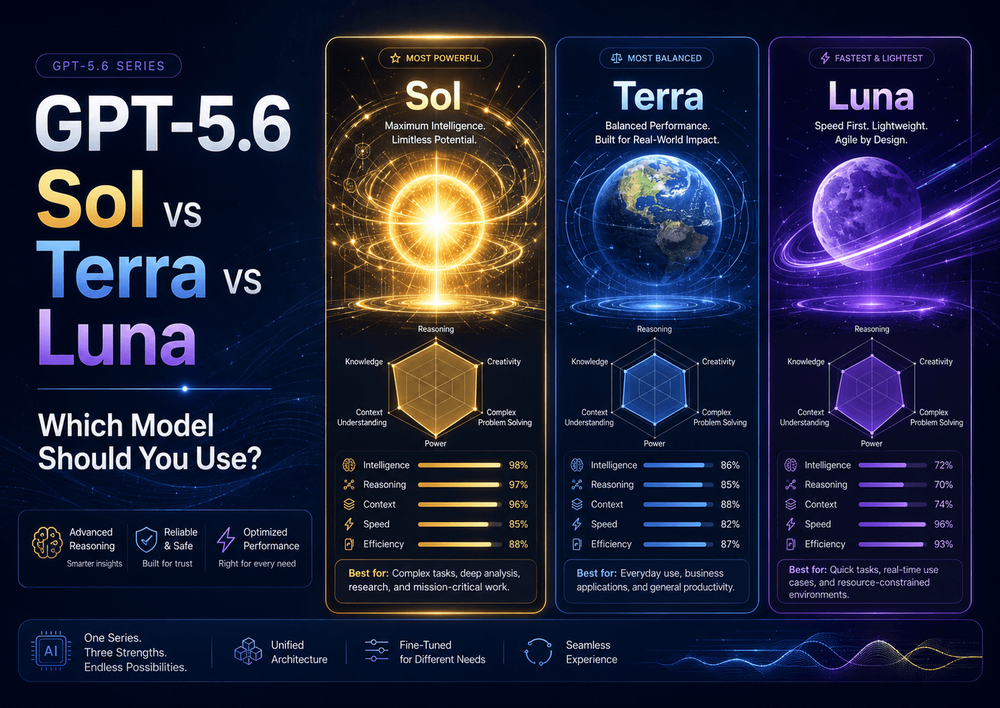
OpenAI introduced the GPT-5.6 model family, consisting of three tiers: the flagship Sol for deep coding and science, the balanced Terra, and the fast Luna. The lineup includes new reasoning modes: 'max' for deep single-agent reasoning and 'ultra' for orchestrating parallel agents. Additionally, the ChatGPT Work product has been launched, designed for autonomous, multi-hour work with large contexts, and Codex functionality has been directly integrated into the ChatGPT interface.
Context
OpenAI's strategic shift from monolithic models to a multi-tier architecture and agentic workflows is aimed at increasing computational resource efficiency. The implementation of Programmatic Tool Calling allows models to independently define and generate tools to perform tasks, simplifying API interaction.
Why It Matters for the Industry
For the industry, this signifies a shift toward standardizing agentic workflows around the OpenAI architecture. Using specialized models (Sol/Terra/Luna) allows developers to build applications with more predictable unit economics by choosing the optimal price-to-quality ratio. The 'ultra' mode sets a new standard for multi-agent systems, where models act as autonomous digital employees.
Why It Matters for Users
Users can now select a model based on specific needs: Luna for simple everyday queries, Terra for standard work, and Sol for critical research or programming. The new ChatGPT Work mode allows users to delegate long-running tasks to the AI that previously required constant human supervision.
What Is Not Yet Known / Limitations
As systems transition toward autonomy, enterprise AI architecture experts point to the need for a revision of management and security processes.
Sources
Author
Look at AI, Editorial Team