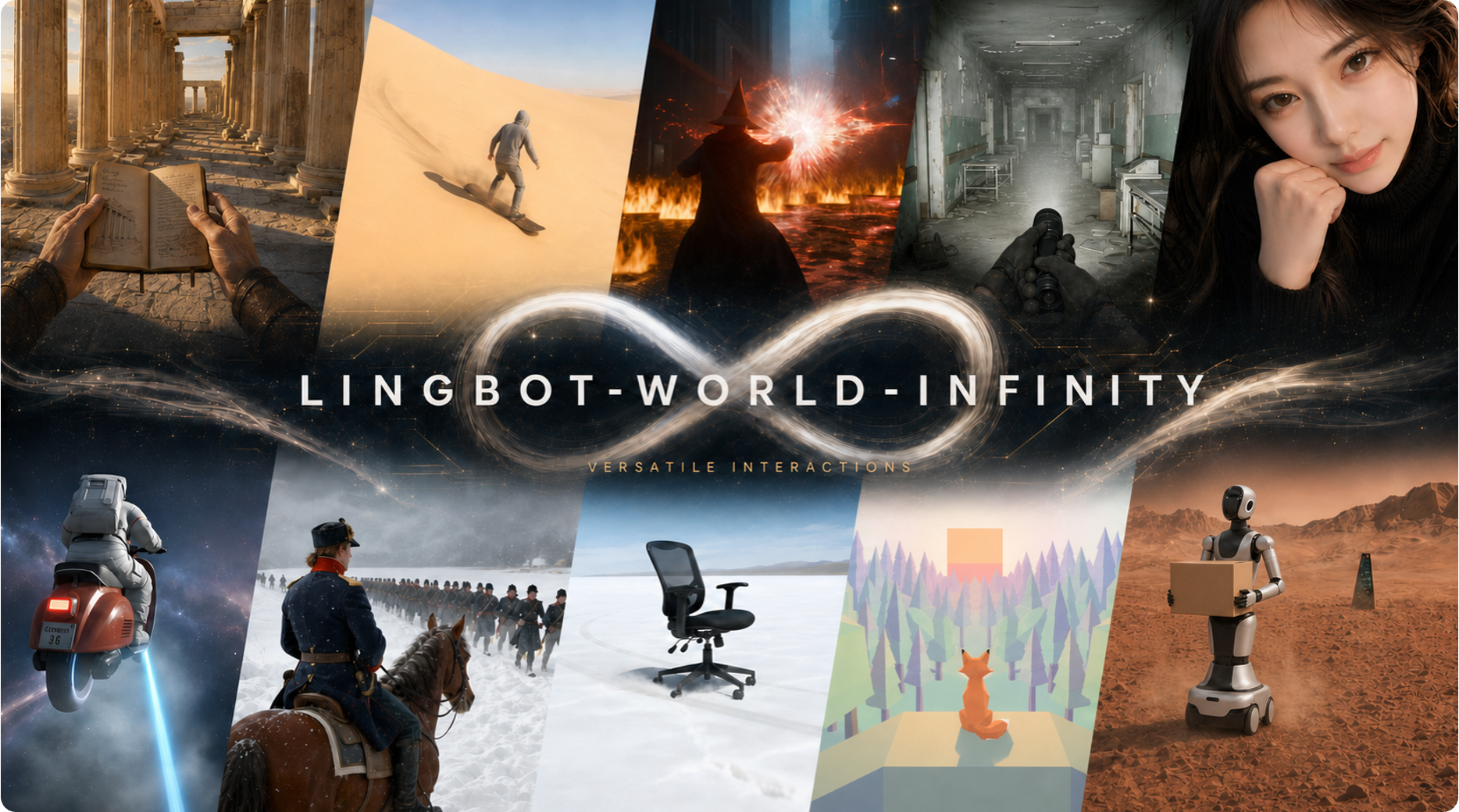
LingBot-World 2.0 (also known as LingBot-World-Infinity) has been introduced—a world generative model capable of creating infinite interactive environments in real time at 720p resolution at 60 fps, with control latency of less than one second.


What Happened
Developers have introduced LingBot-World 2.0, which utilizes an agentic architecture for dynamic environment synthesis. The system splits control between two agents: the *pilot*, responsible for character actions, and the *director*, which synthesizes new world elements as the scene evolves. This allows for high performance and visual consistency during long generation sessions.
Context
Traditional game worlds are built based on pre-baked content. LingBot-World 2.0 proposes a shift toward a runtime-generation paradigm, where the world is created "on the fly" based on text or visual commands, effectively replacing traditional rendering pipelines.
Why It Matters for the Industry
This technology is a significant step toward creating full-fledged generative game engines. Using the pilot + director approach allows for the separation of action execution and environment evolution, which is critical for scalability and the long-term stability of the visual sequence. In the long term, this could transform the GameDev industry by shifting the focus from asset-oriented production to procedurally generated environments and creating efficient simulators for robot training (Sim-to-Real).
Why It Matters for Users
For players, this opens the path to creating infinite adventures in games that are fully AI-generated and adapt to user actions in real time, without pre-set levels or boundaries.
What Is Not Yet Known / Limitations
There is a gap between the optimistic assessments of product roles and the skepticism of engineers regarding the physical correctness of the simulation, as well as uncertainty regarding inference costs and scalability.
Sources
- LingBot-World 2.0 Summary - Robbyant
- GitHub - Robbyant/lingbot-world-v2
- arXiv:2607.07534 - Infinite Worlds with Versatile Interactions
Author
Look at AI, Editorial Staff