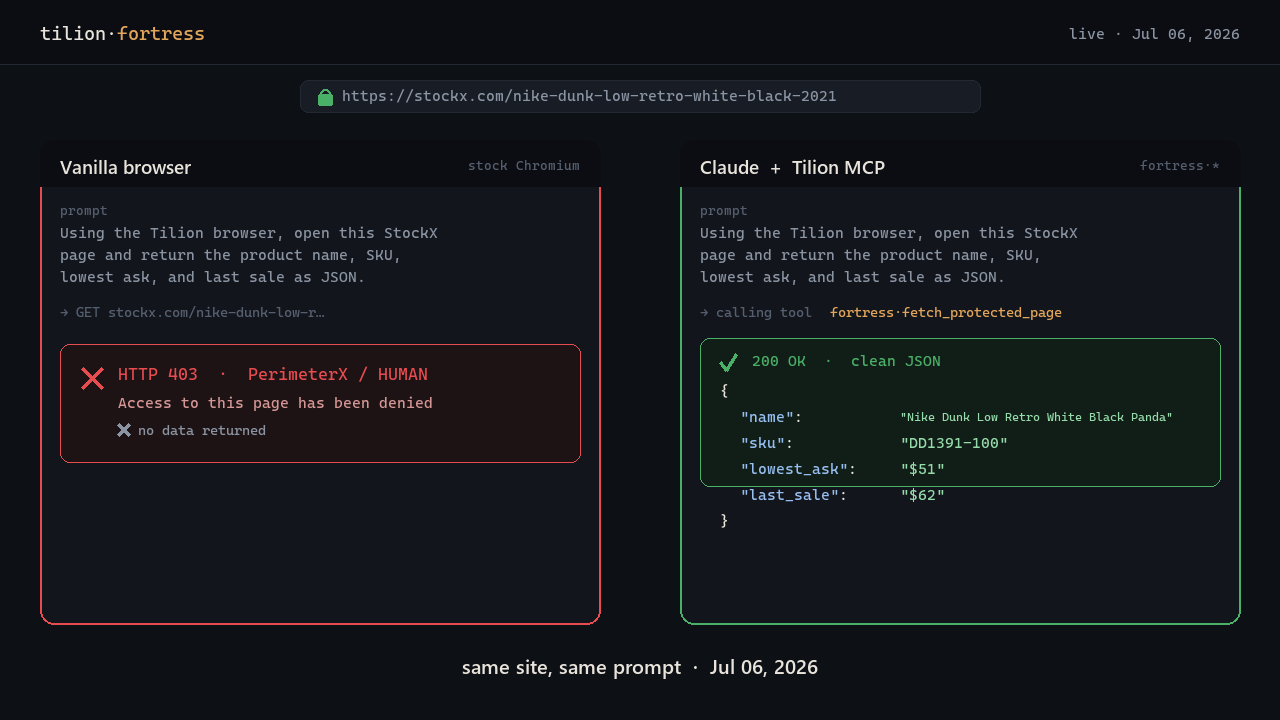
Fortress MCP has been introduced—a specialized Model Context Protocol server developed to ensure seamless access for AI agents to web resources protected by Cloudflare, DataDome, and PerimeterX systems.

What Happened
Developers from the Tilion project have released Fortress MCP, which utilizes a specialized Chromium engine to mimic real user actions. The tool includes 29 functional tools, including web page reading, performing various browser tasks, and full session management, allowing it to bypass CAPTCHAs and other protection mechanisms.
Context
Modern anti-bot protection systems often create an "information blindness" effect for autonomous AI agents, blocking their attempts at automated interaction with content. Fortress MCP operates at the Model Context Protocol (MCP) level, allowing it to be easily integrated into existing frameworks like Claude Code, bridging the gap between a model's ability to reason and its physical ability to retrieve data from protected sources.
Why It Matters for the Industry
This tool could become an important standard for expanding LLM capabilities, turning MCP servers into an abstraction layer for web surfing functions. This may trigger an "arms race" between developers of bypass tools and creators of protection systems, leading to more complex agent system architectures and a need for deeper imitation of human behavior at the browser kernel level.
Why It Matters for Users
Developers of AI agents and automations receive a ready-made toolkit that allows them to instantly increase the autonomy of their systems. Instead of writing complex and labor-intensive workarounds for every protected site, users can use a standardized method for interacting with protected content, significantly accelerating prototyping and the time-to-market for new agent solutions.
What Is Not Yet Known / Limitations
For production use, additional data regarding latency, scalability, and the stability of bypassing dynamic protection systems is required. It is also worth noting that from an ML research perspective, the project is an applied engineering solution rather than a scientific breakthrough in model architecture.
Sources
Author
Look at AI, Editorial Team