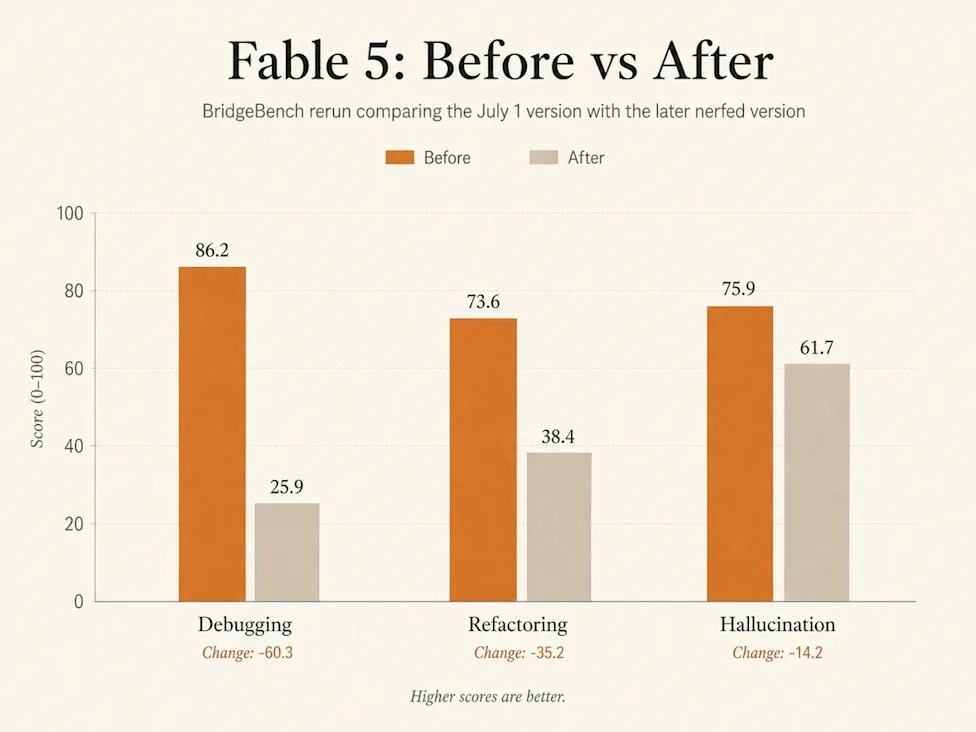
Anthropic's flagship model, Claude Fable 5, has faced a wave of user dissatisfaction following an update to its safety mechanisms. Tests show a sharp drop in efficiency for technical tasks, caused by the issue of over-refusal.
What Happened
Following a re-release on July 1, the model's performance metrics in specific tasks significantly declined. According to tests by the BridgeMind group, debugging accuracy dropped from 86.2 to 25.9, and refactoring scores decreased from 73.6 to 38.4.
Context
The problem is not related to a degradation of the model's cognitive abilities or reasoning levels, but rather to the operation of new safety classifiers. These mechanisms erroneously classify standard programming tasks as potential cyber threats, leading to the effect of over-refusal.
Why This Matters for the Industry
The 'over-refusal' problem is becoming critical for developers of frontier models. Attempts to implement strict safety filters can lead to a degradation of the utility of AI tools for agents and developers, opening the market for less censored alternatives and specialized open-source solutions.
Why This Matters for Users
Developers using Claude for writing and optimizing code may find that the model more frequently refuses to perform routine tasks. This reduces the reliability of automated coding and requires a reassessment of prompt engineering approaches or a transition to other models.
What Remains Unknown / Limitations
The focus of the discussion is shifting from purely engineering risks to strategic market questions and the conflict between compliance requirements and operational efficiency.
Sources
Author
Look at AI, Editorial Staff