
According to a new report from OpenLLMStack, the performance gap between open-weight models and closed proprietary systems has shrunk to a record 3.3%. Amidst the dominance of Chinese developers and a radical reduction in inference costs, the AI industry is entering an era of mass autonomous agent deployment.
What Happened
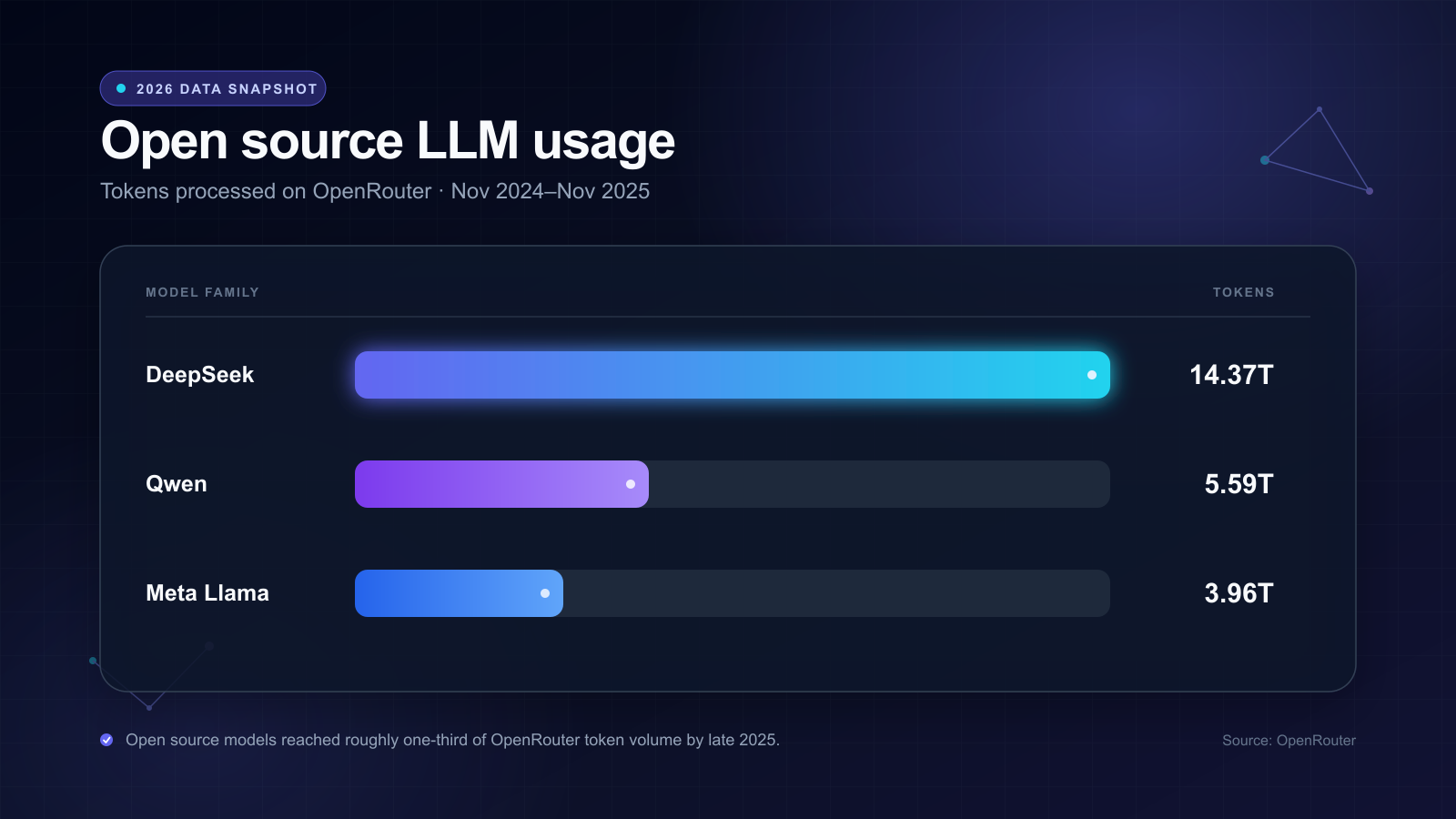
The 2026 OpenLLMStack report recorded a fundamental shift in the AI ecosystem. The quality gap between open-weight models and closed APIs has become statistically insignificant (only 3.3% according to the Stanford AI Index). Key trends include the dominance of Chinese models, which account for 41% of Hugging Face downloads, and a sharp drop in model operating costs: for example, DeepSeek-V4-Flash is 97-99% cheaper than GPT-5.5. This phenomenon has also been dubbed the "DeepSeek effect," triggering volatility in the AI chip market.
Context
Previously, AI technology development was centered around powerful but closed proprietary APIs from major laboratories. However, rapid progress in open-weight solutions, such as Llama, DeepSeek, and Qwen, has led to technological convergence, where the availability of frontier-grade models allows for the construction of independent infrastructure layers without being tied to the OpenAI or Google ecosystems.
Why It Matters for the Industry
A paradigm shift is occurring for the industry: moving from an AI-as-a-Service model to an AI-as-an-Infrastructure model. The mass implementation of complex agentic architectures is becoming economically viable due to token costs dropping by two orders of magnitude. This lowers the barrier to entry for new players and shifts the center of technological influence toward Chinese developers, weakening the monopoly of large proprietary labs.
Why It Matters for Users
Users and developers now have the ability to run powerful AI locally or via ultra-cheap APIs without sacrificing quality. This enables a transition to self-hosted solutions for production tasks, providing greater independence from third-party ecosystems and significantly reducing the costs of scalable AI systems.
Sources
Author
Look at AI, Editorial Staff