
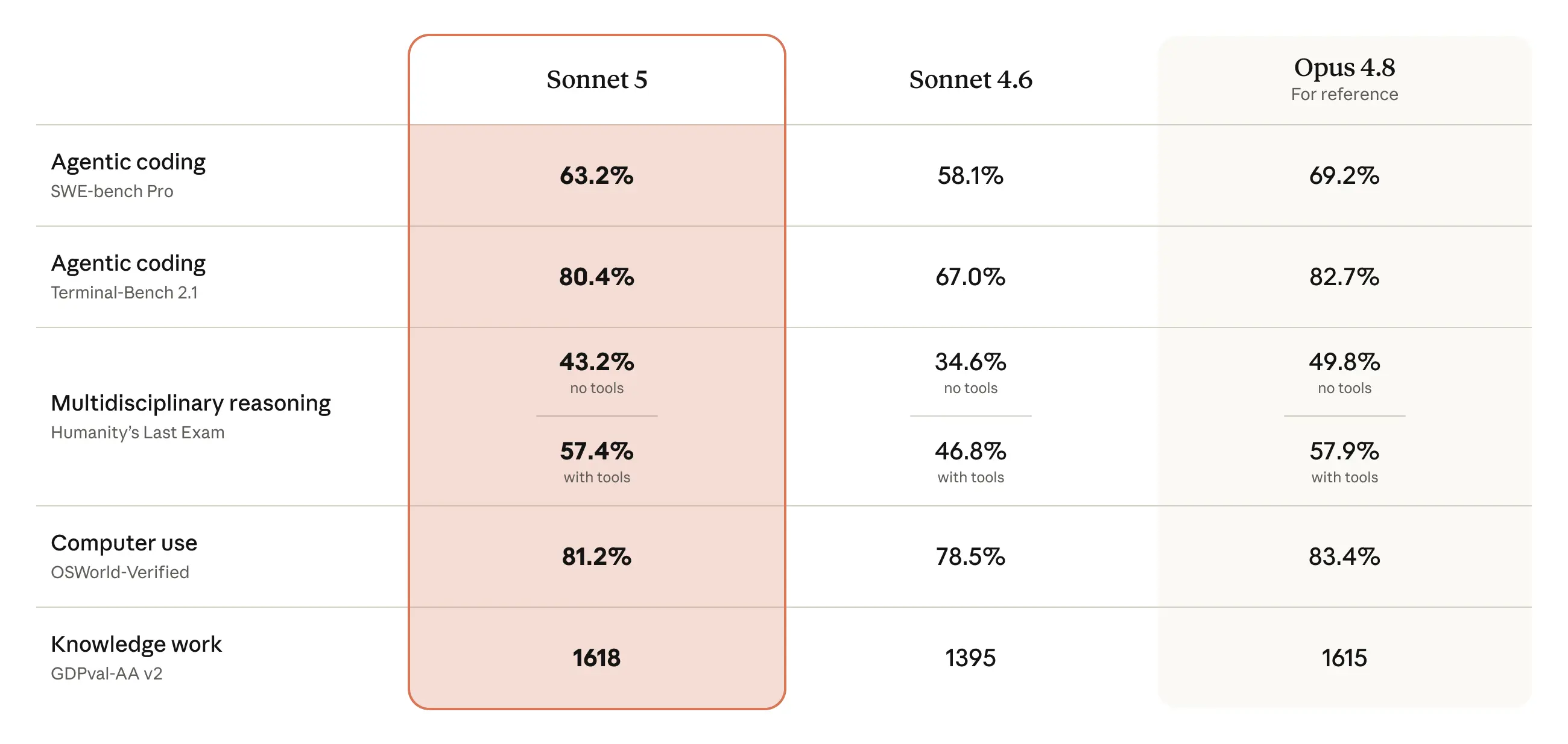
Anthropic has released its new Claude Sonnet 5 model, which is oriented toward the autonomous execution of complex agentic tasks, including planning, browser usage, and terminal operations. The new model demonstrates performance levels on par with the flagship Opus 4.8 while remaining significantly more affordable.

What Happened
Anthropic introduced Claude Sonnet 5, specializing in agentic scenarios. The model is capable of multi-step reasoning and effectively utilizes external tools such as browsers and terminals. Along with the model, an updated tokenizer was introduced, which may increase token consumption by 1.0–1.35x, a factor compensated for by a special pricing system.
Context
Claude Sonnet 5 represents a qualitative shift from universal chatbots to specialized agentic cores. Unlike previous iterations, the focus has shifted toward autonomy in coding and business process automation, while providing improved resilience to prompt injection and more effective rejection of harmful requests within agentic cycles.
Why It Matters for the Industry
For the AI industry, Claude Sonnet 5 becomes an efficient "engine" for creating autonomous systems. The balance between high performance (at the level of Opus 4.8) and low tool-use costs makes the model an ideal base layer for new vertical SaaS solutions, such as autonomous HR agents, AI coders, and automated QA systems.
Why It Matters for Users
For users and developers, this means a significant reduction in the barrier to entry for creating complex agentic systems. Using advanced AI agents for coding, CRM management, or data retrieval is now economically viable even for small projects, allowing for a rapid transition from prototypes to full-scale autonomous workflows.
What Is Not Yet Known / Limitations
The updated tokenizer may lead to a 1.0–1.35x increase in token consumption, which must be taken into account when calculating usage costs.
Sources
Author
Look at AI, Editorial Team