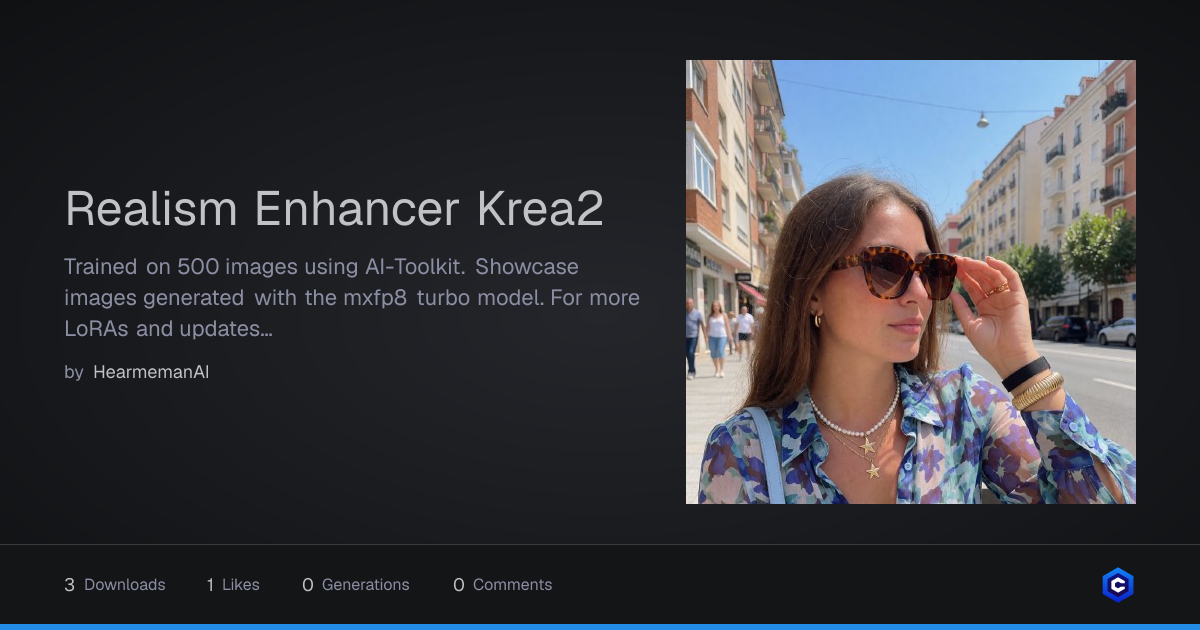
A new specialized LoRA model, Realism Enhancer Krea2 (v1.0), has been released on Civitai, designed to significantly enhance the visual quality of content generated with the new Krea 2 base model.
What Happened
Developers have released the Realism Enhancer Krea2 model, which is optimized to add high detail, sharp textures, and improved lighting to images created using Krea 2. The model supports a wide range of styles, including realistic portraits, anime, and fantasy, while maintaining the semantic integrity of the original prompt.
Context
The release of such adapters demonstrates the high speed at which the community adapts to new foundation models. Instead of waiting for updates to the base architecture, users utilize lightweight layers (LoRA) for rapid personalization and to bring results up to commercial-grade quality.
Why It Matters for the Industry
The emergence of specialized LoRA models for new architectures like Krea 2 accelerates the formation of an adapter ecosystem (including ControlNet). This allows companies and developers to more quickly integrate new SOTA solutions into automated content generation pipelines, creating efficient tools for final post-processing without the need to retrain large models.
Why It Matters for Users
Users gain the ability to significantly improve the detail and realism of their work in Krea 2 "out of the box," without resorting to complex prompt engineering or rewriting original queries. This simplifies the process of achieving professional visual results.
What Is Not Yet Known / Limitations
The technical novelty of the method itself (using LoRA on top of an existing model) is not a scientific breakthrough, but rather a matter of ecosystem adaptation. For full production integration via API, additional data regarding latency and inference costs is required.
Sources
Author
Look at AI, Editorial Team