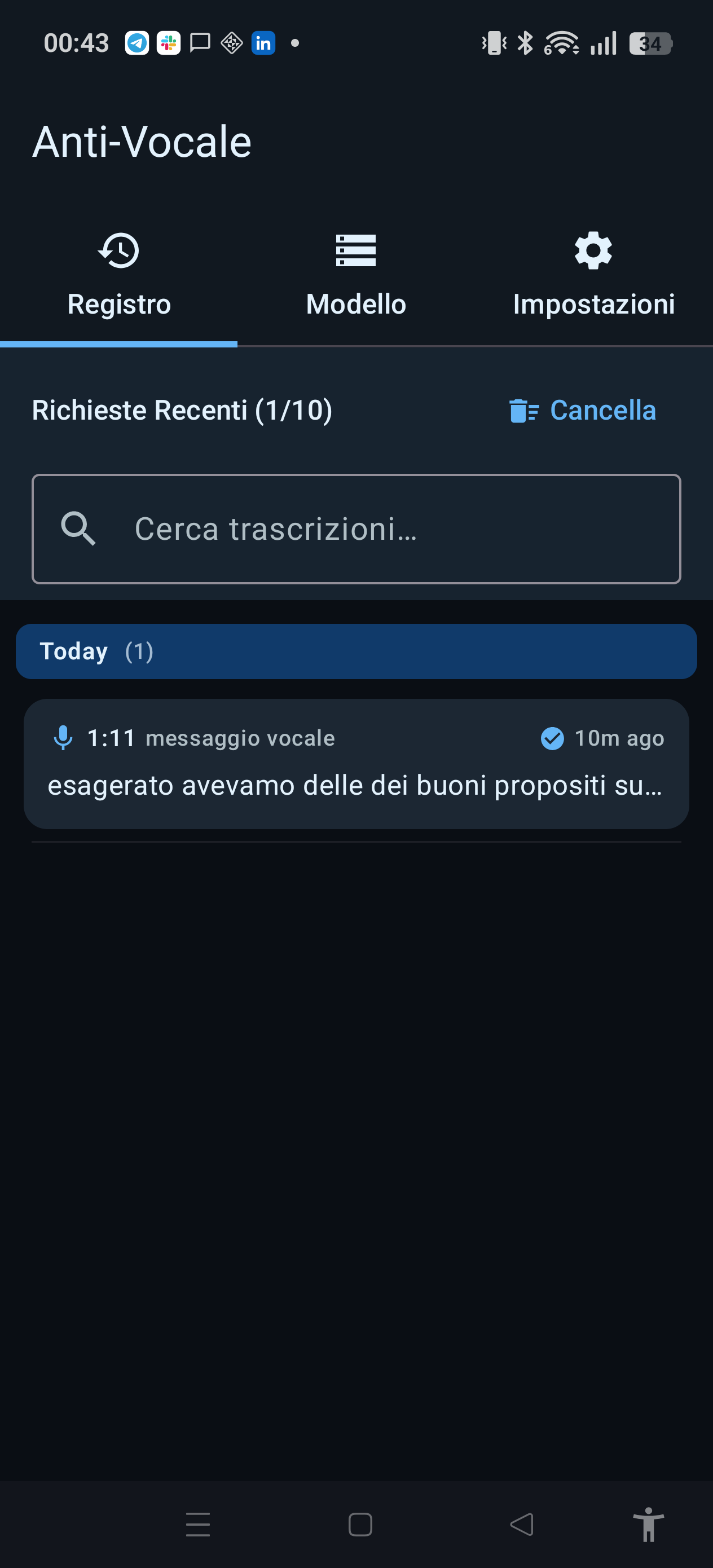
The Anti-Vocale project has been introduced—an Android application that enables converting voice messages to text entirely locally on the device, ensuring maximum privacy and autonomy.


What Happened
Developers have released Anti-Vocale, a mobile application for Android that supports a wide range of ASR (Automatic Speech Recognition) models, including Whisper, Gemma, Parakeet, Qwen3-ASR, and Nemotron 3.5. Users can select a specific model via the "Share" menu in messaging apps. For correct operation, a smartphone with at least 4 GB of RAM and approximately 500 MB of free space is required, although the models themselves can occupy up to 4.2 GB.
Context
The project implements the on-device ASR concept, moving speech processing from cloud servers directly onto mobile hardware. The use of optimized architectures, such as Parakeet TDT, and compressed model versions (for example, Whisper Turbo large, which is about 1 GB in size), makes high-accuracy speech recognition possible on consumer devices without the need for a constant internet connection.
Why It Matters for the Industry
The development of on-device ASR tools increases data privacy and reduces developers' economic dependence on cloud APIs. The emergence of such open-source solutions as Anti-Vocale lowers the barrier to entry for creating private services and provides a platform for testing various ASR architectures on real mobile hardware in offline conditions.
Why It Matters for Users
The application guarantees complete confidentiality, as audio files are not sent to the cloud. This is useful for those who want a text version of voice messages for quick searching through history or those forced to view messages in noisy environments, all while maintaining the ability to work completely offline.
Sources
Author
Look at AI, Editorial Team