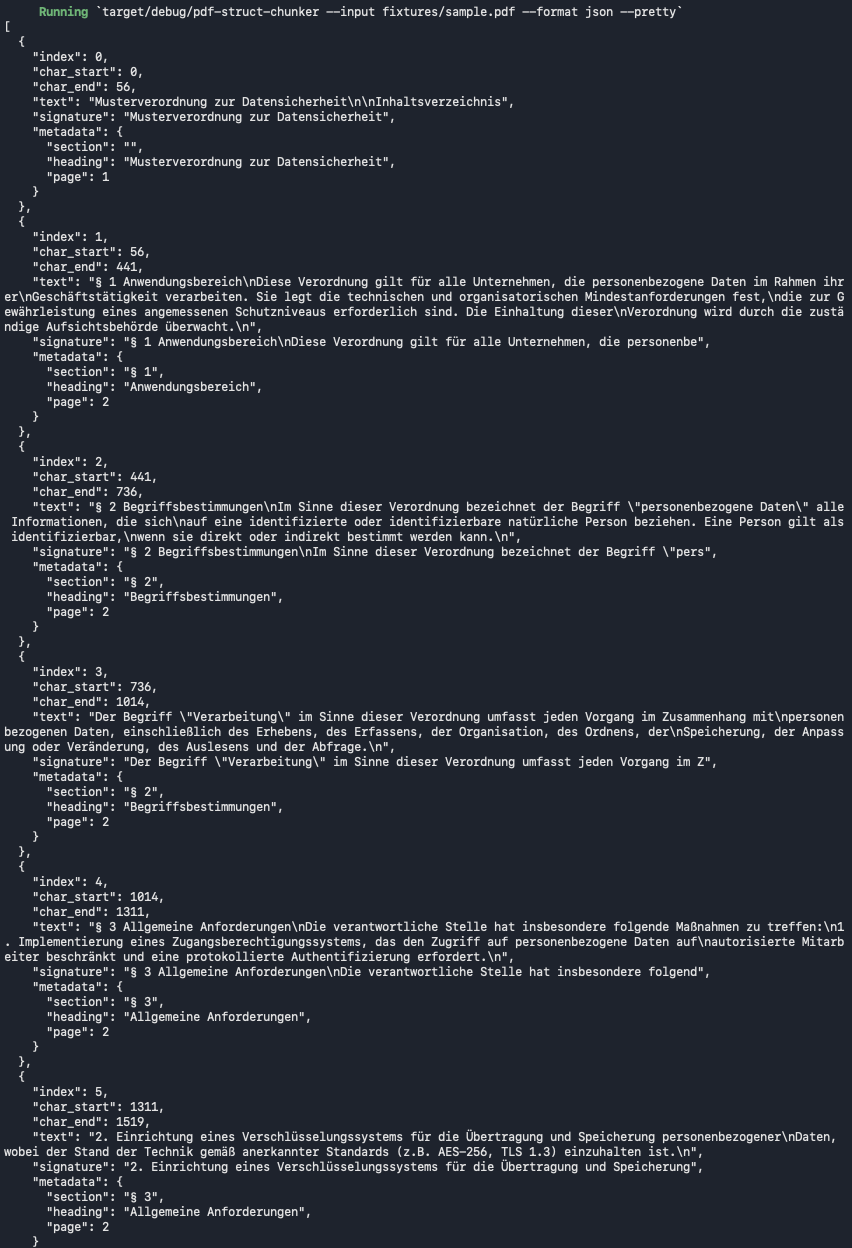
Developers have introduced pdf-struct-chunker—a new tool written in Rust that allows for the semantic chunking of PDF documents without the use of an LLM. By analyzing the document layout, the library preserves the hierarchical structure of headings and paragraphs, ensuring high precision in data preparation for RAG systems.

What Happened
The open-source project pdf-struct-chunker has been released, designed for the intelligent segmentation of PDF files. Instead of traditional token or character-based splitting, the tool utilizes visual metadata analysis, such as X/Y coordinates, font sizes, and text styling. The Rust implementation allows for processing 100 pages in less than one second with minimal memory consumption.
Context
In modern RAG (Retrieval-Augmented Generation) systems, standard "naive" text splitting methods often break semantic blocks, which can trigger neural network hallucinations. Existing alternatives that use LLMs to structure documents are extremely resource-intensive and expensive, creating a barrier to scaling and use in Edge-AI solutions.
Why It Matters for the Industry
For the industry, this tool moves document structure processing from a costly neural network task to a cheap infrastructural process. It allows for a significant increase in indexing quality within RAG stacks without additional GPU costs and reduces the Total Cost of Ownership (TCO) for enterprise AI solutions by optimizing the preprocessing stage.
Why It Matters for Users
Developers of AI-based search engines and big data specialists gain the ability to avoid context loss when extracting information from documents. Using a layout-aware approach allows for passing structurally intact fragments with metadata into vector databases, which directly reduces the risk of the model providing incorrect answers.
Sources
Author
Look at AI, Editorial Staff