In developer CLI tools such as Codex and Claude Code, the /goal function has emerged, transforming a chatbot into a fully autonomous agent capable of independently executing complex tasks until a set objective is achieved.
What Happened
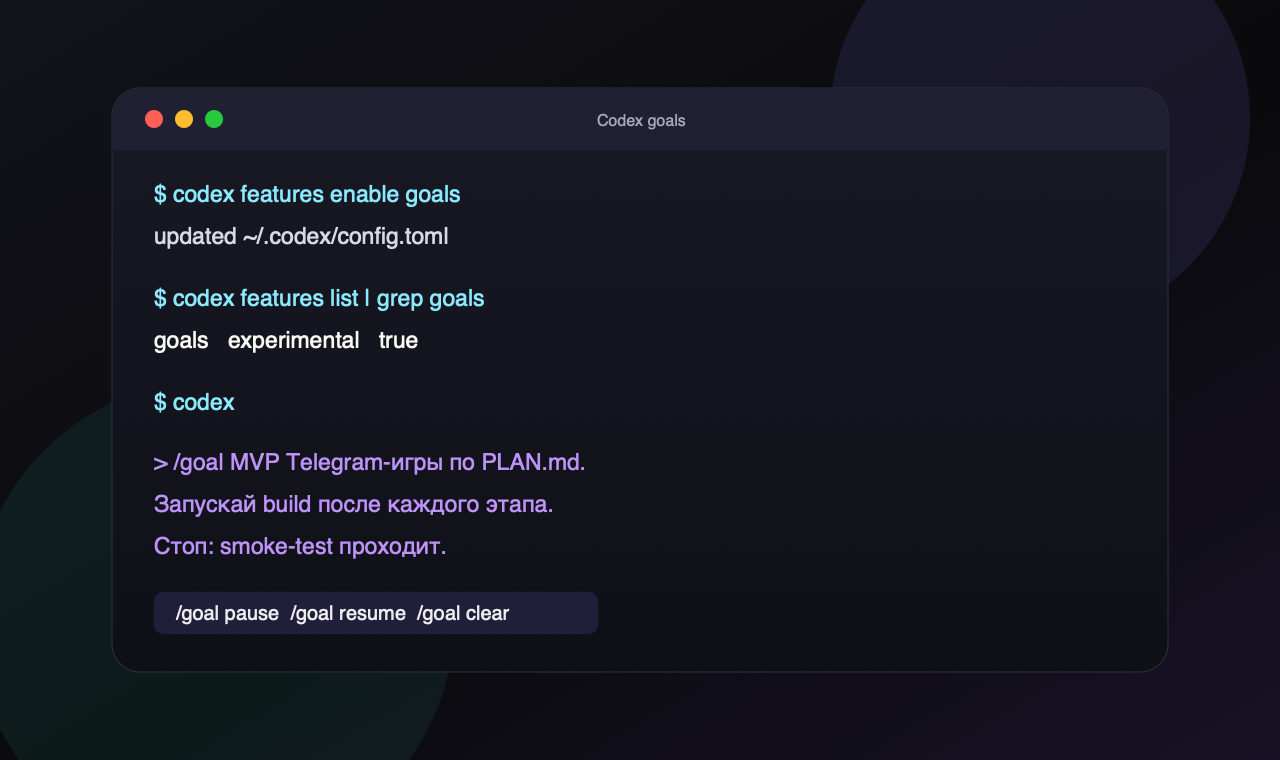
The Codex and Claude Code command-line tools have implemented support for the /goal command. Instead of traditional step-by-step interaction, the user sets a high-level task, such as performing a refactor or fixing bugs. To achieve autonomy, a specialized evaluator model is used to check every completed step and, if necessary, initiate new actions until the result meets the specified success criteria.
Context
This functionality marks a transition from interactive "question-answer" chat interfaces to the concept of an Agentic Workflow. In this model, AI ceases to be just an assistant responding to queries and becomes an autonomous employee capable of independently managing the "action-verification" cycle.
Why It Matters for the Industry
For the industry, this signifies a paradigm shift in software development: the focus is shifting from writing code to system design, setting high-level goals, and verifying the results of agent work. This paves the way for integrating autonomous agents directly into CI/CD pipelines and standardizing protocols for their interaction with existing code infrastructure.
Why It Matters for Users
Developers gain the ability to delegate routine and long-running tasks, such as migrations or backlog grooming, to AI tools running in the background. This allows engineers to avoid being constantly tethered to the monitor, reducing cognitive load and freeing up time for architectural tasks by using AI as a full-fledged "intern."
What Is Not Yet Known / Limitations
There are technical and operational risks, including uncontrolled computation costs, the possibility of infinite loops, and difficulties in controlling the lifecycle of the generated code.
Sources
- Claude Code /goal: Autonomous Work Toward a Result
- Codex /goal: how to enable and configure autonomous work
Author
Look at AI, Editorial Staff